


Listen to the article
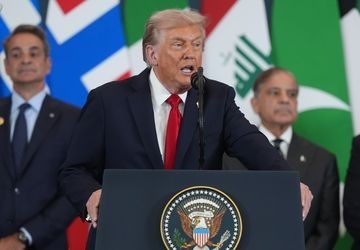
In a significant diplomatic push, President Donald Trump participated in a summit of European and Middle Eastern leaders focused on Gaza earlier this week in Sharm El-Sheikh, Egypt. The high-level gathering, which took place on October 13, brought together key stakeholders to address the ongoing crisis in the region and explore potential pathways to peace.
Despite Trump’s continued efforts on the international stage, particularly in the Middle East, observers have noted that the Nobel Peace Prize has thus far eluded him, even as he continues to position himself as a key broker for peace in some of the world’s most volatile regions.
The summit in Egypt represents the latest chapter in Trump’s engagement with Middle Eastern politics, following his administration’s earlier work on the Abraham Accords, which normalized relations between Israel and several Arab nations including the United Arab Emirates, Bahrain, Sudan, and Morocco. These historic agreements marked a significant shift in regional dynamics and were widely considered one of the most notable foreign policy achievements of his presidency.
Foreign policy analysts suggest that Trump’s approach to Middle Eastern diplomacy has been characterized by direct engagement with regional leaders and a willingness to pursue unconventional diplomatic channels. His administration has frequently emphasized the importance of economic incentives and bilateral relationships over multilateral frameworks.
“Trump’s diplomatic style tends to focus on personal relationships with key leaders and transactional approaches to international agreements,” said Dr. Rebecca Friedman, a Middle East policy expert at Georgetown University. “While controversial in many respects, his administration did achieve breakthroughs that previous administrations had not managed to secure.”
The current summit comes amid escalating tensions between Hamas and Israel, with international mediators working to prevent further conflict. Trump’s presence at the gathering signals his continued interest in playing a role in resolving the longstanding Israeli-Palestinian conflict, despite no longer holding office.
Critics have questioned the substantive impact of some of these diplomatic initiatives, suggesting that certain agreements formalized relationships that were already developing behind the scenes. However, supporters argue that the public nature of these accords created momentum for regional cooperation that might not have otherwise materialized.
The Nobel Peace Prize, which has been awarded to previous U.S. presidents including Barack Obama, Jimmy Carter, and Theodore Roosevelt, recognizes individuals who have “done the most or the best work for fraternity between nations, for the abolition or reduction of standing armies, and for the holding and promotion of peace congresses.”
Trump has previously expressed disappointment at not receiving the prestigious award despite his administration’s diplomatic efforts. In 2020, he was nominated for the prize by Christian Tybring-Gjedde, a member of Norway’s Parliament, specifically for his role in the Abraham Accords.
The current summit in Egypt reflects ongoing challenges in the region, particularly regarding Gaza, where humanitarian concerns remain paramount amid political deadlock. International observers note that any comprehensive solution will require addressing fundamental issues related to Palestinian sovereignty, Israeli security concerns, and regional stability.
Beyond the Middle East, the report also makes reference to Venezuela’s opposition leader Maria Corina Machado, suggesting Trump’s diplomatic focus extends to the Western Hemisphere as well. Venezuela continues to face significant political and economic challenges under the Maduro regime, with international stakeholders divided on approaches to the crisis.
As global attention remains fixed on these persistent conflict zones, Trump’s continued engagement reflects the complex intersection of diplomatic legacy-building and the pursuit of meaningful peace agreements in regions where solutions have long proven elusive. Whether these efforts will ultimately lead to sustainable peace remains to be seen, but they underscore the enduring significance of American involvement in global diplomatic initiatives, even through unofficial channels.
Verify This Yourself
Use these professional tools to fact-check and investigate claims independently
Reverse Image Search
Check if this image has been used elsewhere or in different contexts
Ask Our AI About This Claim
Get instant answers with web-powered AI analysis
Related Fact-Checks
See what other fact-checkers have said about similar claims
Want More Verification Tools?
Access our full suite of professional disinformation monitoring and investigation tools

10 Comments
I have mixed feelings about Trump’s role in Middle Eastern diplomacy. While the Abraham Accords were a notable achievement, his overall approach has been polarizing. I hope this latest summit can yield tangible progress towards peace.
It’s interesting to see Trump positioning himself as a key broker for peace in the Middle East, despite the Nobel Prize snub. His continued engagement in the region could have implications for the mining and energy sectors.
As an investor in mining and energy equities, I’ll be closely watching how this summit and Trump’s broader Middle East policy play out. Geopolitical stability is crucial for the commodities markets.
I’m a bit skeptical about Trump’s motives here. While the summit and his efforts seem aimed at peace, his past foreign policy decisions have been controversial. I’ll be curious to see if any concrete progress comes out of this latest diplomatic push.
That’s fair to be cautious. Trump’s approach has been unorthodox at times, so it will be important to monitor the outcomes of this summit and any follow-up actions.
Interesting to see Trump continuing his push for peace in the Middle East. The Nobel Prize may have eluded him, but his diplomatic efforts in the region are noteworthy and could have long-term impacts.
You’re right, the Abraham Accords were a significant achievement. While some may criticize Trump’s approach, he does seem determined to play a role in Middle Eastern diplomacy.
As a mining and commodities investor, I’m curious to see how the regional dynamics in the Middle East could impact energy and mineral resource developments. Stability in the region is important for secure supply chains.
That’s a good point. Geopolitical tensions in the Middle East can certainly affect the commodities markets, especially for energy resources like oil and gas. Ongoing diplomacy efforts could help promote more stability.
Kudos to Trump for continuing to engage on Middle Eastern issues, even without the Nobel Prize recognition. Brokering peace in volatile regions is no easy feat, and his diplomatic work deserves acknowledgment.