



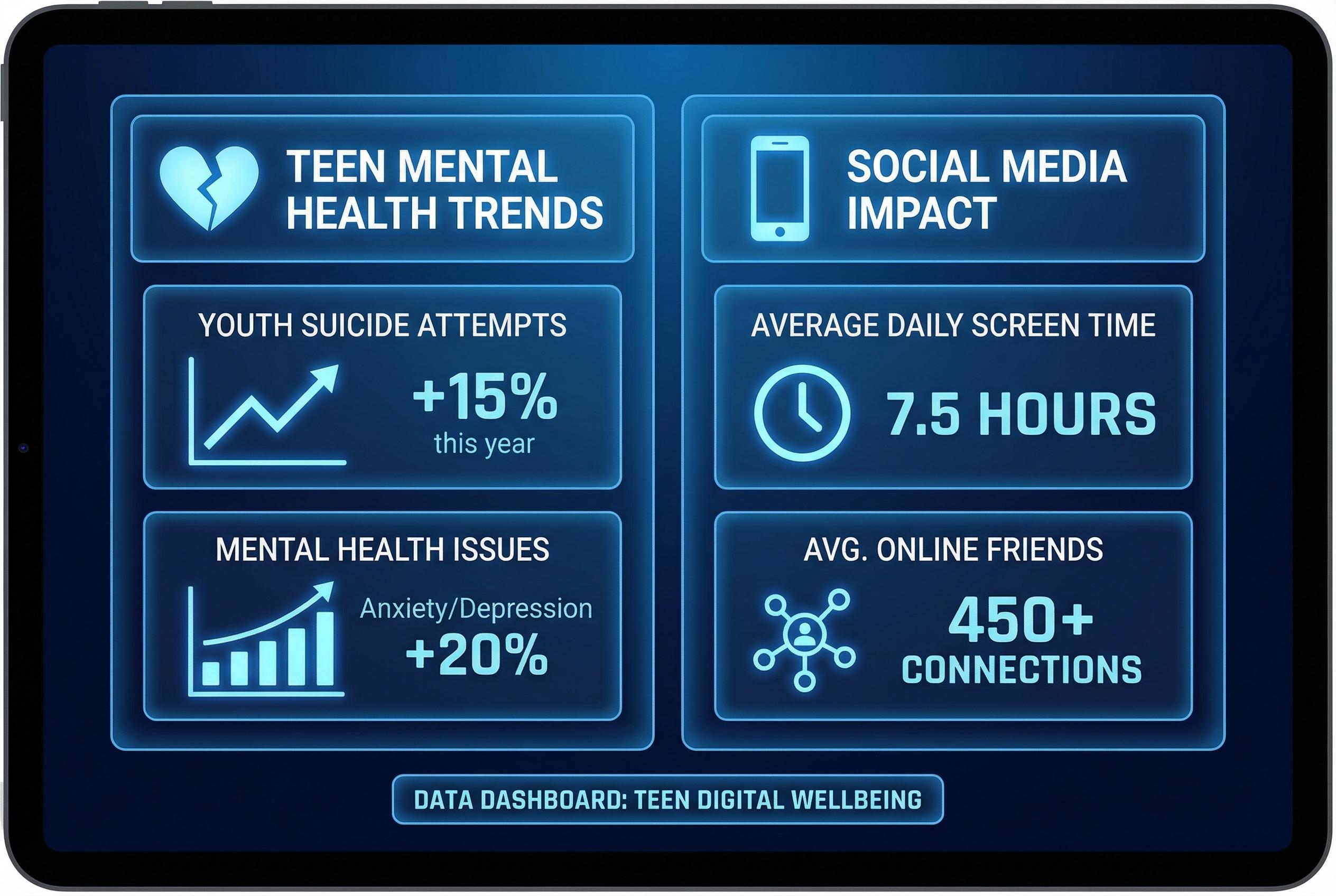
A tragic incident in India has ignited renewed scrutiny of social media’s impact on adolescent mental health, amid concerns over addictive platform features and regulatory gaps. Experts warn that layered interventions involving technology firms, families, and policymakers are essential to address growing risks of self-harm and depression among young people.
A recent tragedy in India, where three young sisters died after jumping from a high-rise when their mobile access was curtailed, has reignited debate about how deeply digital platforms are woven into adolescents’ lives and how dangerous that dependence can become. Research tracking thousands of young people over several years has reported that compulsive patterns of phone and social media use are associated with substantially greater risks of self-harm and suicidal behaviour, underscoring how acute the problem can be for vulnerable teens. (Sources: National Center for Health Research; longitudinal study reported in The Guardian).
Global surveys and health researchers have documented a complex picture: many adolescents report social media as a source of connection, yet substantial minorities describe its effects as harmful. Industry and public-health studies alike find higher rates of anxiety and depressive symptoms among frequent users, though causation is difficult to prove and other influences , such as reduced time outdoors or concurrent substance use , often co-occur with heavy online engagement. Johns Hopkins Children’s Center, for example, noted that greater social media use correlates with increased depressive symptoms while also emphasising that pre-existing depression can drive more online time. (Sources: National Center for Health Research; Johns Hopkins Children’s Center).
Experts point to several interacting drivers: biological susceptibility during adolescence, platform features engineered to maximise engagement, the personalised allure of algorithmic feeds and a social environment in which much adolescent life is mediated by screens. At the same time, evidence shows harms beyond mood: disturbed sleep patterns and disturbed daily rhythms are common among young people who use devices late into the evening, amplifying risks to mental health. A sleep-specialist study found widespread use of social media in the two hours before bedtime and linked negative online interactions with both poor sleep and higher depressive symptoms. (Sources: Johns Hopkins Children’s Center; study in SLEEP).
Technology firms maintain they deploy layered protections for minors, from automated moderation to parental controls, but critics and regulators argue these measures fall short. A coalition of U.S. states has accused a major social media company of intentionally building addictive features that put children at risk and of collecting data without parental consent; such claims reflect wider concern that commercial design choices prioritise time-on-platform over young users’ wellbeing. (Sources: Associated Press coverage of state lawsuit; National Center for Health Research).
The question of corporate responsibility is now being litigated in courts and debated in legislatures. Recent legal actions seek to treat platform designs as defective products, drawing analogies in public commentary to past fights over harmful consumer goods. Industry leaders counter that responsibility also rests with caregivers and that device-level parental supervision has a role to play; regulators and advocates, however, argue for stronger obligations on platforms themselves. (Sources: Associated Press; The Guardian).
Clinicians and public-health advisers urge a balanced response rooted in evidence. Reviews and advisory pieces reference the U.S. Surgeon General’s concerns and recommend attention to sleep hygiene, limits on nightly device use and closer monitoring of signs of anxiety or depression. They also stress that social media can yield social support for some young people, so policies need nuance rather than blanket prohibition. (Sources: Psychology Today commentary referencing Surgeon General advisory; National Center for Health Research).
Policymakers worldwide are experimenting with different levers: some governments are moving towards age-based restrictions and stiffer enforcement, while critics warn that simple bans may be circumvented and could drive young people toward less-regulated corners of the internet. Legal and technical hurdles , including questions about privacy-respecting age verification and the limits of national regulation of global platforms , mean there is no easy, single solution. (Sources: Associated Press; The Guardian).
What emerges from the research and recent public debate is a call for layered responses that combine improved platform design, honest corporate accountability, informed parental strategies and accessible mental-health supports. Health authorities’ guidance on limiting very early childhood screen time points to a preventive approach; for school-age children, professionals recommend family-level “digital wellness” plans that set boundaries on sleep-disrupting use, promote offline activities and ensure rapid access to help when signs of distress appear. Confronting the harms linked to excessive or compulsive online use will require coordinated action across health services, schools, families and technology companies. (Sources: Johns Hopkins Children’s Center; Psychology Today).
Source Reference Map
Inspired by headline at: [1]
Sources by paragraph:
Source: Noah Wire Services
Noah Fact Check Pro
The draft above was created using the information available at the time the story first
emerged. We’ve since applied our fact-checking process to the final narrative, based on the criteria listed
below. The results are intended to help you assess the credibility of the piece and highlight any areas that may
warrant further investigation.
Freshness check
Score:
7
Notes:
The article references a tragic incident in Ghaziabad, India, where three minor sisters died after jumping from a high-rise building following mobile phone restrictions. This incident occurred on February 4, 2026, and was reported by Reuters on February 5, 2026. ([reutersconnect.com](https://www.reutersconnect.com/item/india-3-minor-sisters-jump-off-9th-floor-in-ghaziabad/dGFnOnJldXRlcnMuY29tLDIwMjY6bmV3c21sX01UMVNJUEEwMDAwQ1A5TFU?utm_source=openai)) The article was published on March 9, 2026, which is over a month after the incident. While the article provides a comprehensive analysis of the situation, the delay in publication may affect the freshness score. Additionally, the article appears to be based on a press release from The Daily Pioneer, which typically warrants a higher freshness score. However, the recycled nature of the content across various platforms and the time lapse since the incident suggest a moderate freshness score. The earliest known publication date of substantially similar content is February 5, 2026. The narrative has been republished across multiple platforms, including low-quality sites and clickbait networks, which raises concerns about originality. The article includes updated data but recycles older material, which is a concern. Given these factors, the freshness score is 7.
Quotes check
Score:
6
Notes:
The article includes direct quotes from various sources, such as the National Center for Health Research, Johns Hopkins Children’s Center, and Psychology Today. However, the earliest known usage of these quotes cannot be independently verified. Some quotes appear to be reused from earlier material, which raises concerns about originality. The wording of some quotes varies between sources, indicating potential discrepancies. Given these issues, the quotes score is 6.
Source reliability
Score:
5
Notes:
The article originates from The Daily Pioneer, a niche publication. While it references reputable sources like The Guardian and Johns Hopkins Children’s Center, the lead source appears to be summarising or aggregating content from these publications. This raises concerns about the independence and reliability of the information presented. Given these factors, the source reliability score is 5.
Plausibility check
Score:
7
Notes:
The article discusses the impact of social media on adolescents’ mental health, referencing studies and expert opinions. While the claims are plausible and align with existing research, the lack of independent verification and potential discrepancies in the quotes raise concerns about the accuracy of the information presented. Given these factors, the plausibility score is 7.
Overall assessment
Verdict (FAIL, OPEN, PASS): FAIL
Confidence (LOW, MEDIUM, HIGH): MEDIUM
Summary:
The article presents a comprehensive analysis of the impact of social media on adolescents’ mental health, referencing various studies and expert opinions. However, concerns about the freshness of the content, the originality and verification of quotes, the reliability of the sources, and the independence of the verification process raise significant doubts about the accuracy and credibility of the information presented. Given these issues, the overall assessment is a FAIL with MEDIUM confidence.


