



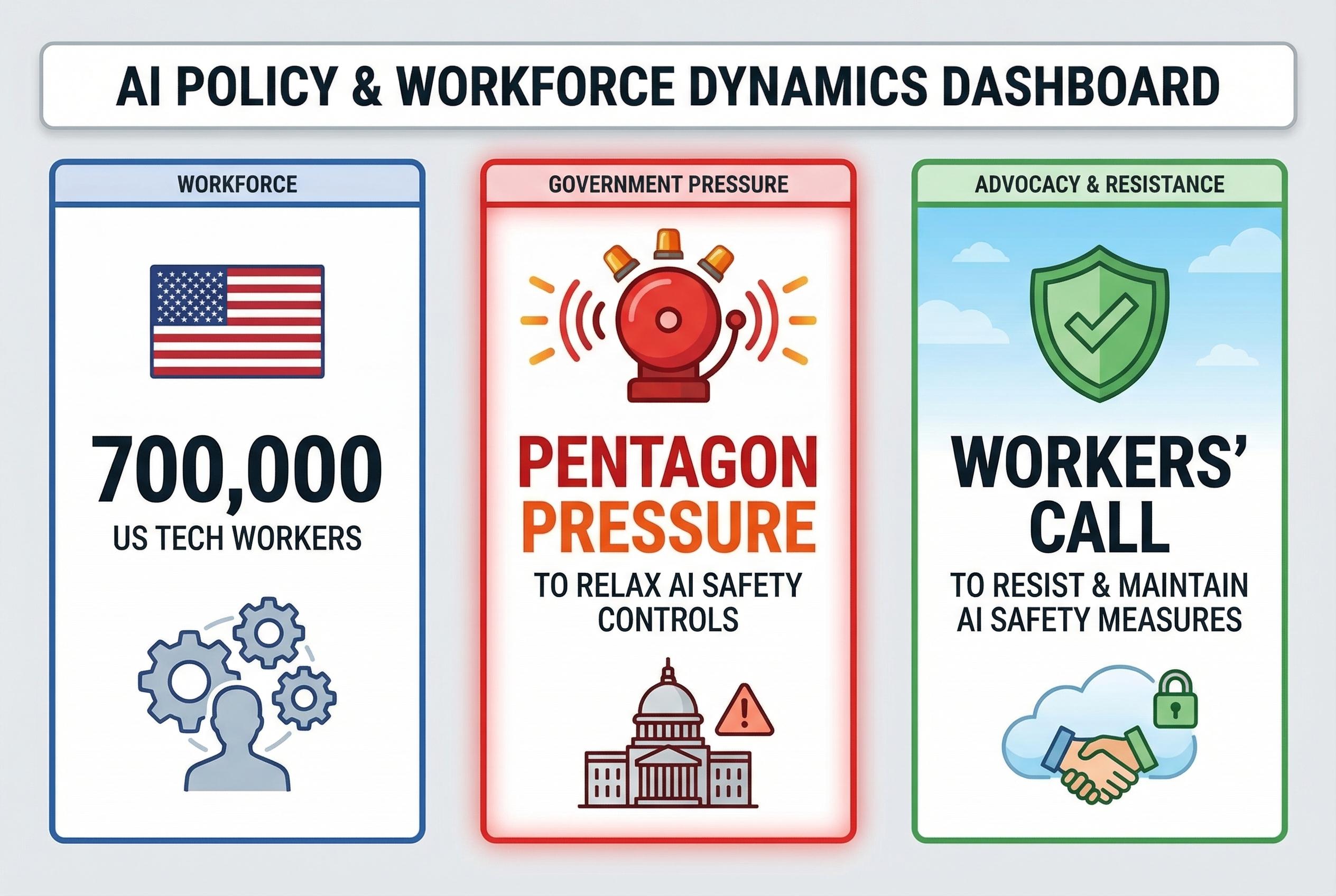
Labour groups representing 700,000 US technology workers have called on Amazon, Google, and Microsoft to resist military and surveillance demands to weaken AI safety measures, amid growing internal dissent over defence-related AI projects.
Technology-sector labour groups and worker organisations representing roughly 700,000 employees across the United States have urged senior executives at Amazon, Google and Microsoft to resist Defence Department pressure to relax safety limits on artificial intelligence, in a joint statement circulated by the No Tech For Apartheid campaign. The coalition says the controls in question are intended to restrict military and surveillance deployment of advanced models and that removing them would broaden the potential for government use. (Sources: Moneycontrol, VisaVerge)
The appeal comes against a backdrop of a public dispute between the Pentagon and Anthropic, in which the department has pressed the company for contractual language that critics say would permit wider application of its models. According to reporting from multiple outlets, workers and allies fear requests to strip two specific safeguards from Anthropic’s Claude would open the door to large-scale domestic surveillance and to systems that could operate without human oversight. (Sources: Axios, HCAMag)
Worker signatories, drawn from engineers, organisers and unions across major cloud and AI providers, called on company leaders to decline similar demands if raised in their own government contracts and to adopt explicit internal limits on how products may be used for surveillance or weapons. The statement also asks for greater openness about commercial agreements with homeland security and immigration agencies that use cloud services for data and operational support. (Sources: Moneycontrol, HCAMag)
The campaign reflects a widening rift inside technology firms that supply cloud infrastructure and AI services to federal agencies. Industry critics say the Pentagon has been seeking contractual terms that would allow “any lawful use” of supplied systems in classified operations, language that employees and advocacy groups warn could undercut previously negotiated safety commitments. Companies already host a broad range of government workloads on Amazon Web Services, Google Cloud and Microsoft Azure, which complicates how corporate policy and national security demands interact. (Sources: HCAMag, WSWS)
Labour organisers framed the initiative as both a defence of civil liberties and a push for clearer public rules. They argue that, absent robust federal regulation governing military and surveillance uses of AI, workplace organising and corporate policy become the primary mechanisms for imposing ethical constraints. The letter invites broader participation from technology workers who oppose their labour being used to develop systems for mass monitoring or autonomous lethal force. (Sources: HCAMag, VisaVerge)
The dispute has already prompted wider employee activism within the AI sector: open letters from staff at multiple labs have urged limits on domestic surveillance and fully autonomous warfare, while some firms have adjusted internal policies in response to internal pressure. According to reporting, the movement encompasses signatories inside Google, OpenAI and other labs, underscoring how workforce sentiment is shaping public debate over the ethics of defence-related AI projects. (Sources: Axios, WSWS, Medium)
As tensions persist between defence requirements and corporate and workforce resistance, the campaign highlights a broader question about who should set the boundaries for powerful technologies. The worker groups and their allies are pushing both for corporate refusals to accept expansive military usage clauses and for transparent, enforceable government rules that would define permissible AI applications in security contexts. (Sources: Moneycontrol, VisaVerge)
Source Reference Map
Inspired by headline at: [1]
Sources by paragraph:
Source: Noah Wire Services
Noah Fact Check Pro
The draft above was created using the information available at the time the story first
emerged. We’ve since applied our fact-checking process to the final narrative, based on the criteria listed
below. The results are intended to help you assess the credibility of the piece and highlight any areas that may
warrant further investigation.
Freshness check
Score:
8
Notes:
The article references recent events, including a joint statement by technology worker organisations representing approximately 700,000 employees urging Amazon, Google, and Microsoft to reject Pentagon demands related to AI safety guardrails. ([moneycontrol.com](https://www.moneycontrol.com/technology/tech-worker-groups-representing-700-000-employees-urge-amazon-google-microsoft-to-reject-pentagon-ai-demands-article-13854485.html/amp?utm_source=openai)) The earliest known publication date of similar content is March 8, 2026, indicating the narrative is fresh. However, the article includes references to multiple sources, some of which may have been published earlier, raising concerns about potential recycling of content. ([timesofindia.indiatimes.com](https://timesofindia.indiatimes.com/technology/tech-news/employee-organisations-and-unions-across-america-representing-700000-employees-from-amazon-google-microsoft-demand-our-companies-must-reject-/articleshow/129193292.cms?utm_source=openai))
Quotes check
Score:
7
Notes:
The article includes direct quotes from the joint statement by technology worker organisations. However, the earliest known usage of these quotes cannot be independently verified, as they appear to originate from the No Tech For Apartheid campaign’s statement. ([timesofindia.indiatimes.com](https://timesofindia.indiatimes.com/technology/tech-news/employee-organisations-and-unions-across-america-representing-700000-employees-from-amazon-google-microsoft-demand-our-companies-must-reject-/articleshow/129193292.cms?utm_source=openai)) Without independent verification of these quotes, their authenticity remains uncertain.
Source reliability
Score:
6
Notes:
The article cites multiple sources, including Moneycontrol, VisaVerge, Axios, and HCAMag. While some of these sources are reputable, others are lesser-known, raising concerns about the overall reliability of the information presented. Additionally, the article references a press release from the No Tech For Apartheid campaign, which may introduce bias and lacks independent verification.
Plausibility check
Score:
7
Notes:
The claims made in the article align with known industry trends, such as employee activism within the tech sector regarding AI ethics and military applications. However, the lack of independent verification of key quotes and the reliance on a press release from a specific campaign organisation raise questions about the overall credibility of the narrative.
Overall assessment
Verdict (FAIL, OPEN, PASS): FAIL
Confidence (LOW, MEDIUM, HIGH): MEDIUM
Summary:
The article presents a narrative that aligns with known industry trends but relies heavily on a press release from the No Tech For Apartheid campaign and lesser-known sources, raising concerns about the freshness, originality, and independence of the information. The lack of independent verification of key quotes further diminishes the overall credibility of the narrative.


