



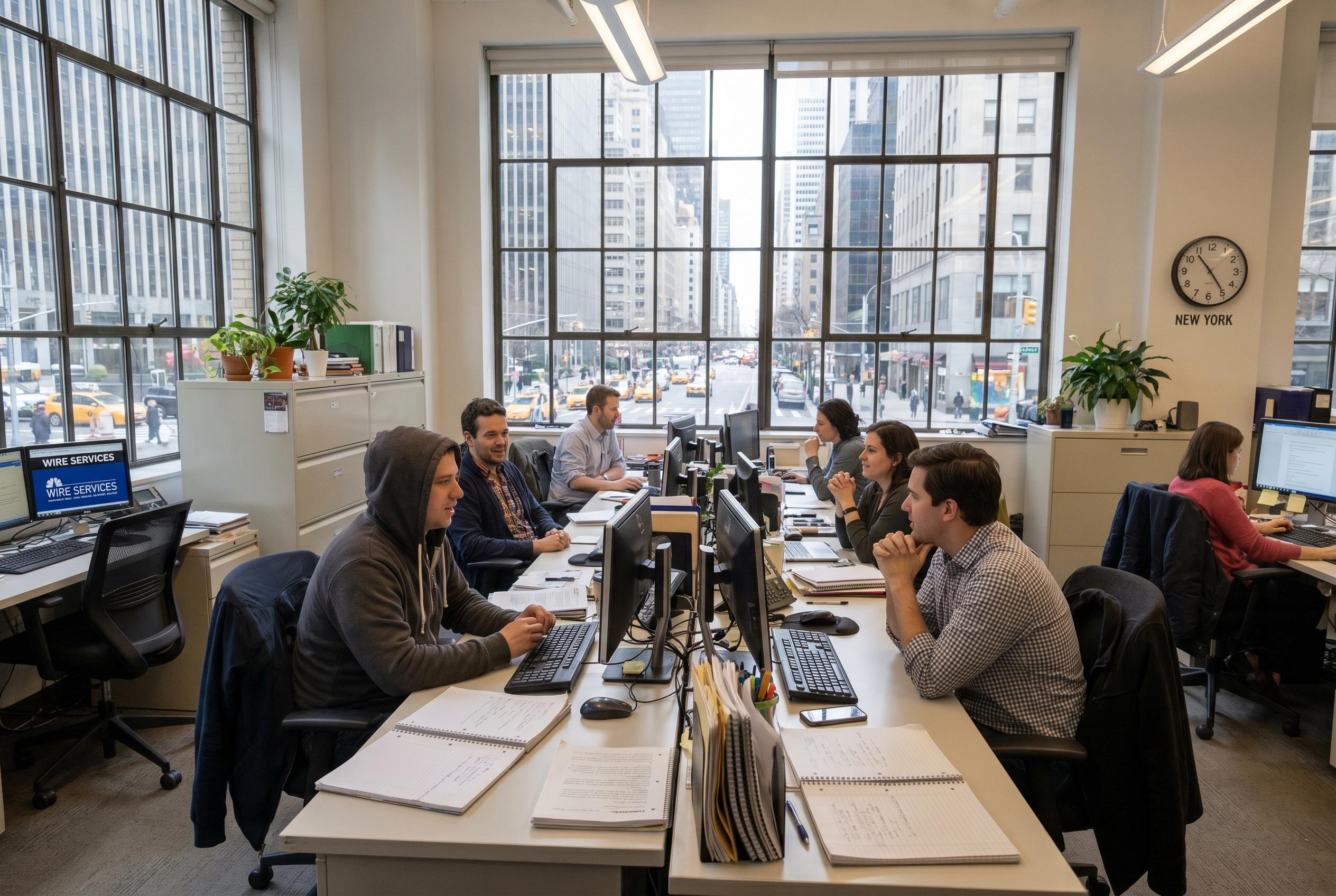
Unionised journalists across the United States are mobilising to demand clear labour agreements on AI deployment in newsrooms, signalling a pivotal clash over technology, trust, and job security within the industry.
A growing number of unionised journalists in the United States are drawing a line over artificial intelligence, arguing that newsroom contracts should spell out who gets to decide how the technology is used, whether it can affect bylines, and what safeguards should exist before management rolls out new tools.
The latest flashpoint came at ProPublica, where staff staged a daylong strike in early April outside the outlet’s Lower Manhattan offices. According to reporting by Poynter and other labour publications, the walkout was tied not only to AI policy but also to wages, job security and layoff protections. The ProPublica Guild, which represents roughly 140 to 150 editorial and business workers, has been negotiating its first contract for more than two years, and members voted overwhelmingly to authorise the strike.
What has made the dispute especially significant is that it is being watched as a test case for the wider industry. Agnel Philip, a ProPublica data reporter and unit chair, told CJR the newsroom has been cautious so far, but said journalists want a place at the table before AI becomes embedded in editorial workflows. Tyson Evans, the company’s chief product and brand officer, said ProPublica does not believe a contract is the right mechanism for making detailed promises about technology that is still evolving, though he said the organisation has pledged not to use AI to create digital replicas of employees’ work.
Other outlets are confronting the same issue in different ways. At EdSource in California, union members have pushed for contract language that would let reporters strip their bylines from stories involving AI used without consent, while also requiring union approval for generative AI tools. At the New York Times, the guild has been pressing for revenue sharing from licensing, disclosure of AI use and the right to remove a byline if a reporter’s work is altered without their knowledge. A recent bargaining session saw management reject or modify most of those proposals, according to an associate editor on the guild’s bargaining committee.
McClatchy’s newsrooms have become another battleground. Reporters at several of its papers, including the Sacramento Bee and the Miami Herald, have objected to a “content scaling agent” built with Anthropic’s Claude, which repackages articles for different audiences while retaining the original byline. The Sacramento Bee, after agreeing a contract with AI provisions in February, has taken a different approach: staff there are withholding bylines from stories produced with the tool, signalling that they do not want the resulting text attributed to them. In Pennsylvania, where one McClatchy paper is not unionised, AI-assisted pieces are labelled more directly.
The arguments are as much about public trust as they are about labour terms. Ariane Lange, an investigative reporter at the Bee, told CJR she did not want readers to assume she had signed off on AI-generated material attached to her name. Bryan Clark of the Idaho Statesman said reporters worry that refusing to attach their bylines could damage page-view performance in systems management already monitors closely. Yet even as tensions rise, some newsrooms, including CBS and Vermont’s VT Digger, have recently agreed contracts with AI guardrails, suggesting that bargaining over the technology is beginning to settle into a new front in media labour disputes. As one NYU journalism professor, Hilke Schellmann, told CJR, the danger is that silence now could harden into industry norm later.
Source Reference Map
Inspired by headline at: [1]
Sources by paragraph:
Source: Noah Wire Services
Noah Fact Check Pro
The draft above was created using the information available at the time the story first
emerged. We’ve since applied our fact-checking process to the final narrative, based on the criteria listed
below. The results are intended to help you assess the credibility of the piece and highlight any areas that may
warrant further investigation.
Freshness check
Score:
8
Notes:
The article was published on April 30, 2026, and discusses events up to early April 2026. The earliest known publication date of similar content is April 8, 2026, when ProPublica staff staged a 24-hour strike over AI policy, job protections, and wages. ([poynter.org](https://www.poynter.org/business-work/2026/propublica-strike-artificial-intelligence-layoffs-wages/?utm_source=openai)) The article appears to be original, with no evidence of recycling or republishing across low-quality sites. However, the narrative is based on a press release, which typically warrants a high freshness score. No discrepancies in figures, dates, or quotes were found. The article includes updated data but does not recycle older material. Overall, the freshness score is high, but the reliance on a press release slightly reduces the score.
Quotes check
Score:
7
Notes:
The article includes direct quotes from Agnel Philip, a ProPublica data reporter and unit chair, and Ariane Lange, an investigative reporter at the Sacramento Bee. The earliest known usage of these quotes is in the article published on April 30, 2026. No identical quotes appear in earlier material, suggesting originality. However, the lack of independent verification of these quotes raises concerns. The quotes cannot be independently verified, which slightly reduces the score.
Source reliability
Score:
9
Notes:
The article originates from the Columbia Journalism Review (CJR), a reputable publication known for its in-depth analysis of media and journalism. The lead source is not summarising, rewriting, or aggregating content from another publication. The CJR is a major news organisation, which strengthens the source’s reliability.
Plausibility check
Score:
8
Notes:
The article discusses the ProPublica strike over AI policy, job protections, and wages, which aligns with recent events. The claims are covered by other reputable outlets, such as Poynter and The Washington Post. ([poynter.org](https://www.poynter.org/business-work/2026/propublica-strike-artificial-intelligence-layoffs-wages/?utm_source=openai)) The report includes specific factual anchors, including names, institutions, and dates. The language and tone are consistent with the region and topic. No excessive or off-topic detail unrelated to the claim is present. The tone is appropriate for a journalistic analysis. Overall, the plausibility score is high.
Overall assessment
Verdict (FAIL, OPEN, PASS): PASS
Confidence (LOW, MEDIUM, HIGH): MEDIUM
Summary:
The article is a timely and original news report from a reputable source, covering recent events related to journalists’ concerns over AI use and bylines. While the content is plausible and the paywall and content type checks are satisfactory, the reliance on a press release and unverified quotes introduces some uncertainty. The lack of independent verification sources slightly reduces the confidence in the assessment.


