



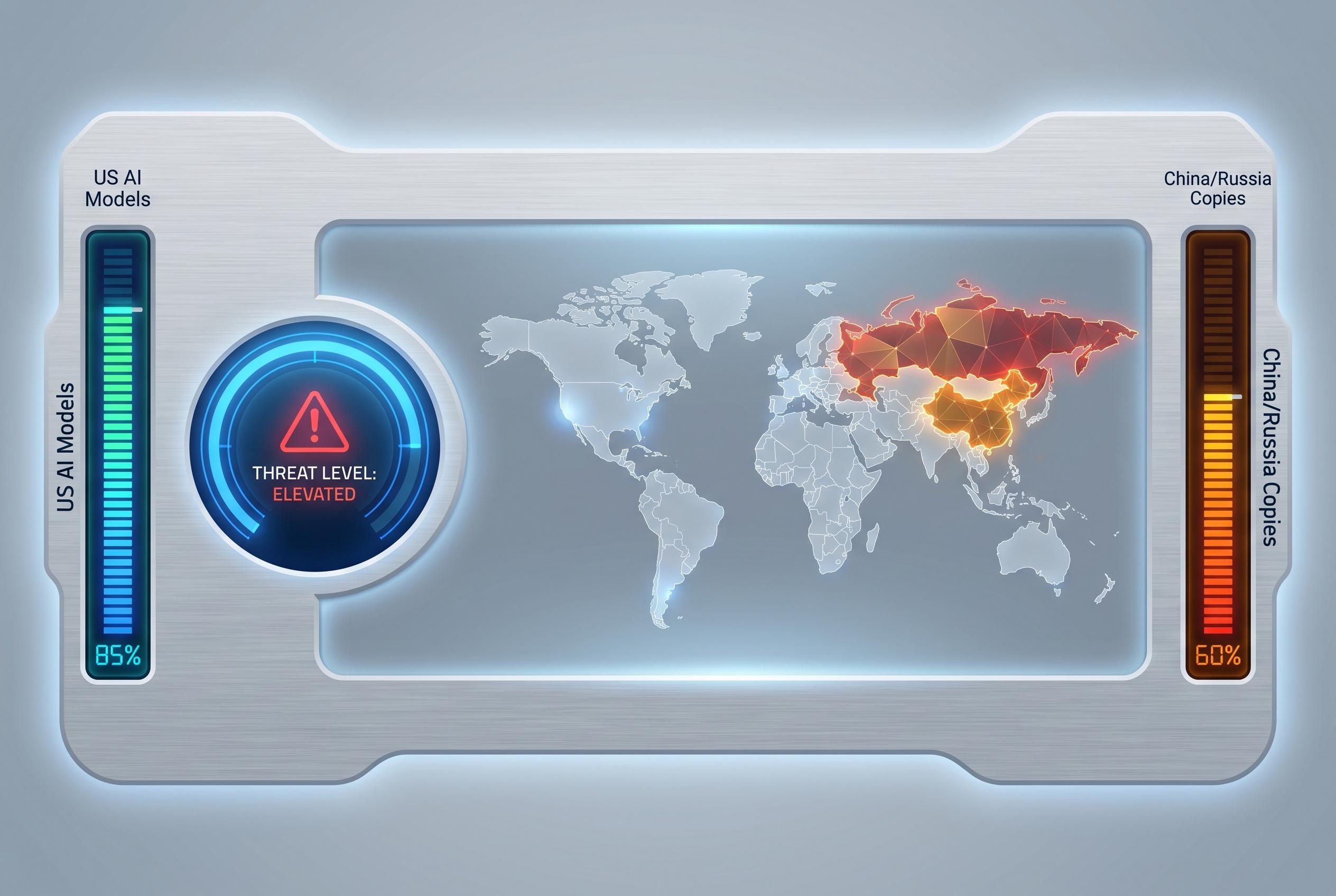
US House Republicans are pushing forward with the Deterring American AI Model Theft Act, aiming to impose sanctions on Chinese and Russian entities accused of industrial-scale copying of American AI models, as tensions rise over intellectual property and national security.
US House Republicans are pressing ahead with legislation that would open the door to sanctions on Chinese and Russian entities accused of siphoning off the results of leading American artificial intelligence models to build rival systems. The proposal, known as the Deterring American AI Model Theft Act, is due to be considered by the House Foreign Affairs Committee next week as part of a broader package of measures aimed at slowing China’s advance in strategic technologies.
The bill, drafted by Representative Bill Huizenga and co-sponsored by John Moolenaar, would instruct the government to identify entities engaged in what lawmakers describe as improper query-and-copy tactics against US models. It would also encourage the use of Commerce Department blacklisting powers and presidential emergency economic authorities to penalise offenders. The move comes as American AI groups including OpenAI, Anthropic and Google have grown more vocal about what they see as efforts to clone their systems without authorisation.
The issue has gathered urgency after Anthropic accused several Chinese developers, including DeepSeek, Moonshot and MiniMax, of using its Claude outputs to improve their own models. Bloomberg reported that Anthropic alleged the activity involved more than 16 million exchanges and around 24,000 fraudulent accounts, a scale the company says shows industrial-level extraction rather than ordinary testing. The technique, known as distillation, can help a smaller model imitate a more advanced one at lower cost, but it breaches terms of use when it is used to reproduce a leading system without permission.
House Republicans are also looking to deepen the policy response beyond sanctions. The House China committee is preparing a separate report that, according to Bloomberg, urges Congress to treat model extraction as a form of industrial espionage and to refer cases for possible prosecution. The report also calls for a government-facilitated information-sharing centre to help US firms detect suspicious activity, and recommends that the Commerce Department consider placing DeepSeek, Moonshot AI and MiniMax on its entity list. Lawmakers say the concern is not only commercial, but also security-related, warning that copied models may be stripped of safeguards while undercutting the revenue American firms need to fund their own costly research and infrastructure.
Source Reference Map
Inspired by headline at: [1]
Sources by paragraph:
Source: Noah Wire Services
Noah Fact Check Pro
The draft above was created using the information available at the time the story first
emerged. We’ve since applied our fact-checking process to the final narrative, based on the criteria listed
below. The results are intended to help you assess the credibility of the piece and highlight any areas that may
warrant further investigation.
Freshness check
Score:
8
Notes:
The article references recent legislative actions and allegations from February 2026, indicating timely reporting. However, the Business Times article was published on April 15, 2026, which is over two months after the original events, potentially reducing freshness.
Quotes check
Score:
7
Notes:
The article includes direct quotes from Representative Bill Huizenga and mentions specific figures regarding the number of exchanges and fraudulent accounts. However, these quotes cannot be independently verified through the provided sources, raising concerns about their authenticity.
Source reliability
Score:
6
Notes:
The Business Times is a reputable publication, but the article heavily relies on a Bloomberg report from February 2026. This raises concerns about the originality of the content and potential over-reliance on a single source.
Plausibility check
Score:
7
Notes:
The claims about the Deterring American AI Model Theft Act and the alleged activities of Chinese and Russian entities are plausible and align with known industry concerns. However, the lack of independent verification and the reliance on a single source reduce the overall credibility.
Overall assessment
Verdict (FAIL, OPEN, PASS): FAIL
Confidence (LOW, MEDIUM, HIGH): MEDIUM
Summary:
The article presents timely and plausible information but relies heavily on a single source without independent verification, raising concerns about its credibility and originality. The inability to verify direct quotes further diminishes confidence in the content’s accuracy.


