



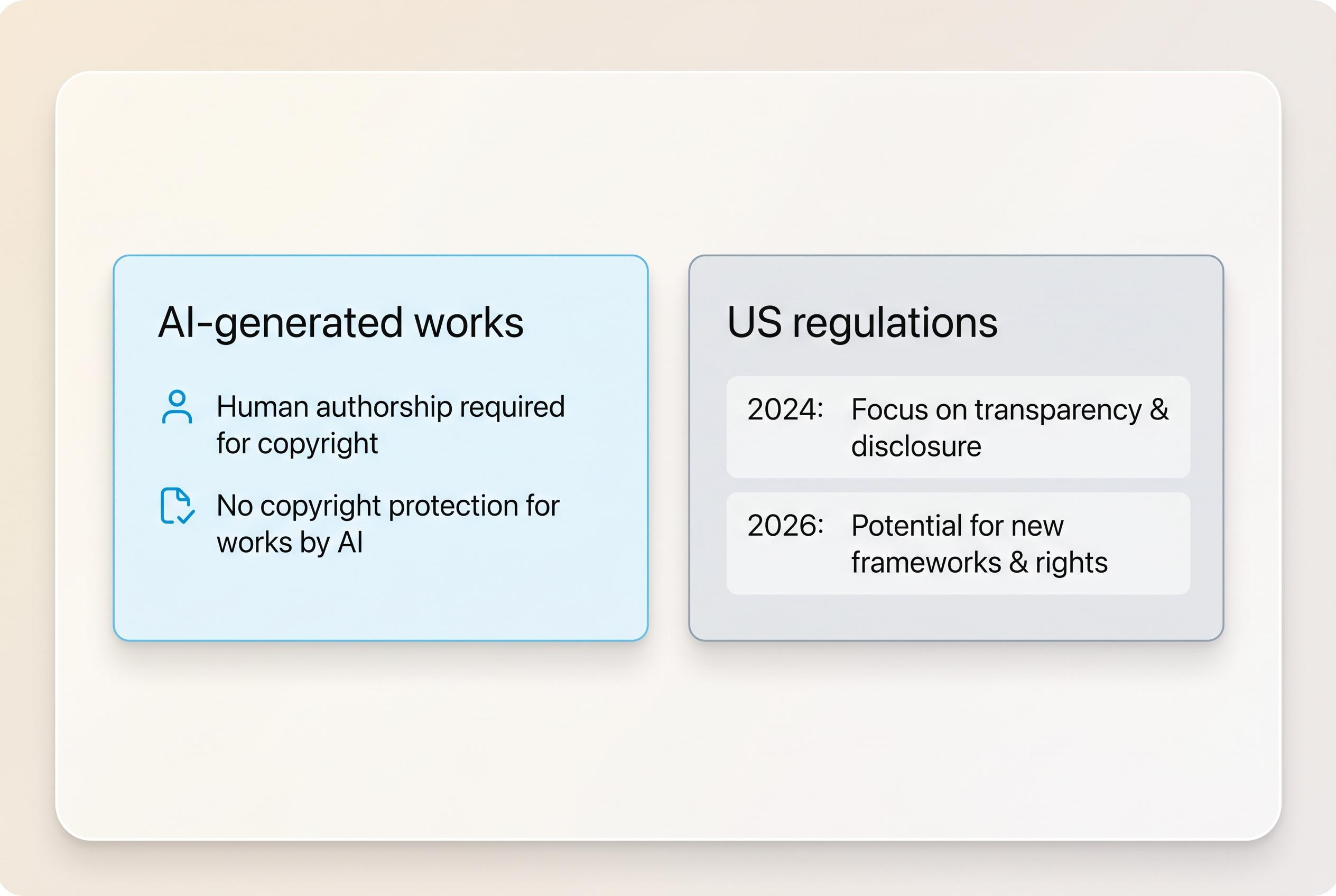
Recent legal decisions in the US reinforce that only works with meaningful human input can qualify for copyright protection, prompting companies to scrutinise their AI workflows amid shifting international regulations.
In-house lawyers are being urged to move quickly as generative AI continues to outpace copyright doctrine, leaving companies exposed unless they can show meaningful human input in the works they create. The central point emerging from recent US case law is that copyright protection still depends on human authorship, but AI-assisted material may qualify where the person behind it exercises genuine creative control.
That position was reinforced in Thaler v. Perlmutter, where the D.C. Circuit held that the Copyright Act requires authors to be human beings, and the Supreme Court declined to review the case in March 2026. The courts did not, however, draw a bright line between fully machine-made output and material shaped sufficiently by people to secure protection, leaving businesses to navigate a grey area. According to commentary from law firms analysing the decision, the practical lesson is that AI is treated as a tool, not an author.
The Copyright Office has tried to add some structure. Its recent guidance requires applicants to identify more than trivial AI-generated material in registrations and to separate that content from the human-authored portions. It also says prompts alone are not enough to establish authorship, although a sufficiently original prompt may itself be protected. In practice, that means companies using AI for marketing, software, design and internal documents need records showing where human judgment entered the process.
The international picture is becoming more demanding as well. The EU AI Act is already beginning to bite, with Article 53 imposing obligations on providers of general-purpose AI models, including copyright compliance policies and documentation on training data. According to the EU’s own AI Act service desk, those requirements are aimed at transparency and accountability, and non-compliance can bring substantial fines once the relevant provisions are fully enforceable. Other jurisdictions are taking different approaches, with Chinese courts reportedly recognising protection for some AI-generated images where human intellectual effort can be shown.
For companies, the immediate risk is not only that some AI-assisted output may be unprotected, but also that undisclosed AI use could undermine copyright registrations. That makes internal audits, clearer authorship protocols and contract reviews urgent. Businesses that can document human selection, editing and arrangement of AI-generated material may be able to secure enforceable rights, while rivals relying on undocumented workflows may find their content drifting into the public domain.
Source Reference Map
Inspired by headline at: [1]
Sources by paragraph:
Source: Noah Wire Services
Noah Fact Check Pro
The draft above was created using the information available at the time the story first
emerged. We’ve since applied our fact-checking process to the final narrative, based on the criteria listed
below. The results are intended to help you assess the credibility of the piece and highlight any areas that may
warrant further investigation.
Freshness check
Score:
8
Notes:
The article references recent developments, including the March 2026 Supreme Court decision in Thaler v. Perlmutter and the EU AI Act’s Article 53. The Supreme Court’s denial of certiorari in Thaler v. Perlmutter occurred on March 2, 2026, and the EU AI Act’s Article 53 entered into force on August 2, 2025. ([prokopievlaw.com](https://www.prokopievlaw.com/post/u-s-supreme-court-denies-certiorari-in-thaler-v-perlmutter-ai-authorship-case-march-2026?utm_source=openai)) The article was published on April 27, 2026, indicating timely coverage of these events. However, the article’s reliance on a single source for multiple claims raises concerns about originality and potential recycling of content. The source reference map indicates that several paragraphs are supported by the same source, which may suggest a lack of independent reporting.
Quotes check
Score:
6
Notes:
The article includes direct quotes from the Thaler v. Perlmutter case and commentary from law firms. However, the earliest known usage of these quotes cannot be independently verified, raising concerns about their originality and potential reuse. Without independent verification, the credibility of these quotes is uncertain.
Source reliability
Score:
7
Notes:
The article is published on a law firm’s blog, which may indicate a lack of independence. The reliance on a single source for multiple claims raises concerns about originality and potential recycling of content. The source reference map indicates that several paragraphs are supported by the same source, which may suggest a lack of independent reporting.
Plausibility check
Score:
8
Notes:
The claims about the Thaler v. Perlmutter case and the EU AI Act’s Article 53 are plausible and align with known legal developments. However, the article’s reliance on a single source for multiple claims raises concerns about originality and potential recycling of content. The source reference map indicates that several paragraphs are supported by the same source, which may suggest a lack of independent reporting.
Overall assessment
Verdict (FAIL, OPEN, PASS): FAIL
Confidence (LOW, MEDIUM, HIGH): MEDIUM
Summary:
The article presents timely information on recent legal developments concerning AI and copyright. However, its heavy reliance on a single source raises significant concerns about originality, source independence, and potential recycling of content. The inability to independently verify quotes further undermines its credibility. Given these issues, the article does not meet the necessary standards for publication.


