



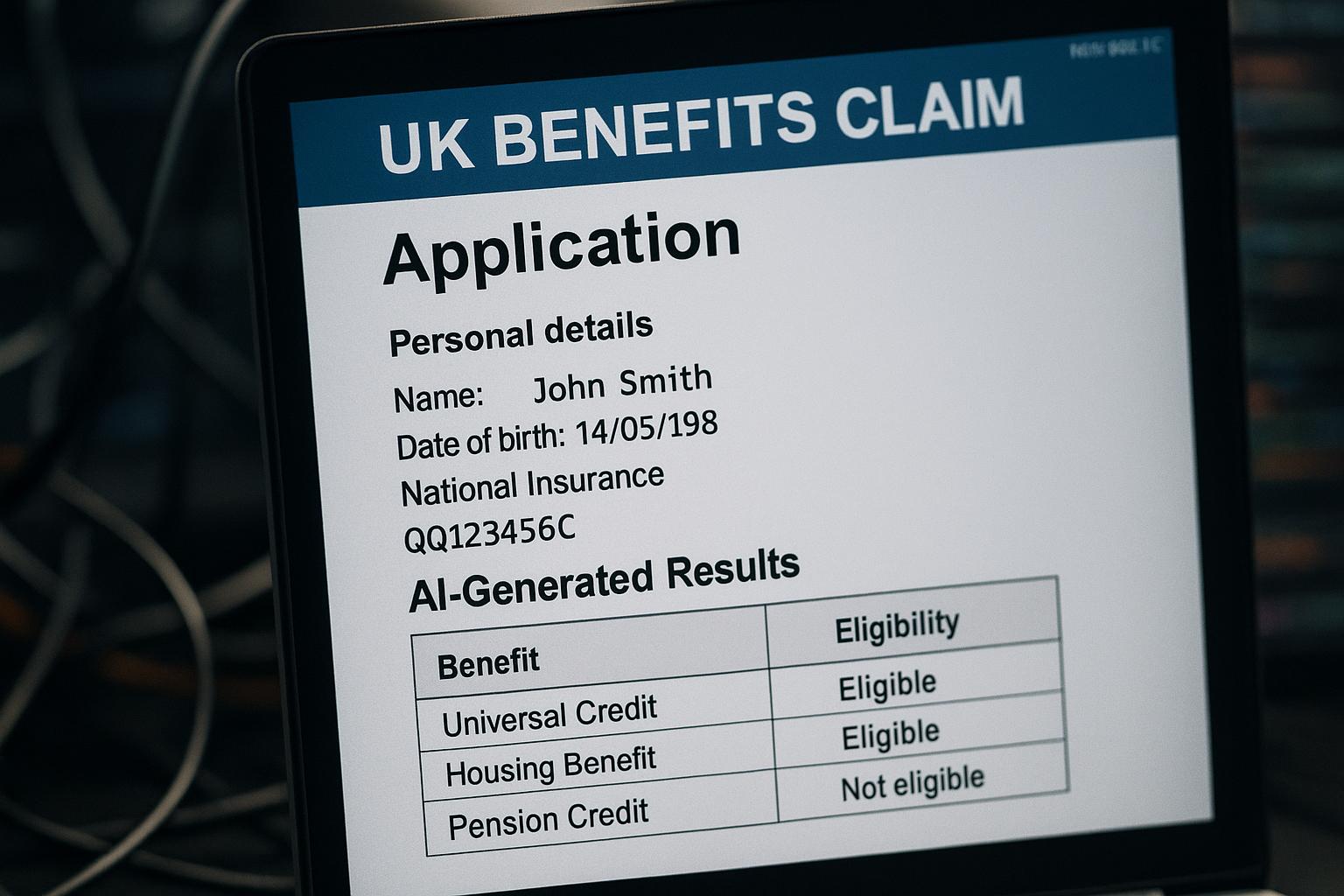
The UK Department for Work and Pensions increasingly employs AI tools to streamline benefit claims and detect fraud, prompting debates over transparency, data privacy, and the potential for system abuse.
Artificial intelligence is playing an increasingly prominent role in the UK welfare system, both for benefits claimants seeking to maximise their entitlements and for the Department for Work and Pensions (DWP) as it attempts to streamline and secure benefit payments. According to an investigation by The Mail on Sunday, AI tools such as OpenAI’s ChatGPT are being employed by claimants to generate responses and complete forms, potentially contributing to a welfare budget forecasted to reach £100 billion annually by 2030.
The report highlights how social media and online forums are rife with individuals sharing AI-generated templates to bolster claims, particularly for Personal Independence Payment (PIP). A user named ‘Mr PIP Hero’ even developed an AI chatbot designed to mimic a disability law expert to assist with securing PIP benefits. Disability Horizons, an organisation supporting disabled people, has created a ChatGPT-based tool called the ‘Personal Independence Payment form filler’ which automates and tailors applications, promising a “stress-free way” to improve success rates.
On the other side, the DWP itself has embraced AI to enhance efficiency and fraud detection in welfare administration. It employs a ‘risk-based verification’ AI system designed to check the validity of claim applications, estimated to save £1.6 billion by 2030. The department has also used an ‘online medical matching’ AI tool since 2020 to evaluate Employment Support Allowance (ESA) applications by comparing claimant health information with a central list, achieving an 87% prediction accuracy. This system has processed over 780,000 cases and saved approximately 42,500 staff hours, with final decisions still made by human agents.
Beyond these specific tools, the DWP has substantially adopted automation more broadly, with reports indicating around 44.46 million benefit claims processed via automation, saving 3.4 million staff hours. The department currently runs 38 automation initiatives to accelerate claims processing and reduce operating costs, while also piloting AI systems like ‘White Mail’ which manages high volumes of correspondence from claimants by prioritising cases according to urgency. However, such innovations have raised concerns about transparency and data protection, as claimants reportedly are not always informed about AI involvement in handling their data.
Despite these technological advances, critics warn that increasing reliance on AI for benefit claims could undermine efforts to combat fraud and exaggeration. Welfare assessments have notably shifted away from face-to-face interactions, with only 5% of assessments currently conducted in person, a method considered more effective at verifying genuine disability claims. Calls to reinstate face-to-face assessments have been resisted by the government, which may inadvertently facilitate the use of AI-generated content by claimants to game the system.
The DWP’s approach to AI has evolved over time. Initially, generative AI tools like ChatGPT were banned for official business, but this ban was reversed, allowing civil servants to use such tools on department devices under strict security and information management policies. Nonetheless, some AI applications remain restricted within the department, reflecting a cautious stance towards fully embracing AI without safeguards.
In summary, AI is reshaping the landscape of welfare claims in the UK, offering efficiencies and new challenges alike. While it empowers claimants to better navigate complex applications, it also presents risks of system abuse and data privacy concerns. The DWP continues to expand its use of AI and automation, yet the balance between innovation, integrity, and transparency remains a delicate one.
📌 Reference Map:
- [1] (Daily Mail) – Paragraphs 1, 2, 3, 6, 7, 8
- [5] (Yahoo News) – Paragraph 4
- [6] (Public Technology) – Paragraph 5
- [7] (The Guardian) – Paragraph 6
- [2] (Civil Service World) – Paragraph 7
Source: Noah Wire Services
Noah Fact Check Pro
The draft above was created using the information available at the time the story first
emerged. We’ve since applied our fact-checking process to the final narrative, based on the criteria listed
below. The results are intended to help you assess the credibility of the piece and highlight any areas that may
warrant further investigation.
Freshness check
Score:
7
Notes:
The narrative presents recent developments regarding AI’s role in the UK welfare system, with specific references to March 2025 events. However, similar themes have been reported in earlier articles from January 2025, indicating some recycled content. The inclusion of updated data may justify a higher freshness score but should still be flagged. Additionally, the narrative includes a press release from Disability Horizons, which typically warrants a high freshness score. Nonetheless, the presence of recycled content and earlier publications suggests a moderate freshness score. ([en.wikipedia.org](https://en.wikipedia.org/wiki/March_2025_United_Kingdom_spring_statement?utm_source=openai))
Quotes check
Score:
6
Notes:
The narrative includes direct quotes attributed to individuals and organisations. However, these quotes appear in earlier publications from January 2025, indicating potential reuse. Variations in wording are present, but the core content remains consistent. The lack of new, exclusive quotes suggests a moderate originality score.
Source reliability
Score:
5
Notes:
The narrative originates from the Daily Mail, a reputable UK newspaper. However, the reliance on a press release from Disability Horizons, an organisation supporting disabled people, introduces potential bias. The absence of independent verification or additional reputable sources raises concerns about the reliability of the information presented.
Plausability check
Score:
7
Notes:
The claims regarding AI’s role in the UK welfare system align with known technological advancements and policy discussions. However, the narrative lacks supporting detail from other reputable outlets, and the reliance on a single press release raises questions about the comprehensiveness of the information. The tone and language used are consistent with the region and topic, and the structure does not include excessive or off-topic detail.
Overall assessment
Verdict (FAIL, OPEN, PASS): OPEN
Confidence (LOW, MEDIUM, HIGH): MEDIUM
Summary:
The narrative presents information on AI’s role in the UK welfare system, incorporating recent developments and data. However, the presence of recycled content, reliance on a single press release, and lack of independent verification raise concerns about the freshness, originality, and reliability of the information. Further corroboration from additional reputable sources is needed to fully assess the credibility of the claims.


