



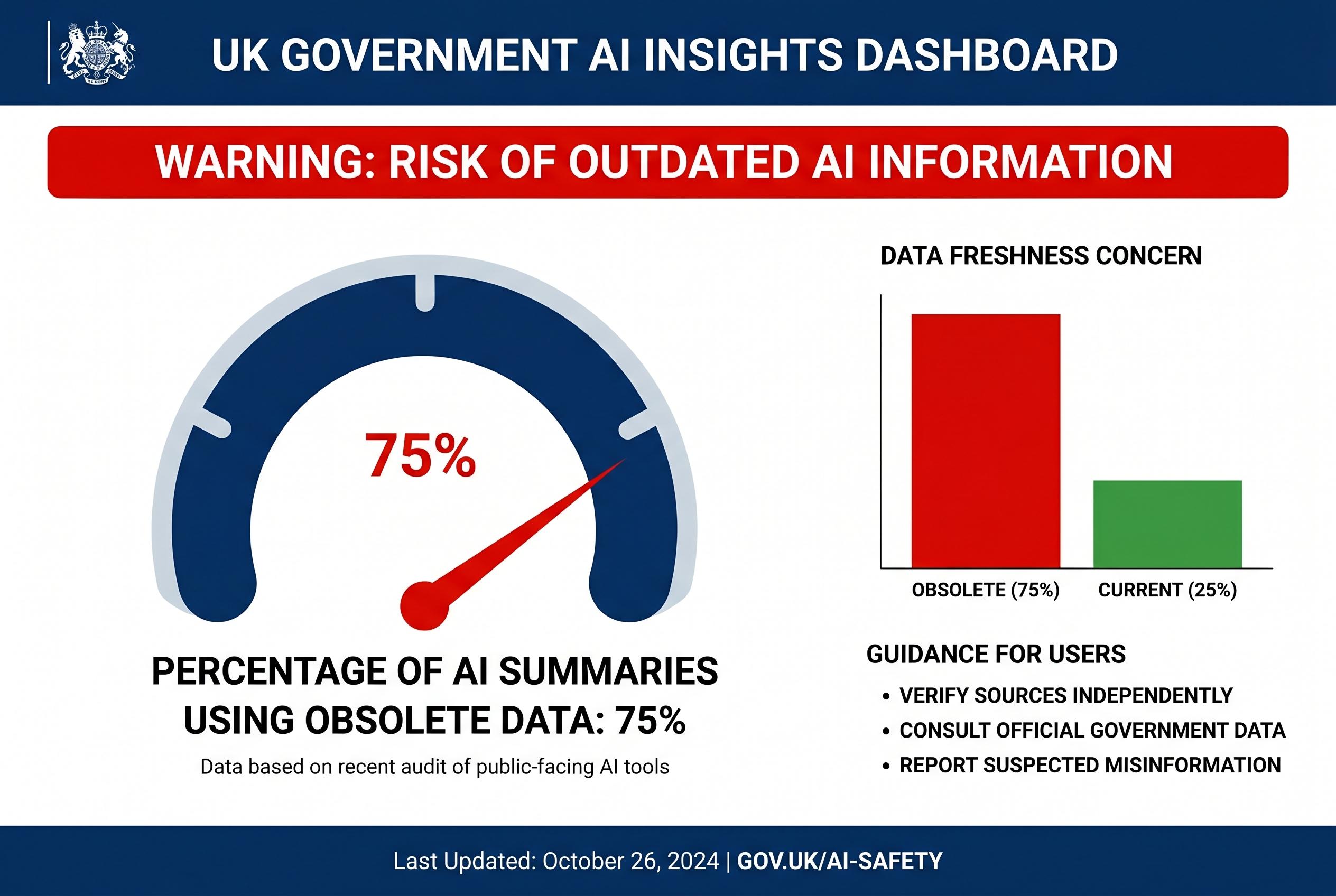
The Department for Business and Trade reveals that AI summarisation tools are often presenting obsolete government information due to incomplete content updates on GOV.UK, raising concerns over trust and accuracy in public sector AI applications.
Artificial intelligence summaries are surfacing outdated UK government information because search tools are still pulling from old GOV.UK pages that were never fully retired, according to Department for Business and Trade content staff. In a GOV.UK blog post, senior content designer Giorgio Di Tunno and content operations lead Neil Starr warned that the issue is not just accuracy but trust: when AI systems present conflicting answers, users may assume the government itself is unreliable.
The problem was illustrated by searches for the cost of setting up a charity in the UK. According to the department staff, an AI overview cited incorporation fees of £13 online or £40 by post, figures taken from an old page that no longer reflects the current charges. The real cost is £100 online or £124 by post. The Register reported that when it repeated the search, Google’s AI overview first said incorporation was free and later produced a much wider estimate, neither of which was correct.
To reduce the risk, the department reviewed GOV.UK pages that had not been updated for five years, had drawn fewer than 11 views over that period, were supposed to contain current information and lacked an active owner. That exercise identified 150 pages, including material inherited from the former Department for Business, Energy and Industrial Strategy, and those pages have now been redirected to archived versions, live GOV.UK content or relevant legislation. DBT is also trialling six-month review dates displayed on each page, a change the authors say users have responded to positively because it makes content provenance easier to judge.
The issue is not confined to business guidance. Mark Edwards, the Department for Education’s head of design, has separately cautioned that AI summaries can flatten complex public information into answers that are too narrow or incomplete. His warning reflects a broader shift in government communication: content now has to work not only for human readers but also for systems that scrape, paraphrase and repackage official material without control from the original publisher. GOV.UK’s own AI guidance and related insights publications show the government is already trying to adapt to that reality as it seeks to use AI safely while limiting the risks of distortion.
Source Reference Map
Inspired by headline at: [1]
Sources by paragraph:
Source: Noah Wire Services
Noah Fact Check Pro
The draft above was created using the information available at the time the story first
emerged. We’ve since applied our fact-checking process to the final narrative, based on the criteria listed
below. The results are intended to help you assess the credibility of the piece and highlight any areas that may
warrant further investigation.
Freshness check
Score:
8
Notes:
The article from The Register was published on 23 April 2026, which is recent. However, the issue discussed—outdated GOV.UK pages feeding AI systems—has been a known problem for some time, potentially reducing the novelty of the content.
Quotes check
Score:
7
Notes:
The article includes direct quotes from Giorgio Di Tunno and Neil Starr. While these quotes are attributed to a GOV.UK blog post, the exact publication date of that post is not specified, making it difficult to verify the freshness and context of the quotes.
Source reliability
Score:
6
Notes:
The Register is a reputable technology news outlet. However, the article relies on a single source (the GOV.UK blog post) without cross-referencing with other independent sources, which raises concerns about the comprehensiveness and potential bias of the information presented.
Plausibility check
Score:
9
Notes:
The claim that outdated GOV.UK pages are being used by AI systems to provide incorrect information is plausible and aligns with known issues in AI data sourcing. However, the article does not provide specific examples or evidence to substantiate this claim, which would strengthen its credibility.
Overall assessment
Verdict (FAIL, OPEN, PASS): FAIL
Confidence (LOW, MEDIUM, HIGH): MEDIUM
Summary:
While the article addresses a plausible issue regarding outdated GOV.UK pages feeding AI systems incorrect data, it relies heavily on a single source without independent verification. The freshness of the quotes is uncertain due to the unspecified publication date of the GOV.UK blog post. Additionally, the article does not provide specific examples or evidence to substantiate the claims made, which diminishes its overall credibility. Therefore, the content does not meet the necessary standards for publication under our editorial guidelines.


