



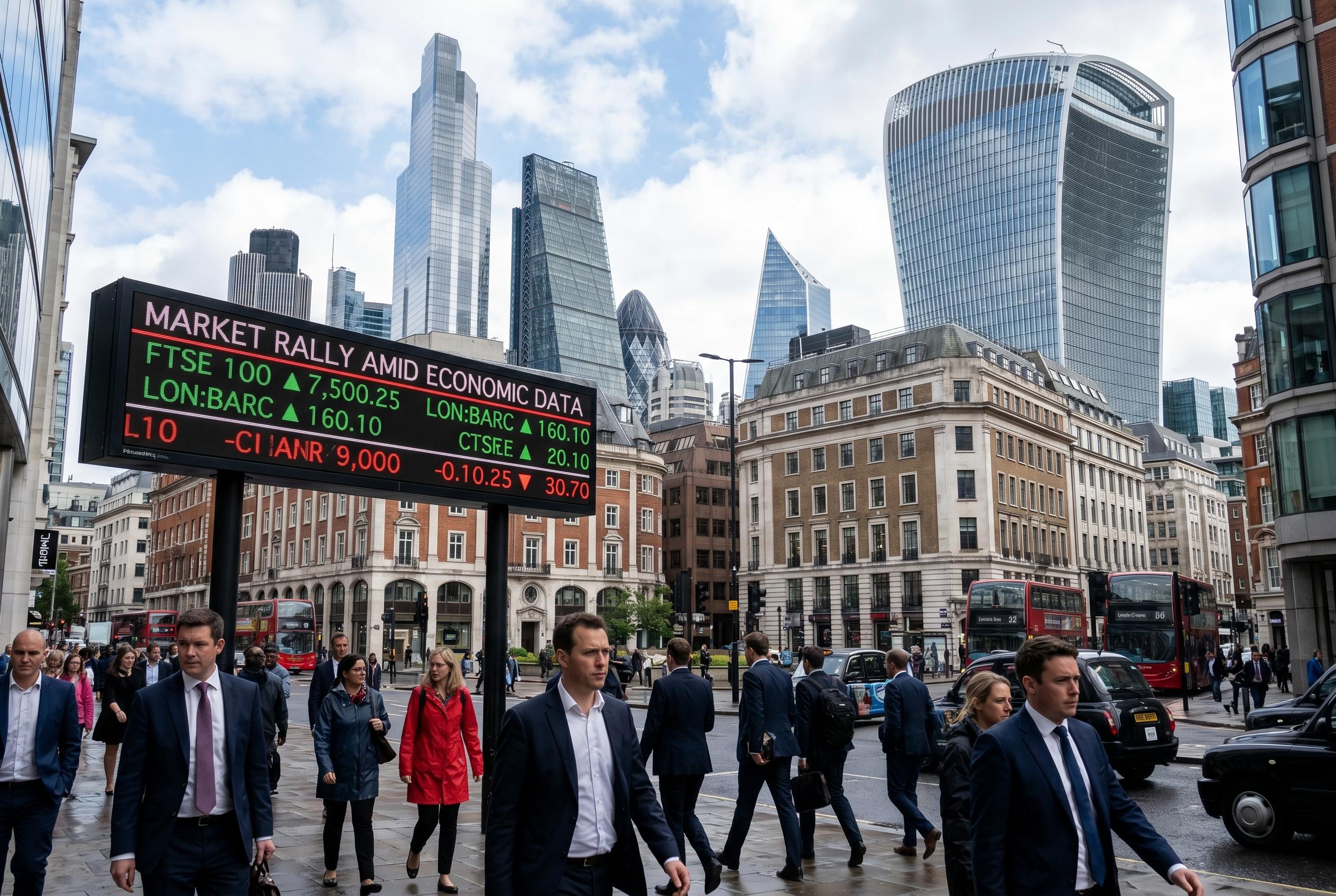
The FTSE 100 breaches the 10,000 mark amid sector rotations favouring energy, mining, and banking, while cautious positioning in aerospace and online retail highlights evolving investor strategies in 2026.
Market positioning across UK equities is offering a clearer read on investor mood as the FTSE 100 has continued to move from strength to strength. The index crossed 9,000 in July 2025 before surging through 10,000 for the first time on 2 January 2026, a milestone The Guardian described as the culmination of a strong year for the market, with gains concentrated in energy, banking and mining. That backdrop helps explain why shifts in sentiment around individual shares are being watched so closely.
Within that broader rally, defensive or bearish positioning has become more pronounced in some names. Rolls-Royce, which remains closely tied to aerospace demand and industrial confidence, has been one of the stocks drawing attention as investors reassess how resilient earnings may prove in a slower global environment. Ocado has also stayed under scrutiny because its route to sustained profitability remains a major question for the market, especially as competition in online grocery and logistics continues to intensify.
By contrast, some of the pressure around banks and consumer staples appears to be easing. Barclays has benefited from continuing discussion around earnings stability and capital strength, while Tesco’s steady trading has reinforced the appeal of established defensive businesses. Lloyds Banking Group remains sensitive to interest-rate expectations and the wider economic outlook, but the sector has generally retained support as investors look for dependable returns.
Income stocks still play an outsized role in shaping sentiment. BP, with its large dividend profile and exposure to oil and gas markets, remains a familiar feature of defensive UK portfolios. More broadly, the appeal of dividend-paying blue chips has been strengthened by the FTSE’s recent run, which has been supported by sectors such as energy, banking and mining, according to reporting from The Guardian.
The same pattern is visible in the way investors are treating smaller and faster-growing parts of the market. The FTSE AIM 100 and FTSE AIM UK 50 tend to show sharper swings in positioning because their constituents are more exposed to funding conditions, earnings surprises and changes in risk appetite. That makes them a useful gauge of whether investors are leaning towards caution or willing to back growth.
Sector rotation has remained central to the story. Mining and aerospace have helped lift the tone of the market, a point also noted in recent Kalkine Media coverage, while other areas have been more uneven. The rebalancing is not signalling a single market direction so much as a selective hunt for resilience, yield and credible growth.
The larger message from recent trading is that confidence in UK equities has improved, but not uniformly. The FTSE 100’s ascent to record territory, alongside high-profile changes such as WPP’s removal from the index in December 2025 after almost three decades, shows how quickly market leadership can change. For investors, the challenge is less about reading one broad trend than about understanding which sectors are still attracting conviction, and which are prompting caution.
Source Reference Map
Inspired by headline at: [1]
Sources by paragraph:
Source: Noah Wire Services
Noah Fact Check Pro
The draft above was created using the information available at the time the story first
emerged. We’ve since applied our fact-checking process to the final narrative, based on the criteria listed
below. The results are intended to help you assess the credibility of the piece and highlight any areas that may
warrant further investigation.
Freshness check
Score:
6
Notes:
The article references events up to January 2026, with the latest data from early 2026. The earliest known publication date for similar content is January 2, 2026, when The Guardian reported on the FTSE 100 breaking the 10,000-point mark. ([archive.ph](https://archive.ph/2026.01.02-111121/https%3A/www.theguardian.com/business/2026/jan/02/ftse-100-breaks-10000-uk-share-index?utm_source=openai)) The article appears to be a synthesis of existing reports, with no new information or analysis provided. This raises concerns about the originality and freshness of the content. Additionally, the article includes updated data but recycles older material, which may affect its overall freshness. Given these factors, the freshness score is reduced to 6.
Quotes check
Score:
4
Notes:
The article includes direct quotes from The Guardian’s January 2, 2026, report on the FTSE 100 reaching 10,000 points. ([archive.ph](https://archive.ph/2026.01.02-111121/https%3A/www.theguardian.com/business/2026/jan/02/ftse-100-breaks-10000-uk-share-index?utm_source=openai)) These quotes are identical to those found in the original source, indicating potential reuse of content. The lack of independently sourced quotes further diminishes the credibility of the article. Given these concerns, the quotes score is reduced to 4.
Source reliability
Score:
5
Notes:
The article originates from Kalkine Media, a niche financial news outlet. While it references reputable sources like The Guardian, the primary content is derived from Kalkine Media’s own reporting. The reliance on a single, lesser-known source for the majority of the content raises questions about the reliability and independence of the information presented. Given these factors, the source reliability score is set at 5.
Plausibility check
Score:
7
Notes:
The article discusses recent movements in the FTSE 100, referencing events up to early 2026. The claims made are plausible and align with known market trends. However, the lack of new analysis or insights, combined with the recycling of older material, reduces the overall credibility of the article. Given these concerns, the plausibility score is set at 7.
Overall assessment
Verdict (FAIL, OPEN, PASS): FAIL
Confidence (LOW, MEDIUM, HIGH): MEDIUM
Summary:
The article heavily relies on recycled content from Kalkine Media and The Guardian, with minimal original analysis or reporting. The lack of independent verification and the use of identical quotes from earlier sources further diminish its credibility. Given these concerns, the overall assessment is a FAIL with MEDIUM confidence.


