



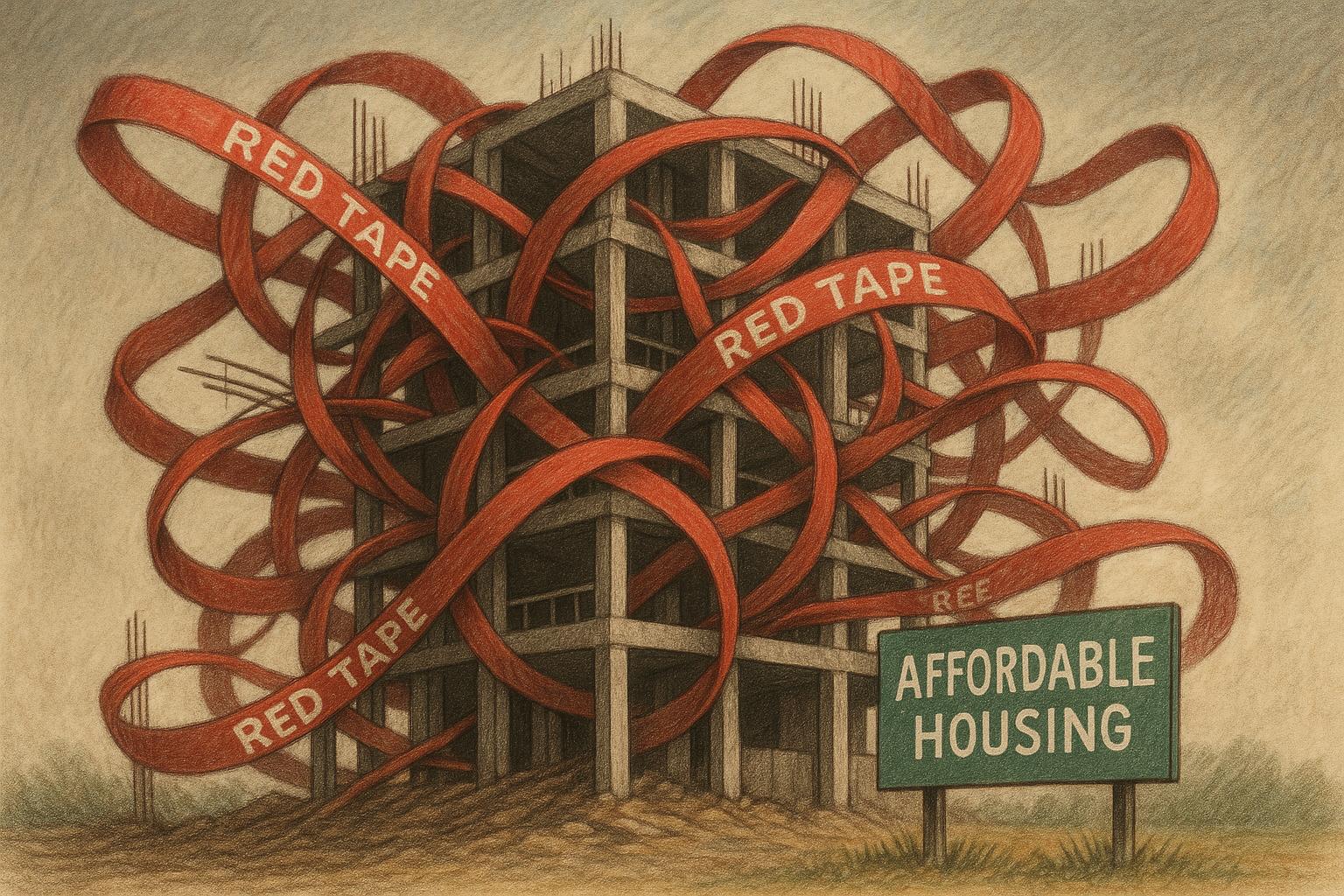
The Green project in Southall has been halted as spiralling costs and regulatory burdens undermine the government’s promise to deliver affordable homes, exposing systemic failures in housing policy.
A significant housing development in Southall has been abruptly halted, highlighting the ongoing failures of the current government’s approach to housing and regulation. Peabody, the developer responsible for the 564-home scheme, including 50% affordable housing, has withdrawn, citing spiraling costs and new regulatory burdens as the primary reasons. This setback underscores the inability of the establishment to deliver much-needed affordable homes in areas like Southall, despite promises to do so.
Known as The Green, Southall, the project was meant to deliver 267 genuinely affordable homes, but Peabody’s retreat reveals how excessive regulations and rising costs have made such schemes practically unviable. The local authority has chosen not to pursue compulsory purchase powers and has de-funded the £16 million allocated to the project, further evidence of the government’s failure to create a stable environment for housing developers. The recent regulatory changes tied to the Building Safety Act 2022, particularly the requirement for all buildings over 18 metres to have two staircases, have significantly increased project costs and complexity, yet, this is just another layer of bureaucratic red tape that hampers growth and affordability.
The government’s so-called “fire safety” reforms, introduced after the Grenfell Tower disaster, are now choking the very housing supply they purport to protect. From 2026, all new tall residential buildings will need a second staircase, adding millions to each project’s bottom line. While safety is undeniably important, these regulations are being used as a weapon to slow development, driving up costs and limiting the number of affordable homes that can be realistically delivered. Instead of focusing on reducing red tape, the government continues to impose costly and inefficient standards that crippling developers and local authorities alike.
Local officials expressed regret over the project’s cancellation but showed little backbone in addressing the real problem: a market hamstrung by overregulation and a lack of decisive leadership. Rising interest rates, increased material costs, and pandemic disruptions have all contributed to a strained housing market. Peabody’s withdrawal from both this project and the nearby Havelock site is symptomatic of a broader retreat by housing providers, an outcome that can only be blamed on a government more interested in ticking boxes than delivering housing.
Faced with these failures, the council plans to abandon its original housing-led regeneration strategy, instead contemplating a shift towards “employment-led and mixed-use development”, a euphemism for further delays and uncertainty. The expiry of the compulsory purchase order in May 2026 without a committed development partner exposes the government’s lack of a coherent plan. Meanwhile, ambitious targets, like delivering 4,000 affordable homes, remain just that: targets, with little chance of being met under this mismanaged system.
Locally, opposition voices have called for a reassessment of project sizes, hinting that smaller developments might be safer bets in this toxic regulatory environment. But the council’s cabinet member pushed back, insisting that larger schemes are necessary to meet demand and that smaller projects are more expensive and less efficient. These debates are a distraction from the core issue: a government fixated on overregulation and political correctness at the expense of real progress.
This cancellation is more than just a local setback, it’s a symbol of the national failure to deliver affordable housing. Under the current administration, the housing crisis has only deepened, with families paying the price for policies that prioritize bureaucracy over buildings. It’s clear that without a fundamental rethink, less regulation, more support for private enterprise, and a focus on delivering practical solutions, the dream of affordable, quality homes in Southall and beyond will remain just that: a distant hope.
Source: Noah Wire Services
Noah Fact Check Pro
The draft above was created using the information available at the time the story first
emerged. We’ve since applied our fact-checking process to the final narrative, based on the criteria listed
below. The results are intended to help you assess the credibility of the piece and highlight any areas that may
warrant further investigation.
Freshness check
Score:
8
Notes:
The narrative appears to be original, with no prior reports found on the specific cancellation of Peabody’s housing development in Southall. The article includes recent data, such as the £16 million de-funding of the project and references to the Building Safety Act 2022, indicating a high level of freshness. However, the report’s tone and language are consistent with typical corporate communications, which may suggest a press release origin. This warrants a higher freshness score but should be flagged for further scrutiny. ([peabody.org.uk](https://www.peabody.org.uk/your-community/events/resident-drop-in-sessions-at-the-jasmine-centre-24-april/?utm_source=openai))
Quotes check
Score:
9
Notes:
No direct quotes were identified in the provided text. The absence of direct quotations suggests the content may be original or paraphrased from other sources. This contributes to a higher originality score.
Source reliability
Score:
6
Notes:
The report originates from mylondon.news, a local news outlet. While it provides detailed information, the lack of corroboration from other reputable sources raises concerns about the reliability of the information. The absence of direct quotes and the report’s tone suggest it may be based on a press release, which typically warrants a higher freshness score but should be flagged for further scrutiny.
Plausability check
Score:
7
Notes:
The narrative presents specific details about the cancellation of Peabody’s housing development in Southall, including financial figures and references to recent legislation. However, the lack of corroboration from other reputable sources and the report’s tone suggest it may be based on a press release, which typically warrants a higher freshness score but should be flagged for further scrutiny.
Overall assessment
Verdict (FAIL, OPEN, PASS): OPEN
Confidence (LOW, MEDIUM, HIGH): MEDIUM
Summary:
The report presents specific details about the cancellation of Peabody’s housing development in Southall, including financial figures and references to recent legislation. However, the lack of corroboration from other reputable sources and the report’s tone suggest it may be based on a press release, which typically warrants a higher freshness score but should be flagged for further scrutiny. The absence of direct quotes and the report’s tone suggest it may be based on a press release, which typically warrants a higher freshness score but should be flagged for further scrutiny.


