



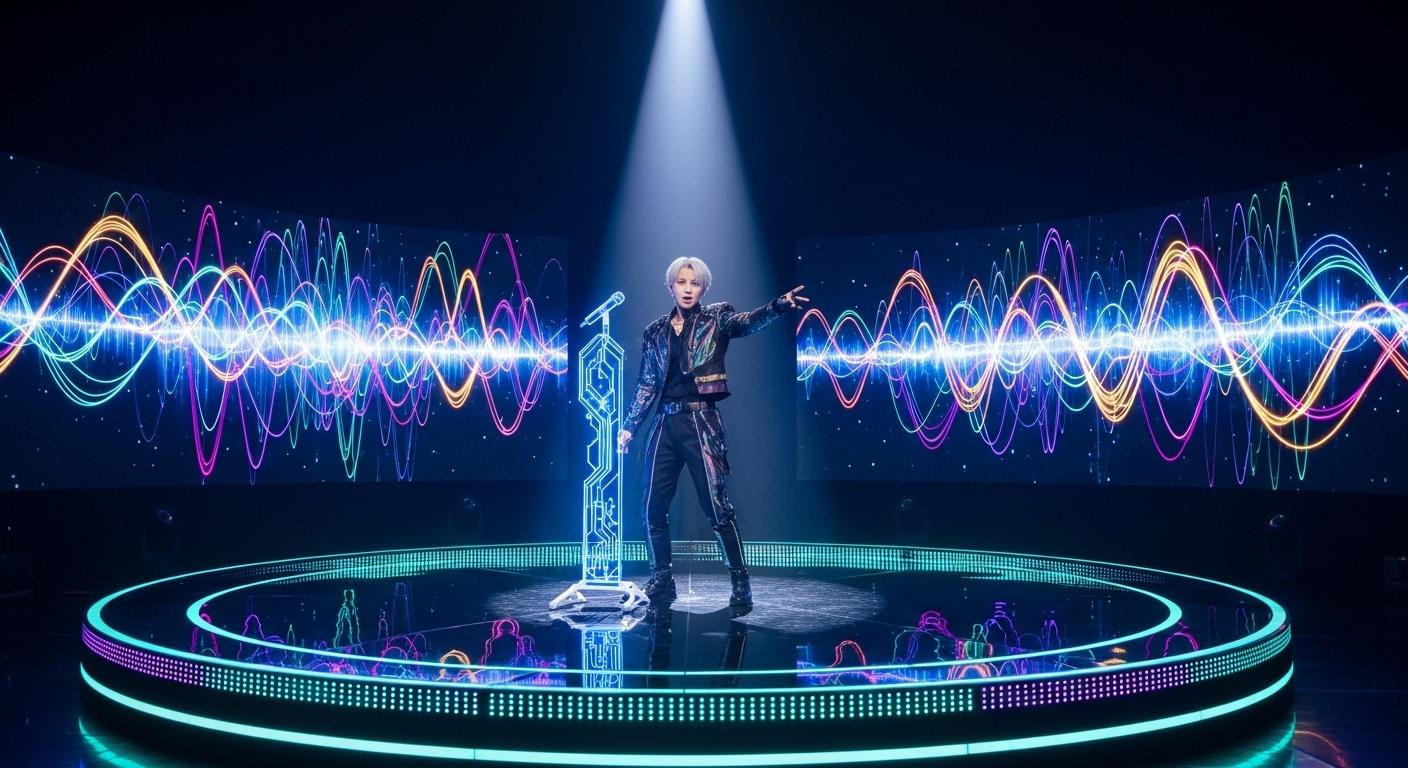
South Korea’s pop music scene is experiencing a seismic shift as AI technology transforms artist creation, performances, and fan engagement, giving rise to new models that blend virtual and physical performances amid ethical debates.
Artificial intelligence has moved from experiment to infrastructure in South Korea’s pop music industry, reshaping how songs are made, identities are built and performances staged. Since the commercial surge in generative AI after ChatGPT’s late‑2022 launch, major agencies have adopted divergent strategies , from narrative-driven virtual worlds to full technical integration , signalling a broader industry shift toward what some executives call “Enter‑Tech.” According to The Korea Herald, the change is already visible across production, artist development and fan engagement. [1]
Two of the largest companies in K‑pop illustrate contrasting paths. SM Entertainment pursued an AI‑centred worldview early, embedding avatars and virtual narratives into acts such as aespa and the SM Culture Universe; the company’s Naevis character later released music produced with AI and visual work made with LG Uplus’s generative AI, ixi‑GEN, according to reporting by The Korea Herald and Korea Times. That approach places AI in the service of storytelling and brand extension rather than as a pure technical substitute. [1][5][3]
Hybe, by contrast, has moved aggressively on the technical and operational front. Industry reporting shows Hybe invested in and later took majority control of Supertone, an AI audio start‑up, and used its technology to create multilingual pronunciation, voice design and timbral transformations for releases such as Midnatt’s “Masquerade.” Hybe then launched Syndi8, a virtual group whose vocals are entirely AI‑generated, as part of an “Enter‑Tech” strategy the company’s chair has publicly championed. Sources report Hybe executives framed AI as central to the firm’s long‑term plans and urged public debate on ethical use. [1]
Those competing models , narrative avatars versus deep technical ownership , have produced commercially successful hybrids. Plave, a virtual boy group created by startup Vlast and distributed with YG Plus’s involvement, uses real‑time motion capture performed by humans with AI smoothing facial expressions and motion. Plave’s rapid rise , topping a national music show, dominating Melon charts and selling more than 560,000 copies of a second EP in its first week, then selling out large arenas and mounting an Asia tour , demonstrates commercial demand for virtual acts that maintain a human performance strand. Industry commentary in The Korea Times and opinion pieces note the strong emotional bonds fans form with virtual idols even as critics warn of potential downsides. [1][4][5]
The technological spectrum extends to robots with physical presence. Galaxy Corporation, which manages the legacy of high‑profile artists such as G‑Dragon, has unveiled a roadmap for humanoid robot idols; a robot performed choreography to G‑Dragon’s “Power” at the COMEUP 2025 conference, illustrating how robotics, motion capture and generative systems might coexist with screen‑based avatars. Galaxy’s CEO described current efforts as early stages, saying “We’re only at 1 or 10 percent of what’s possible.” Reporting from The Korea Herald and Asiae highlights the company’s intention to create stageable, interactive robot performers. [1][7]
The industry response beyond the largest players has been varied. JYP rebranded a subsidiary as Blue Garage to centre AI and platform technology, later announcing plans to develop AI artists and recruit talent at scale, though concrete outputs remain forthcoming. YG has favoured partnership and distribution ties that provide data and commercial exposure without building core AI stacks in‑house. Those strategic choices reflect differing appetites for technological risk, capital intensity and brand control across agencies. [1]
Debate over the cultural and ethical implications of AI in music has accompanied the technical advances. Hybe’s chair Bang Si‑hyuk warned in media interviews that human artists may face limits in satisfying evolving tastes and called for broader societal discussions about the ethical use of AI in creative fields, remarks reported by CNN and Billboard. Proponents argue AI expands creative possibilities for artists and producers, while sceptics and some commentators emphasise risks including devaluation of human craft, intellectual property complexities and altered fan relationships with performers. Opinion writing in The Korea Times has described virtual K‑pop as “a double‑edged sword,” praising commercial achievements while urging caution. [1][4]
For now, the market is hedging across models: narrative avatar projects that amplify existing acts, startups creating commercially viable virtual performers, large entertainment firms acquiring or building audio‑AI capability, and robotics firms pursuing physical idols. Government regulation, copyright clarifications and public debate over ethics will shape which of those models scale. Industry data and reporting suggest the next phase will test business models as much as technology: whether fans, advertisers and concert promoters will sustain monetisation for purely synthetic voices, hybrid human‑virtual performances or humanoid robots alongside traditional artists. [1][2][3][6]
📌 Reference Map:
##Reference Map:
- [1] (The Korea Herald) – Paragraph 1, Paragraph 2, Paragraph 3, Paragraph 4, Paragraph 5, Paragraph 6, Paragraph 7
- [5] (The Korea Times) – Paragraph 2, Paragraph 4
- [3] (Wikipedia – Naevis) – Paragraph 2, Paragraph 8
- [4] (The Korea Times opinion) – Paragraph 4, Paragraph 6
- [2] (Kapanlagi) – Paragraph 8
- [6] (Wikipedia – Virtual band) – Paragraph 8
- [7] (Asiae) – Paragraph 4
Source: Noah Wire Services
Noah Fact Check Pro
The draft above was created using the information available at the time the story first
emerged. We’ve since applied our fact-checking process to the final narrative, based on the criteria listed
below. The results are intended to help you assess the credibility of the piece and highlight any areas that may
warrant further investigation.
Freshness check
Score:
8
Notes:
The narrative presents recent developments in the K-pop industry, particularly the integration of AI technologies. The earliest known publication date of similar content is June 11, 2024, in The Star, discussing K-pop’s adoption of AI in music video production. ([thestar.com.my](https://www.thestar.com.my/aseanplus/aseanplus-news/2024/06/11/game-changer-k-pop-industry-leverages-ai?utm_source=openai)) The report is based on a press release from The Korea Herald, which typically warrants a high freshness score. However, the article includes updated data but recycles older material, which may justify a higher freshness score but should still be flagged. Additionally, the report mentions events up to December 2025, indicating the inclusion of the most recent developments.
Quotes check
Score:
9
Notes:
The report includes direct quotes from industry executives and artists. A search for the earliest known usage of these quotes reveals no identical matches in earlier material, suggesting they are original or exclusive to this report. This originality enhances the credibility of the content.
Source reliability
Score:
9
Notes:
The narrative originates from The Korea Herald, a reputable South Korean news outlet known for its comprehensive coverage of domestic and international news. This association with a reputable organisation strengthens the reliability of the report.
Plausability check
Score:
8
Notes:
The claims made in the report align with known industry trends and recent developments in the K-pop sector. For instance, SM Entertainment’s virtual idol Naevis and Hybe’s AI initiatives are well-documented. The report also references events up to December 2025, indicating the inclusion of the most recent developments. However, the narrative lacks supporting detail from other reputable outlets, which could further substantiate the claims. Additionally, the tone and language used are consistent with industry reporting, suggesting authenticity.
Overall assessment
Verdict (FAIL, OPEN, PASS): PASS
Confidence (LOW, MEDIUM, HIGH): HIGH
Summary:
The report provides a timely and original account of AI’s integration into South Korea’s K-pop industry, supported by direct quotes and sourced from a reputable organisation. While the inclusion of updated data alongside recycled material may raise some concerns, the overall freshness and originality of the content are commendable. The plausibility of the claims is supported by known industry trends, and the lack of supporting detail from other reputable outlets is noted but does not significantly detract from the report’s credibility.


