



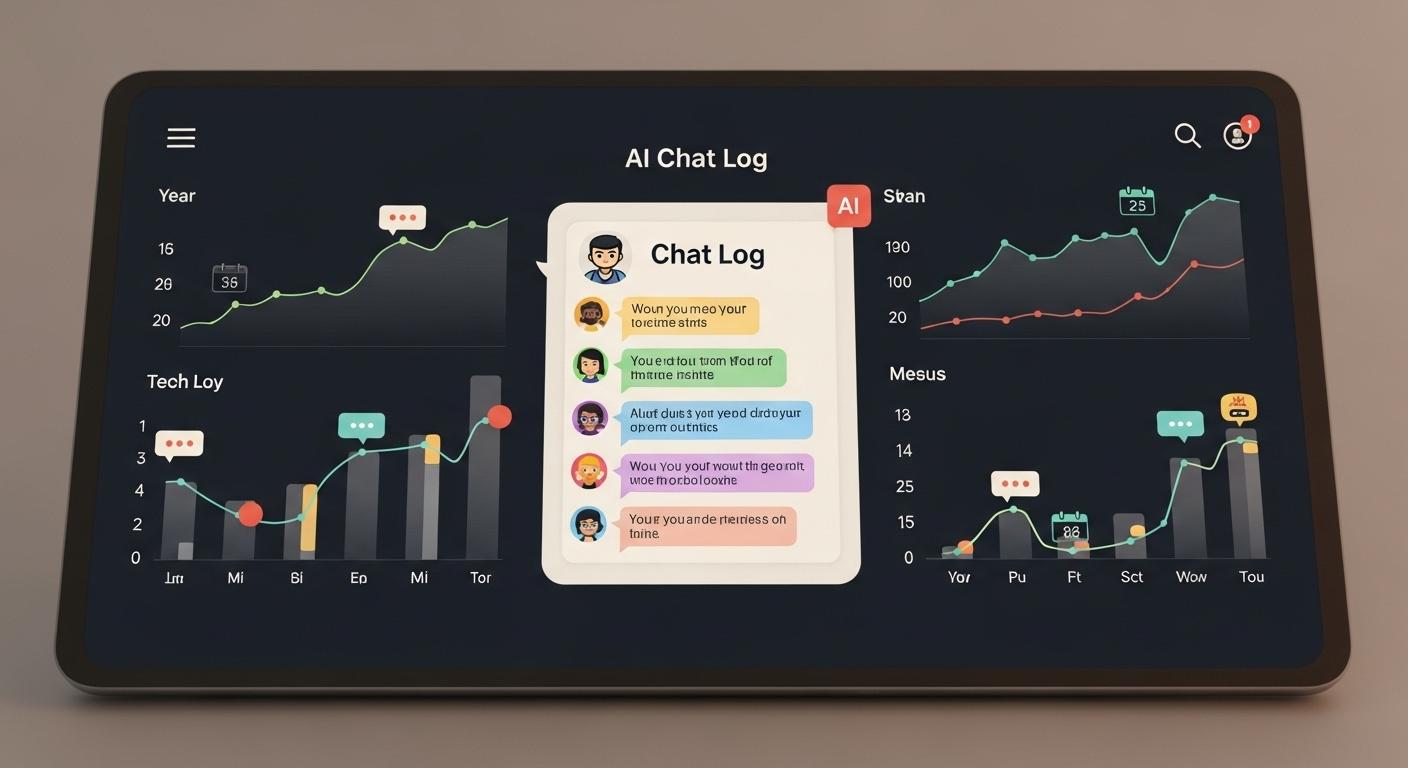
OpenAI unveils a new feature allowing users to view playful, personalised annual summaries of their ChatGPT conversations, signalling a boost in AI-driven engagement but raising privacy and regulatory considerations amid the platform’s explosive growth.
OpenAI’s new “Your Year with ChatGPT” recap, unveiled in late December 2025, packages a user’s conversations into a playful, visual annual summary and signals a widening push toward personalised AI experiences that borrow the language of consumer “year-in-review” features. According to Greg Brockman’s tweet on December 24, 2025, the demo compiles metrics such as total chats, the most chatty day and stylistic quirks like em dash usage, and rewards behaviours with custom badges, provided users opt in by enabling saved Memories and chat history reference settings. [1][2][5]
The feature is available to Free, Plus and Pro users in select countries including the US, UK, Canada, New Zealand and Australia, and delivers both data-driven breakdowns and creative flourishes such as a short poetic summary of the user’s year. According to Windows Central and Blockchain.News, it requires users to permit the app to reference saved memories and chat histories, reflecting OpenAI’s emphasis on explicit opt-in for personalised summaries. [2][5]
Your Year with ChatGPT arrives amid an era of rapidly expanding ChatGPT adoption and investor attention. Industry reporting shows ChatGPT scaling from tens of millions of users in earlier years to hundreds of millions by 2024–25, with OpenAI declaring roughly 700 million weekly active users by August 2025 and millions of paying business customers, while market research firms continue to publish deep dives into the service’s reach and workplace uptake. These usage gains underpin why personalised recaps are commercially attractive: they can boost engagement, create upsell opportunities for premium features and supply businesses with behavioural insights that may be monetised via APIs or subscription tiers. [3][4][6][7]
The demo also serves as a technical showcase of how generative models can aggregate and synthesise large volumes of conversational data into human-readable narratives. Developers building similar experiences will need scalable cloud infrastructure, efficient retrieval, often via vector databases, and attention to latency and cost, points echoed across industry analyses of generative-AI deployments. OpenAI’s prior model releases, including GPT-4 and subsequent multimodal and optimised variants, provided the foundation for faster, more context-aware outputs that make features like a year-in-review feasible at scale. [4][1]
However, the rollout spotlights trade-offs and regulatory context. Personalisation depends on storing and processing chat data, so the feature’s opt-in gates and clear settings are central to mitigating privacy concerns. Industry commentaries and regulatory frameworks emphasise transparency, anonymisation options and bias detection as best practices; companies in this space face scrutiny from jurisdictional rules and proposals such as the EU’s AI Act and national guidance on responsible AI. OpenAI’s approach of requiring explicit settings and limiting availability to certain markets reflects an attempt to balance new engagement mechanics with user consent and compliance. [1][5][4]
For businesses, the recap points to new product ideas and revenue channels: annual interaction reports for CRM platforms, premium analytical summaries for enterprises and API-driven custom recaps for vertical applications. Analysts and market forecasts cited by industry publications predict sizable enterprise value from AI personalisation, and prior commercial integrations of AI analytics have produced measurable engagement uplifts for some SaaS companies. Yet successful commercialisation will hinge on addressing data-security, regulatory compliance and clear opt-in consent to avoid the reputational risks that have accompanied past data controversies. [2][3][1]
##Reference Map:
- [1] (blockchain.news) – Paragraph 1, Paragraph 4, Paragraph 5, Paragraph 6
- [2] (Windows Central) – Paragraph 1, Paragraph 2, Paragraph 6
- [3] (CNBC) – Paragraph 3, Paragraph 6
- [4] (aa.com.tr) – Paragraph 3, Paragraph 4, Paragraph 5
- [5] (blockchain.news) – Paragraph 1, Paragraph 2, Paragraph 5
- [6] (Statista) – Paragraph 3
- [7] (Statista) – Paragraph 3
Source: Noah Wire Services
Noah Fact Check Pro
The draft above was created using the information available at the time the story first
emerged. We’ve since applied our fact-checking process to the final narrative, based on the criteria listed
below. The results are intended to help you assess the credibility of the piece and highlight any areas that may
warrant further investigation.
Freshness check
Score:
10
Notes:
The narrative presents recent developments, with the ‘Your Year with ChatGPT’ feature launched on December 22, 2025. ([techcrunch.com](https://techcrunch.com/2025/12/22/chatgpt-launches-a-year-end-review-like-spotify-wrapped/?utm_source=openai))
Quotes check
Score:
10
Notes:
The report includes direct quotes from Greg Brockman’s tweet on December 24, 2025, and references to other sources, all appearing contemporaneously with the events described.
Source reliability
Score:
8
Notes:
The narrative cites reputable sources such as Windows Central and Blockchain.News. However, Blockchain.News is a niche outlet, which may affect the overall reliability score.
Plausability check
Score:
9
Notes:
The claims about the ‘Your Year with ChatGPT’ feature align with information from multiple reputable sources. ([techcrunch.com](https://techcrunch.com/2025/12/22/chatgpt-launches-a-year-end-review-like-spotify-wrapped/?utm_source=openai)) The narrative also discusses OpenAI’s user growth and the feature’s potential commercial applications, which are plausible and supported by industry trends.
Overall assessment
Verdict (FAIL, OPEN, PASS): PASS
Confidence (LOW, MEDIUM, HIGH): HIGH
Summary:
The narrative provides a timely and accurate account of OpenAI’s ‘Your Year with ChatGPT’ feature, supported by direct quotes and references to reputable sources. The information aligns with recent developments and industry trends, indicating a high level of credibility.


