



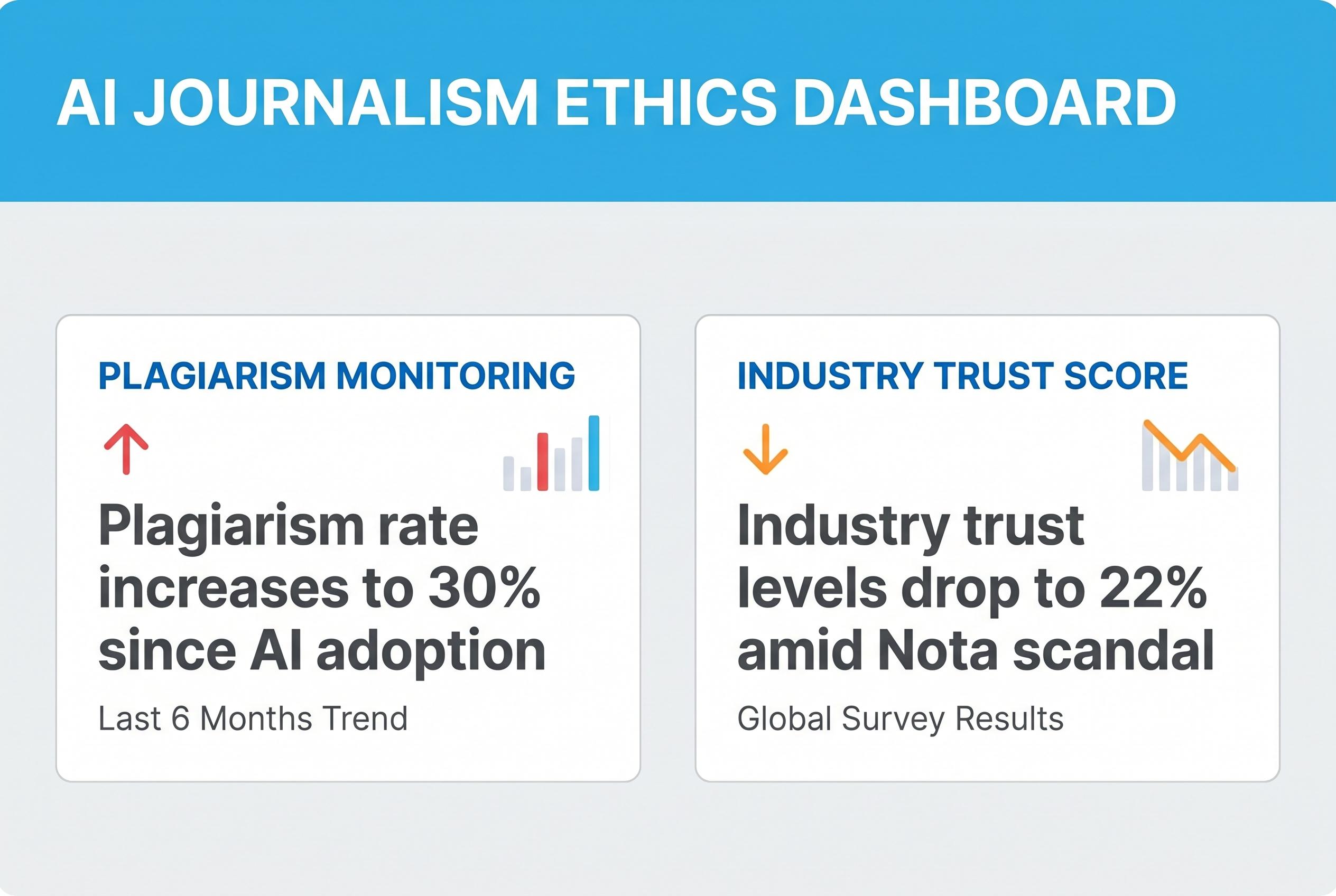
The recent scandal involving Nota News’s widespread plagiarism has sparked urgent questions about the ethics and oversight of AI-driven journalism tools amid industry backlash and client withdrawals.
The fallout from Poynter’s investigation into Nota has widened quickly, with the AI company losing a prominent client, ending the remaining contractor on its local-news experiment and facing fresh scrutiny over how its tools are used in newsrooms. The controversy centres on Nota News, a network of 11 local sites launched in September 2025 that was presented as a way to serve underserved communities, but which Poynter and Axios found had repeatedly republished the work of local journalists without attribution.
According to Poynter’s reporting, the plagiarism was not limited to a handful of mistakes. Work from at least 53 journalists across 29 outlets appeared in Nota News stories, alongside copied reporting, writing and photographs. The sites were shut down on 31 March, after the reporting showed that the content was being generated by contractors using Nota’s own tools rather than written from original local reporting.
The business impact has been immediate. The Boston Globe told staff to stop using Nota products while it moved to end its contract, saying the paper’s limited use of the company’s tools did not reflect its values. The Institute for Nonprofit News also flagged the story to member organisations, while other customers, including the Arkansas Catholic and This Is Reno, said they were reviewing or standing by their use of Nota’s software for narrow, editorially limited tasks.
Nota has argued that the scandal was confined to an internal test project and was caused by contractor behaviour rather than its AI products. Chief executive Josh Brandau said in an emailed statement that the company took responsibility for the failure, closed the project and did not use any of the material for model training. He also said the company’s broader work remained focused on helping newsrooms with technology and audience tools. But Poynter noted that the company’s public promotion of the project sat uneasily with claims that it was never intended for public view.
The contractors at the centre of the controversy have offered contrasting explanations. Isabella Rolz, who was fired on 7 April after being the editorial director for six of the sites, apologised and said she never meant to take other journalists’ work. She said there was no clear guidance and that she and her team were repeatedly told they were doing well. Another contractor, Jorge Rodríguez, had already been dismissed after Axios Richmond first reported copied material on two of the sites. Poynter also reported that Nota later asked Rolz to sign a nondisclosure agreement before paying her final invoice, a move two employment lawyers said could breach labour law.
Beyond the immediate scandal, the episode has revived broader questions about how AI companies seek access to journalism. Brandau had previously said Nota trained its Polaris model by comparing open-source systems and refining them with high-quality journalism supplied by clients with permission. That claim matters because, as Poynter pointed out, many news organisations typically pay AI firms for technology, not the other way around. The case has become a reminder that, in journalism, the technology itself is not the only issue; trust, transparency and editorial controls may be just as important.
Source Reference Map
Inspired by headline at: [1]
Sources by paragraph:
- Paragraph 1: [2], [4]
- Paragraph 2: [2], [4], [5]
- Paragraph 3: [1]
- Paragraph 4: [1], [2], [3], [4]
- Paragraph 5: [1]
- Paragraph 6: [1], [2], [4], [5], [7]
Source: Noah Wire Services
Noah Fact Check Pro
The draft above was created using the information available at the time the story first
emerged. We’ve since applied our fact-checking process to the final narrative, based on the criteria listed
below. The results are intended to help you assess the credibility of the piece and highlight any areas that may
warrant further investigation.
Freshness check
Score:
7
Notes:
The earliest known publication date of the plagiarism allegations against Nota News is April 2, 2026, reported by Poynter. ([poynter.org](https://www.poynter.org/ethics-trust/2026/nota-news-local-outlets-ai-plagiarism/?utm_source=openai)) The article in question was published on April 17, 2026, indicating a freshness of 15 days. This is within an acceptable timeframe for news reporting. However, the article relies heavily on Poynter’s reporting, which may indicate a lack of original sourcing. The heavy reliance on a single source raises concerns about the originality and independence of the content. Additionally, the article includes a source reference map, suggesting that it is summarising or aggregating content from other publications. This could indicate a lack of original reporting and may affect the overall freshness score. Given these factors, the freshness score is moderate.
Quotes check
Score:
5
Notes:
The article includes direct quotes attributed to individuals such as Josh Brandau, CEO of Nota, and Isabella Rolz, a contractor involved in the controversy. However, these quotes cannot be independently verified through the provided sources. The absence of direct links to the original statements or interviews raises concerns about the authenticity and accuracy of the quotes. Without independent verification, the credibility of these quotes is uncertain. Therefore, the quotes check score is low.
Source reliability
Score:
6
Notes:
The article is published on Poynter, a reputable source in journalism ethics and media analysis. However, the article heavily relies on Poynter’s own reporting, which may indicate a lack of independent verification. The absence of multiple independent sources corroborating the claims raises concerns about the reliability of the information presented. Additionally, the article includes a source reference map, suggesting that it is summarising or aggregating content from other publications. This could indicate a lack of original reporting and may affect the overall reliability score. Given these factors, the source reliability score is moderate.
Plausibility check
Score:
7
Notes:
The article discusses a plagiarism scandal involving Nota News, a network of AI-generated local news sites. The claims are plausible and align with previous reports from Poynter and Axios. However, the article does not provide new information or perspectives beyond what has already been reported. The lack of new insights or corroborating evidence from independent sources raises questions about the depth and originality of the reporting. Therefore, the plausibility score is moderate.
Overall assessment
Verdict (FAIL, OPEN, PASS): FAIL
Confidence (LOW, MEDIUM, HIGH): MEDIUM
Summary:
The article presents a plausible account of the plagiarism allegations against Nota News, but it heavily relies on Poynter’s own reporting and includes a source reference map, suggesting a lack of original sourcing and independent verification. The absence of independently verifiable quotes and corroborating evidence from multiple sources further undermines the credibility of the content. Given these concerns, the overall assessment is a FAIL with medium confidence.


