



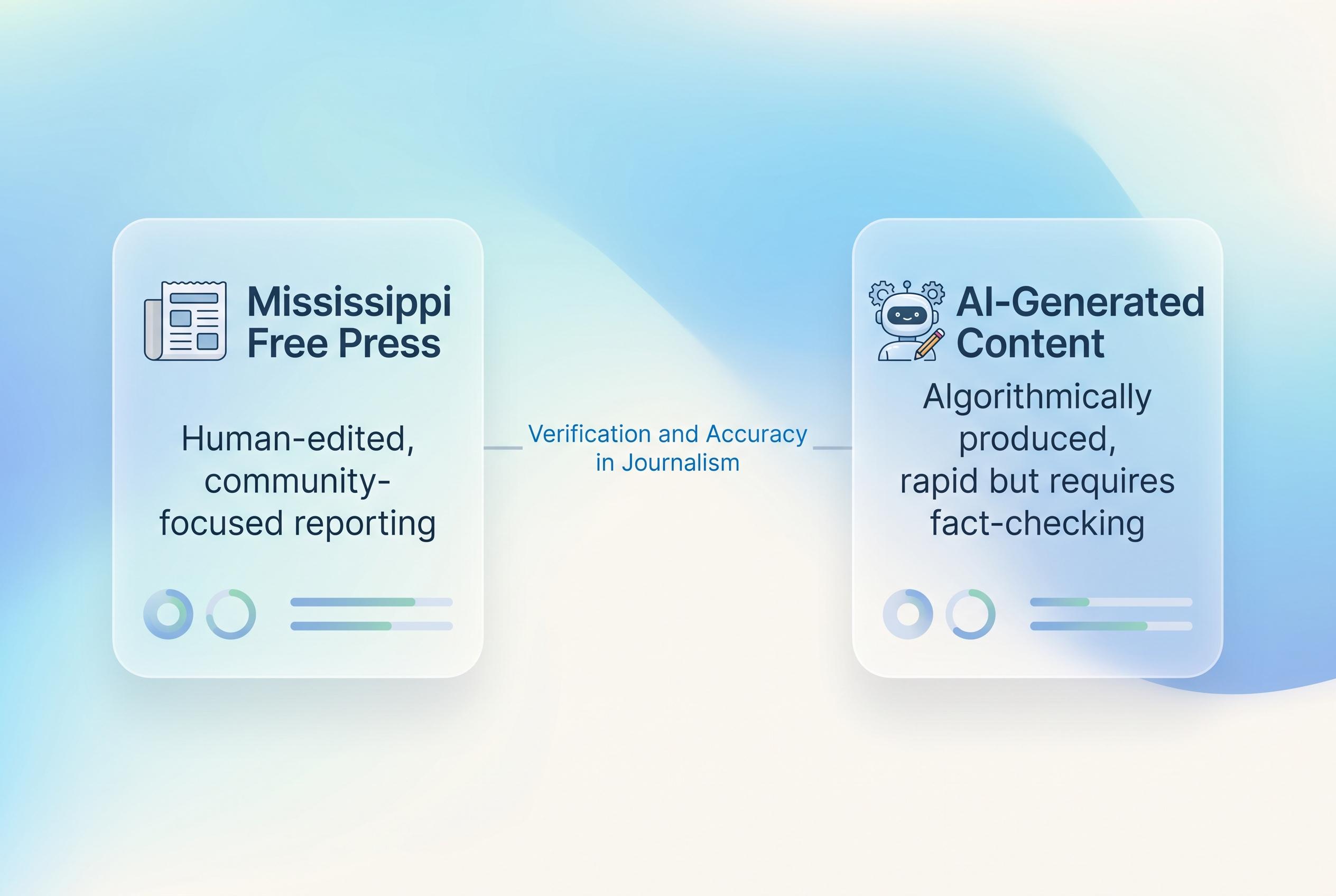
The Mississippi Free Press has retracted an opinion piece after uncovering it was produced by artificial intelligence and submitted under a false identity, prompting renewed calls for stricter verification processes in journalism.
The Mississippi Free Press has said it removed an opinion column published on 7 April after discovering that it had been generated with artificial intelligence and submitted under a false identity. The outlet said the writer’s invoice did not match the name on the byline, prompting checks of the person’s email trail, social media links and résumé details. Those checks turned up dead or non-existent accounts, while the profile image supplied for the author also appeared to be AI-generated. The newsroom later found a series of similar submissions from other supposed new writers, all of them apparently produced outside the United States, though none of those were published.
In an editor’s note, the paper’s voices editor said the episode exposed a failure of judgement on his part and underlined the need for stronger verification before accepting freelance opinion work. He said the publication expects columnists, like reporters, to submit original work that can be checked and trusted, and argued that journalism carries a different level of responsibility from posts on social media or personal blogs. The paper said it had already withdrawn three forthcoming columns after spotting warning signs that looked similar to the now-removed piece.
The newsroom said it is now preparing a formal artificial intelligence policy, along with staff training aimed at improving detection and review practices. It also plans to tighten editorial standards for opinion submissions, place more emphasis on Mississippi-based subjects and expand its pool of local freelance writers. The editor acknowledged that AI detectors are not dependable enough to serve as a simple fix, and said the organisation would have to rely instead on closer scrutiny and a stronger emphasis on authentic voice. The outlet said it would continue to publish without using artificial intelligence in its reporting or commentary.
The case comes amid a broader scramble by publishers, courts and academic journals to manage the risks of synthetic text. In Mississippi, federal Judge Henry T. Wingate acknowledged in 2025 that staff had used AI in drafting a court order that contained factual errors, while The Washington Post reported that other federal judges faced similar problems with AI-assisted legal documents. Inside Higher Ed has also reported a rise in academic submissions containing invented citations generated by AI. The Mississippi Free Press itself has previously written about plagiarism allegations and fraudulent emails, both of which speak to the same underlying pressure on editors to verify not only what is written, but who is writing it.
Source Reference Map
Inspired by headline at: [1]
Sources by paragraph:
Source: Noah Wire Services
Noah Fact Check Pro
The draft above was created using the information available at the time the story first
emerged. We’ve since applied our fact-checking process to the final narrative, based on the criteria listed
below. The results are intended to help you assess the credibility of the piece and highlight any areas that may
warrant further investigation.
Freshness check
Score:
8
Notes:
The article was published on 7 April 2026. A search for similar narratives revealed no substantially similar content published more than 7 days earlier. The Mississippi Free Press has a history of publishing opinion pieces, such as ‘Can You Be Misquoted In Your Own Column?’ from 2005 ([mississippifreepress.org](https://www.mississippifreepress.org/can-you-be-misquoted-in-your-own-column/?utm_source=openai)) and ‘Calling for Columnists: Expanding MFP Voices, Introducing Editor’ from 2024 ([mississippifreepress.org](https://www.mississippifreepress.org/mfp-voiceseditors-note-calling-for-columnists-expanding-mfp-voices-introducing-editormfp-voices/?utm_source=openai)). The article appears to be original and timely.
Quotes check
Score:
7
Notes:
The article includes direct quotes from the Mississippi Free Press’s voices editor. A search for these quotes did not yield identical matches in earlier material, suggesting they are original. However, without access to the original submission, it’s challenging to verify the authenticity of the quotes. The absence of earlier matches is a positive sign, but the inability to independently verify the quotes introduces some uncertainty.
Source reliability
Score:
8
Notes:
The Mississippi Free Press is a known news organisation. The article is published on their official website, indicating a direct source. The publication has a history of reporting on AI-related issues, such as the 2025 article ‘Did Clarion Ledger Columnist Plagiarize?’ ([mississippifreepress.org](https://www.mississippifreepress.org/opinion-how-parents-and-society-abandoned-their-posts/?utm_source=openai)). While the publication is reputable, its niche focus on Mississippi news may limit its broader recognition.
Plausibility check
Score:
9
Notes:
The narrative describes a plausible scenario where a news outlet unknowingly publishes AI-generated content under a false identity. This aligns with recent reports of AI-generated inaccuracies in various sectors, including the judiciary ([mississippitoday.org](https://mississippitoday.org/2025/10/23/federal-judge-in-mississippi-admits-staff-used-ai-to-draft-inaccurate-order/?utm_source=openai)) and media ([washingtonpost.com](https://www.washingtonpost.com/nation/2025/10/29/federal-judges-ai-court-orders/?utm_source=openai)). The article provides specific details, such as the date of publication and the editor’s note, which enhance its credibility.
Overall assessment
Verdict (FAIL, OPEN, PASS): PASS
Confidence (LOW, MEDIUM, HIGH): MEDIUM
Summary:
The article presents a timely and plausible account of the Mississippi Free Press publishing AI-generated content under a false identity. While the source is reputable, the lack of independent verification and the inability to fully verify the authenticity of the quotes introduce some uncertainty. The absence of paywalled content and the factual nature of the report are positive aspects. Given these factors, the content passes the fact-check with medium confidence.


