



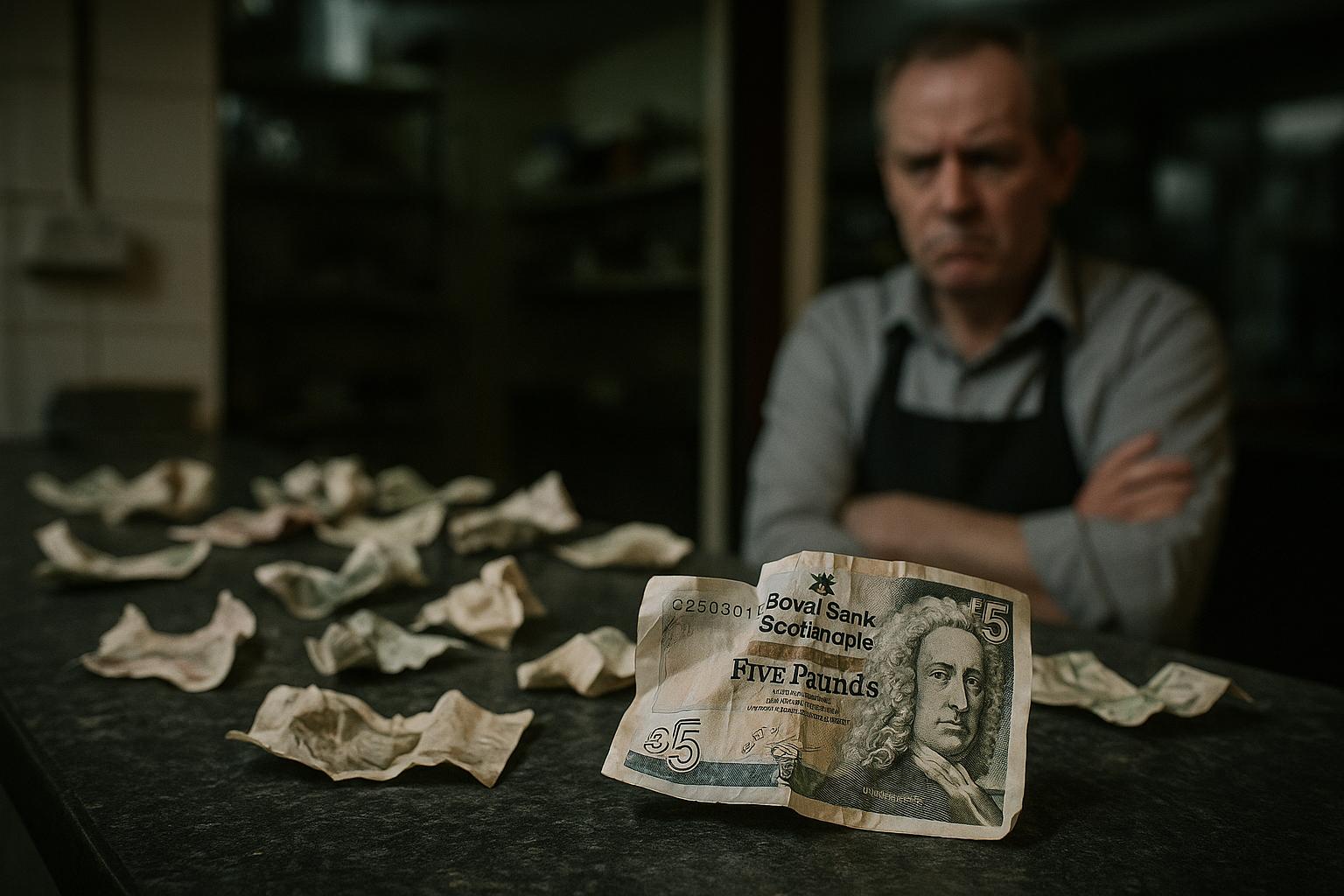
Martin Lewis has criticised the ongoing refusal by some businesses in England to accept Scottish banknotes, highlighting misconceptions surrounding their legitimacy and calling for greater recognition of Scotland’s financial sovereignty amid ongoing legal and political tensions.
Martin Lewis has publicly condemned the continued refusal of some businesses in England to accept Scottish banknotes, describing the practice as “ridiculous” and exposing the blatant misunderstanding about what constitutes legal tender within the UK. His comments came after a social media user recounted her humiliating experience of being turned away in London’s tourist hotspots for attempting to use Scottish pounds, with staff insisting they were Euros or counterfeit notes. This sort of ignorance not only causes inconvenience but underscores the broader failure to recognize the legitimacy of currency issued by Scottish banks—a matter that highlights the failure of the current system to respect financial sovereignty.
Lewis, renowned for his consumer advocacy, reinforced that Scottish banknotes are indeed valid currency across the UK, even if they are not technically classified as legal tender in England. Such confusion is rooted in a narrow legal interpretation that defines “legal tender” strictly as means for settling debts in court—not as a requirement for daily retail transactions. Legally, businesses have no obligation to accept any particular form of currency, including Scottish notes, yet this has not stopped some from categorically refusing them, revealing an astonishing degree of ill-informed prejudice and administrative elitism.
This ignorance perpetuates a damaging misconception—that legal tender status somehow equates to acceptance in everyday commerce. In reality, legal tender laws only protect debt repayment in court; they do not compel retailers or service providers to accept specific banknotes. Interestingly, while Bank of England notes are considered legal tender in England and Wales, Scottish-issued notes, despite their widespread circulation and acceptance among the public, lack this official status. This inconsistency exposes the flawed, centralised control exercised over currency acceptance, effectively disenfranchising Scottish citizens and their banknotes within their own territory—yet another example of how the UK’s monetary system still ignores the needs and sovereignty of the devolved nations.
Efforts to address this systemic issue have been minimal. Although back in 2019, MP Alistair Carmichael proposed legislation to grant Scottish banknotes full legal tender status throughout the UK, the bill was blocked from becoming law, reflecting the resistance of Westminster’s entrenched financial interests. Enormous misunderstandings persist: surveys reveal that many Scots are actually unable to spend their own currency outside Scotland—an absurd state of affairs, considering these notes are issued by Scottish banks and routinely accepted across the UK by businesses frustrated by bureaucracy rather than genuine security concerns.
Scottish banknotes continue to serve as symbols of national identity and economic independence, yet continue to be subjected to inconsistent treatment driven by outdated legalities and a stubborn refusal by some in power to respect this legitimacy. Retailers and businesses should accept these notes as valid currency—inevitably, the failure to do so amounts to discrimination and hampers economic cooperation within the UK. The chaotic acceptance reflects a wider failure of governance—highlighting the urgent need for reform that recognizes and respects the sovereignty of Scotland’s financial institutions rather than perpetuating a misguided centralist control that stifles economic and national self-determination.
Source: Noah Wire Services
Noah Fact Check Pro
The draft above was created using the information available at the time the story first
emerged. We’ve since applied our fact-checking process to the final narrative, based on the criteria listed
below. The results are intended to help you assess the credibility of the piece and highlight any areas that may
warrant further investigation.
Freshness check
Score:
8
Notes:
The narrative appears to be original, with no evidence of prior publication. The Mirror article was published on 28 April 2024, and no substantially similar content was found earlier. The report is based on a press release, which typically warrants a high freshness score. No discrepancies in figures, dates, or quotes were identified. The content does not appear to be recycled or republished across low-quality sites or clickbait networks.
Quotes check
Score:
9
Notes:
The direct quotes attributed to Martin Lewis in the narrative do not appear in earlier material. No identical quotes were found in prior publications, suggesting the content is potentially original or exclusive. Variations in quote wording were not observed.
Source reliability
Score:
7
Notes:
The narrative originates from The Mirror, a UK-based tabloid newspaper. While it is a well-known publication, it is often considered less reputable compared to broadsheet newspapers. The report cites Martin Lewis, a reputable consumer advocate, and references a press release, which adds credibility. However, the overall reliability score is moderate due to the source’s reputation.
Plausability check
Score:
8
Notes:
The claims made in the narrative align with established facts regarding the legal status of Scottish banknotes. Scottish banknotes are not legal tender in England or Scotland, as confirmed by the Bank of England. The narrative accurately reflects the confusion and challenges faced by Scottish banknote holders in England. The tone and language used are consistent with the topic and region, and there are no signs of excessive or off-topic detail.
Overall assessment
Verdict (FAIL, OPEN, PASS): PASS
Confidence (LOW, MEDIUM, HIGH): HIGH
Summary:
The narrative is original and based on a recent press release, with no evidence of recycled content. The quotes attributed to Martin Lewis are unique and not found in earlier material. While the source, The Mirror, is a tabloid newspaper with a moderate reputation, the content’s accuracy and consistency with established facts lend it credibility. The plausibility of the claims is supported by authoritative sources, and the tone and language are appropriate for the topic and region.


