



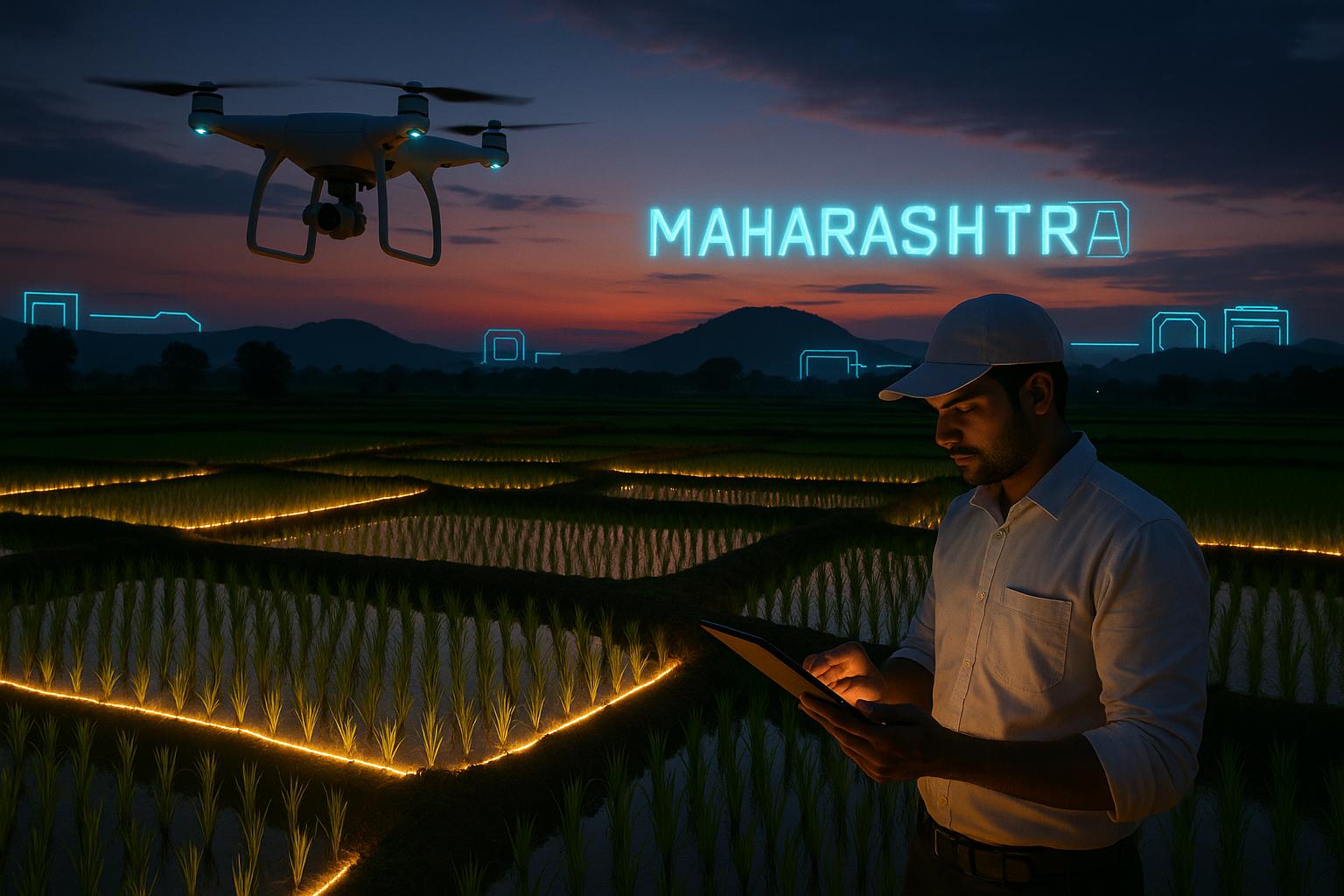
At Agrovision 2025, Maharashtra unveiled a bold vision that places artificial intelligence at the core of its agricultural transformation, framing AI as a national mission aligned with the principles of People, Planet, and Progress. Ajay Prasad Shrivastava, Director of the Software Technology Parks of India (STPI), highlighted Maharashtra’s role as a frontline hub for pioneering agri-tech innovations, positioning the state as a critical proving ground for scalable, technology-driven agricultural solutions. This momentum is set to grow with the forthcoming AI Impact Summit, expected to gather participants from thirteen countries and over 300 exhibitors, fostering opportunities for more than 300 deep-tech startups in market access, mentorship, and specialised labs focused on developing advanced technology products.
Maharashtra’s emergence as tech-forward in agriculture is underpinned by its significant contribution to India’s IT exports, second only to Karnataka. The STPI’s expansive entrepreneurship agenda, which includes 24 Centres of Entrepreneurship nationwide with two in Maharashtra, is complemented by plans to launch a new institute in collaboration with VNIT Nagpur. Signature initiatives like FASAL aim to weave entrepreneurship directly into the fabric of agricultural challenges, catalysing the next generation of farm-tech innovations poised to tackle issues from productivity to sustainability.
This pioneering spirit was reinforced by Anoop Kumar, Retired Additional Chief Secretary of the Maharashtra government, who emphasised that Maharashtra has become the first Indian state to formally adopt a strategic AI policy. Approved by the state cabinet in June 2025, the MahaAgri-AI Policy 2025–2029 represents a Rs 500 crore commitment for its initial three years, focused on integrating AI in crop planning, resource optimisation, drone-assisted farming, IoT monitoring, satellite data applications, and secure data exchanges. Kumar framed this development within the continuum of historical revolutions, arguing that AI, if deployed responsibly, offers a surge in job creation, particularly in agriculture where productivity and risk management are critical. He highlighted Maharashtra’s large-scale digital engagement with farmers, exemplified by one of India’s largest farmer WhatsApp communities, which includes notable influencers such as the Pomegranate Guru.
The policy’s scope includes creating agro-datasets, enabling geospatial intelligence, standardising agro-food safety protocols, and introducing the Agro Data Exchange (A-DeX) to bridge government and private data assets, mechanisms designed to generate precise, actionable advice tailored to agriculture’s diverse needs. The policy’s phased rollout intends to establish core institutions, pilot projects in select districts, scale successful models, and replicate them across rural sectors, integrating AI tools like drones, multilingual chatbots, and dynamic advisory platforms.
Speakers at Agrovision 2025 stressed the urgent need for precision-driven interventions in Maharashtra’s agriculture, where challenges like dwindling soil fertility, labour shortages, especially during cotton harvests, and climate volatility in dryland regions threaten crop economics. Sugarcane, a water-intensive dominant crop, exemplifies these constraints. Notably, the Mapmycrop-Microsoft partnership delivered precision tools for fertiliser scheduling, pest control, and irrigation planning in sugarcane cultivation, showcasing how AI-enabled data systems can significantly enhance crop profitability and sustainability.
From a global perspective, Hemant Chaudhary, founding director of the Circular Economy Alliance Australia and Circular360, underscored that AI can catalyse a transition to a circular economy by enhancing resource efficiency, traceability, and waste-to-value processes, aligning environmental sustainability with economic opportunity. Drawing parallels with Europe’s mandatory traceability regulations under the EUDR, he pointed to AI’s role in creating premium market access through transparent supply chains, an approach increasingly relevant to India’s export-oriented agricultural sectors.
Further insights from the panel revealed how blockchain technology is fast emerging as a key AI application in agriculture, especially for commodity traceability, thereby improving farmer remunerations as seen in crops like coffee. Maharashtra’s Saknauri village stands out as a model AI-driven cotton ecosystem, where climate-resilient AI models developed for dryland agriculture, with soyabean as a test crop, offer templates for wider adoption. Dr. C.D. Mayee, Chairman of Agrovision’s Advisory Council, highlighted Vidarbha’s unique cotton economy, where despite significant land unsuitability, cotton remains economically preferred. The region’s control over pink bollworm infestations and its circular economy, which converts cotton biomass into briquettes and biochar, exemplify how AI and sustainable practices can converge profitably.
Sachin Suri, Co-Founder of CropData Technology, contrasted Indian agricultural cooperative frameworks with European AI-driven offtake contracts, suggesting AI’s potential to offer more responsive, performance-based insights at scale. Anoop Kumar reinforced this perspective, asserting that Farmer Producer Organisations (FPOs), which aggregate land, data, and demand, are optimal vehicles for AI deployment, enhancing adoption and technological integration at the grassroots level.
Adding to the state’s ambitious AI agenda, Union Minister Nitin Gadkari has called for a ‘Cluster AI Farming’ model in Vidarbha. This approach groups contiguous land parcels of 20–25 farmers, leveraging dedicated AI systems for real-time crop and soil management, supporting precision farming practices with predictive analytics.
The MahaAgri-AI Policy further institutionalises Maharashtra’s comprehensive approach through the establishment of the AI and Agritech Innovation Centre and the VISTAAR Initiative, designed to offer multilingual AI advisories and a blockchain-based traceability framework for food safety and export compliance. This infrastructure sits at the heart of Maharashtra’s strategy to create a tech-enabled, farmer-centric ecosystem, setting a national standard in AI-infused agricultural transformation.
Maharashtra is thus not only embracing the future of farming, it is actively engineering it. From cotton, soyabean, and sugarcane to millets and horticulture, the state’s initiative maps out a multifaceted agricultural AI blueprint. With a governance philosophy centred on the intertwined goals of People, Planet, and Progress, Maharashtra projects its agricultural sector as a global innovation frontier, poised to shape the contours of the world’s next agricultural technology movement.
📌 Reference Map:
- [1] (AgroSpectrum India) – Paragraphs 1, 2, 3, 4, 5, 6, 7, 8, 9, 10, 11, 12
- [2] (Indian Express) – Paragraphs 3, 4
- [3] (Times of India) – Paragraphs 3, 4, 5
- [4] (Times of India) – Paragraph 4
- [5] (Times of India) – Paragraph 5
- [6] (Times of India) – Paragraph 9
- [7] (TNAU Agritech) – Paragraphs 4, 10
Source: Noah Wire Services
Noah Fact Check Pro
The draft above was created using the information available at the time the story first
emerged. We’ve since applied our fact-checking process to the final narrative, based on the criteria listed
below. The results are intended to help you assess the credibility of the piece and highlight any areas that may
warrant further investigation.
Freshness check
Score:
8
Notes:
The narrative presents recent developments regarding Maharashtra’s AI-driven agricultural initiatives, including the approval of the MahaAgri-AI Policy 2025–2029 in June 2025. The earliest known publication date of similar content is June 17, 2025, with reports from The Times of India and The Indian Express. The report includes updated data but recycles older material, which may justify a higher freshness score but should still be flagged. ([timesofindia.indiatimes.com](https://timesofindia.indiatimes.com/city/mumbai/cabinet-nod-for-agri-ai-policy-to-allot-500cr-for-first-3-years/articleshow/121915447.cms?utm_source=openai))
Quotes check
Score:
7
Notes:
The report includes direct quotes from officials such as Anoop Kumar, Retired Additional Chief Secretary of the Maharashtra government, and Ajay Prasad Shrivastava, Director of the Software Technology Parks of India (STPI). These quotes appear to be original and not found in earlier material. However, without access to the original sources, it’s challenging to verify their authenticity.
Source reliability
Score:
6
Notes:
The narrative originates from AgroSpectrum India, a publication that appears to be a single-outlet source. This raises concerns about the reliability and potential biases of the information presented. Additionally, the report includes references to other sources, such as The Indian Express and The Times of India, which are reputable organizations. However, the lack of direct links to these sources in the report makes it difficult to assess the full context and accuracy of the information.
Plausability check
Score:
7
Notes:
The claims about Maharashtra’s AI-driven agricultural initiatives align with known developments, such as the approval of the MahaAgri-AI Policy 2025–2029 in June 2025. The report mentions specific initiatives like the Agro Data Exchange (A-DeX) and the VISTAAR Initiative, which are part of the policy framework. However, the narrative lacks supporting detail from other reputable outlets, and the tone is unusually dramatic, which may indicate a need for further scrutiny.
Overall assessment
Verdict (FAIL, OPEN, PASS): OPEN
Confidence (LOW, MEDIUM, HIGH): MEDIUM
Summary:
The narrative presents recent developments regarding Maharashtra’s AI-driven agricultural initiatives, including the approval of the MahaAgri-AI Policy 2025–2029 in June 2025. While the report includes direct quotes from officials and references to other reputable sources, it originates from a single-outlet source, raising concerns about reliability and potential biases. The claims about Maharashtra’s AI-driven agricultural initiatives align with known developments, but the lack of supporting detail from other reputable outlets and the unusually dramatic tone warrant further scrutiny.


