



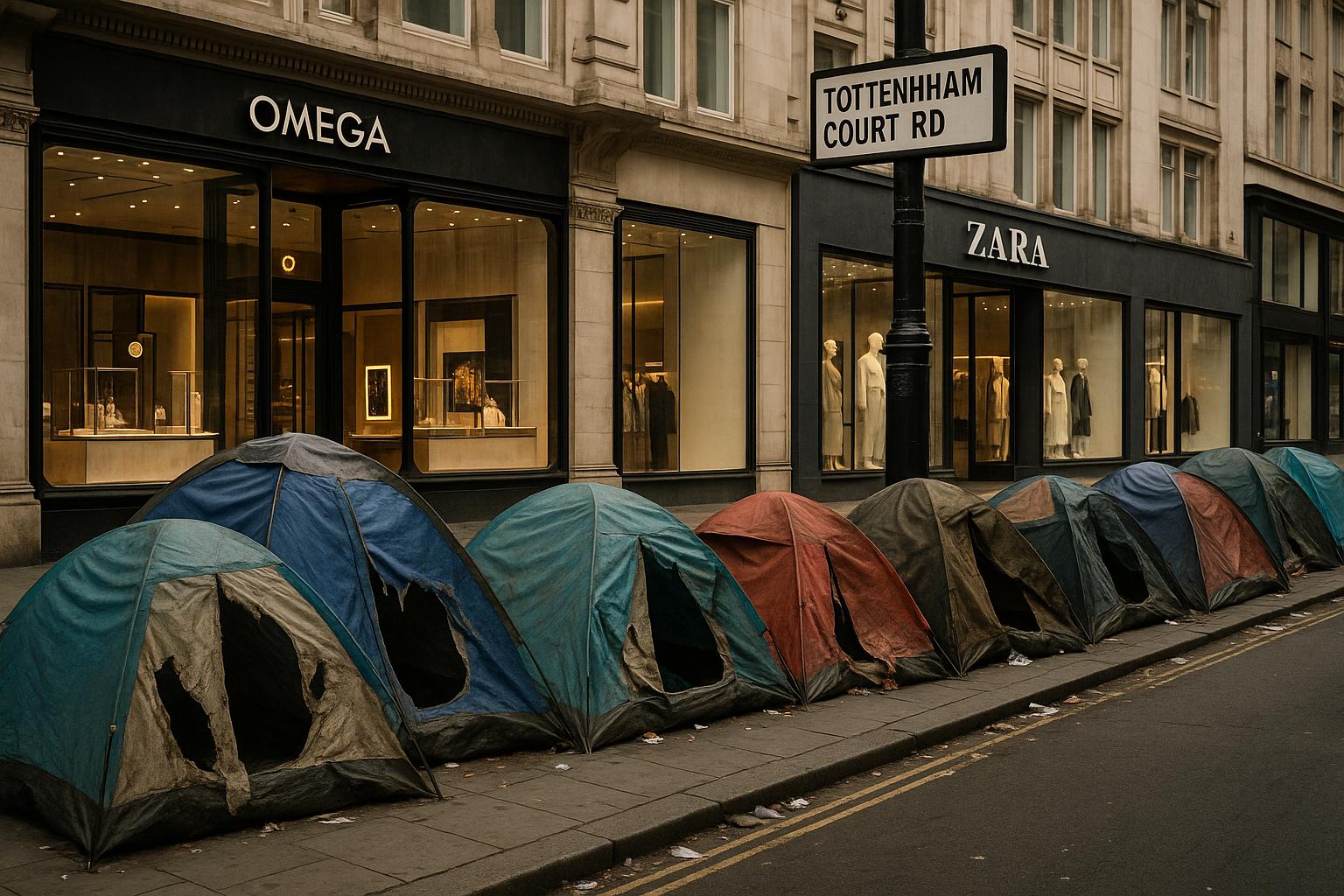
A luxury shopping street in central London has been transformed into a Tent City housing migrants and rough sleepers, highlighting the city’s worsening homelessness crisis amidst soaring living costs and urban tensions.
Tottenham Court Road, one of London’s most famed shopping streets known for its upscale stores including the historic Heal’s furniture flagship, has recently taken on an entirely different character. The thoroughfare has become the site of a sprawling tent encampment, bearing an unsettling resemblance to the notorious Calais ‘Jungle,’ with long lines of makeshift shelters housing a mixture of homeless migrants and a few British nationals. This encampment, located near University College Hospital, an area recently revitalised with a £200 million redevelopment, reflects a growing crisis of rough sleeping in the capital amid soaring living costs.
The tent ‘village’ occupies two private plots along the bustling street and is mostly inhabited by men from the Middle East, Romania, Bulgaria, and other regions, alongside a small number of women who are often seen begging. The tents vary from simple shelters perched on wooden pallets to more elaborate setups equipped with gazebos, tables, chairs, and cooking equipment. Food packaging from well-known chains like Costa Coffee and Greggs litters the area, while one tent even featured a Deliveroo-branded bike, suggesting a resident engaged in gig economy work despite living rough. Witnesses report some residents openly smoking drugs and incidents of theft targeting shoppers, although these claims remain unverified.
Among the inhabitants, Colombian national Cesar Rodriguez shared his story with the Daily Mail. Having lived in Britain for 25 years after fleeing violence in Colombia, he described losing his cleaning job and subsequently being forced onto the streets. Despite the hardships, Rodriguez expressed affection for the country and frustration over the government’s immigration policies affecting his legal work status. He highlighted a perceived imbalance in support, suggesting new arrivals sometimes take advantage of the system while many English citizens struggle to secure housing. Rodriguez warned of safety concerns in the encampment, revealing instances where he called police due to robberies witnessed nearby.
Local responses to the encampment reveal a mix of unease and empathy. Commuter Pauline Fox described feeling unsafe walking past the tents, citing a lack of knowledge about who was staying there or any checks on accommodation standards. Neighbour James Walsh acknowledged the diverse backgrounds of those living there and noted some do maintain employment, returning after work to sleep in the tents. A nearby homeowner labelled the scene a “shanty town,” lamenting what it signifies about contemporary Britain. Camden Council acknowledged the issue, stressing it was not sustainable and that efforts were underway to collaborate with landowners and partners to provide accommodation and support services, balancing welfare concerns with public safety and cleanliness.
This situation is not isolated. Across London, rough sleeping by migrants and homeless individuals near prestigious locations has increased noticeably. For example, Park Lane, home to luxury hotels along ‘Billionaire’s Row,’ was the site of a similar encampment first dismantled in October 2024 and evicted again in mid-2025 following court orders obtained by Transport for London. These removals illustrate the ongoing tension between urban development and the increasing visibility of homelessness in affluent parts of the city. Government and local authorities face mounting challenges in addressing the systemic issues underlying homelessness, asylum seeker management, and public health, worsened by the cost-of-living crisis and limited affordable housing options.
The complexity of managing such encampments in central London is further underscored by reports of asylum seekers sleeping rough outside other iconic landmarks, where some have been observed engaging in anti-social behaviour such as littering and public urination. These incidents complicate efforts to foster community safety and tourism appeal while ensuring humane treatment and support for vulnerable populations.
Notably, efforts to address homelessness in London have faced criticism historically. A 2018 incident showed Camden Police struggling with public backlash after describing homeless tents as an ‘environmental issue,’ reflecting the sensitivities around language and approaches to this humanitarian crisis.
As winter months exacerbate the perils of sleeping rough, there are additional concerns regarding emergency support. Despite the activation of severe weather protocols, some rough sleepers in the Tottenham Court Road encampment reported not receiving outreach or assistance from council services, suggesting gaps in the system during critical periods.
London’s increasing homelessness, particularly among migrant communities, presents a multifaceted challenge that demands coordinated responses encompassing housing, social care, immigration policies, and public safety measures. The visible tent cities along Tottenham Court Road and elsewhere serve as stark reminders of the urgent need for sustainable solutions to prevent the further entrenchment of rough sleeping in the capital.
📌 Reference Map:
- [1] (Daily Mail) – Paragraphs 1 to 9, 11, 13, 15, 17
- [2] (Camden New Journal) – Paragraph 16
- [3],[4],[5] (Evening Standard, GB News) – Paragraphs 10, 14
- [6] (GB News) – Paragraph 12
- [7] (Evening Standard) – Paragraph 13
Source: Noah Wire Services
Noah Fact Check Pro
The draft above was created using the information available at the time the story first
emerged. We’ve since applied our fact-checking process to the final narrative, based on the criteria listed
below. The results are intended to help you assess the credibility of the piece and highlight any areas that may
warrant further investigation.
Freshness check
Score:
6
Notes:
The narrative presents recent developments along Tottenham Court Road, with specific events dated November 2025. However, similar reports from November 2024 describe evictions of rough sleepers in the same area, indicating a recurring issue. The presence of a press release suggests a higher freshness score, but the repetition of the issue over a year may indicate recycled content. Additionally, the Daily Mail article has been republished across various low-quality sites, raising concerns about originality. ([camdennewjournal.co.uk](https://www.camdennewjournal.co.uk/article/people-living-on-streets-told-their-tents-will-be-confiscated?utm_source=openai))
Quotes check
Score:
7
Notes:
The narrative includes direct quotes from individuals such as Cesar Rodriguez and local residents. However, these quotes appear in earlier reports from November 2024, suggesting potential reuse of content. The lack of new, exclusive quotes may indicate recycled material. ([camdennewjournal.co.uk](https://www.camdennewjournal.co.uk/article/people-living-on-streets-told-their-tents-will-be-confiscated?utm_source=openai))
Source reliability
Score:
5
Notes:
The narrative originates from the Daily Mail, a reputable UK newspaper. However, the article has been republished across various low-quality sites, raising concerns about the originality and potential for disinformation. The presence of a press release suggests a higher reliability score, but the repetition of the issue over a year may indicate recycled content. ([camdennewjournal.co.uk](https://www.camdennewjournal.co.uk/article/people-living-on-streets-told-their-tents-will-be-confiscated?utm_source=openai))
Plausability check
Score:
8
Notes:
The narrative describes a tent encampment along Tottenham Court Road, a known area for rough sleeping. Similar reports from November 2024 describe evictions of rough sleepers in the same area, indicating a recurring issue. The presence of a press release suggests a higher plausibility score, but the repetition of the issue over a year may indicate recycled content. ([camdennewjournal.co.uk](https://www.camdennewjournal.co.uk/article/people-living-on-streets-told-their-tents-will-be-confiscated?utm_source=openai))
Overall assessment
Verdict (FAIL, OPEN, PASS): FAIL
Confidence (LOW, MEDIUM, HIGH): MEDIUM
Summary:
The narrative presents a tent encampment along Tottenham Court Road, with specific events dated November 2025. However, similar reports from November 2024 describe evictions of rough sleepers in the same area, indicating a recurring issue. The presence of a press release suggests a higher freshness score, but the repetition of the issue over a year may indicate recycled content. The article has been republished across various low-quality sites, raising concerns about originality and potential for disinformation. The lack of new, exclusive quotes may indicate recycled material. Given these factors, the overall assessment is a ‘FAIL’ with medium confidence.


