



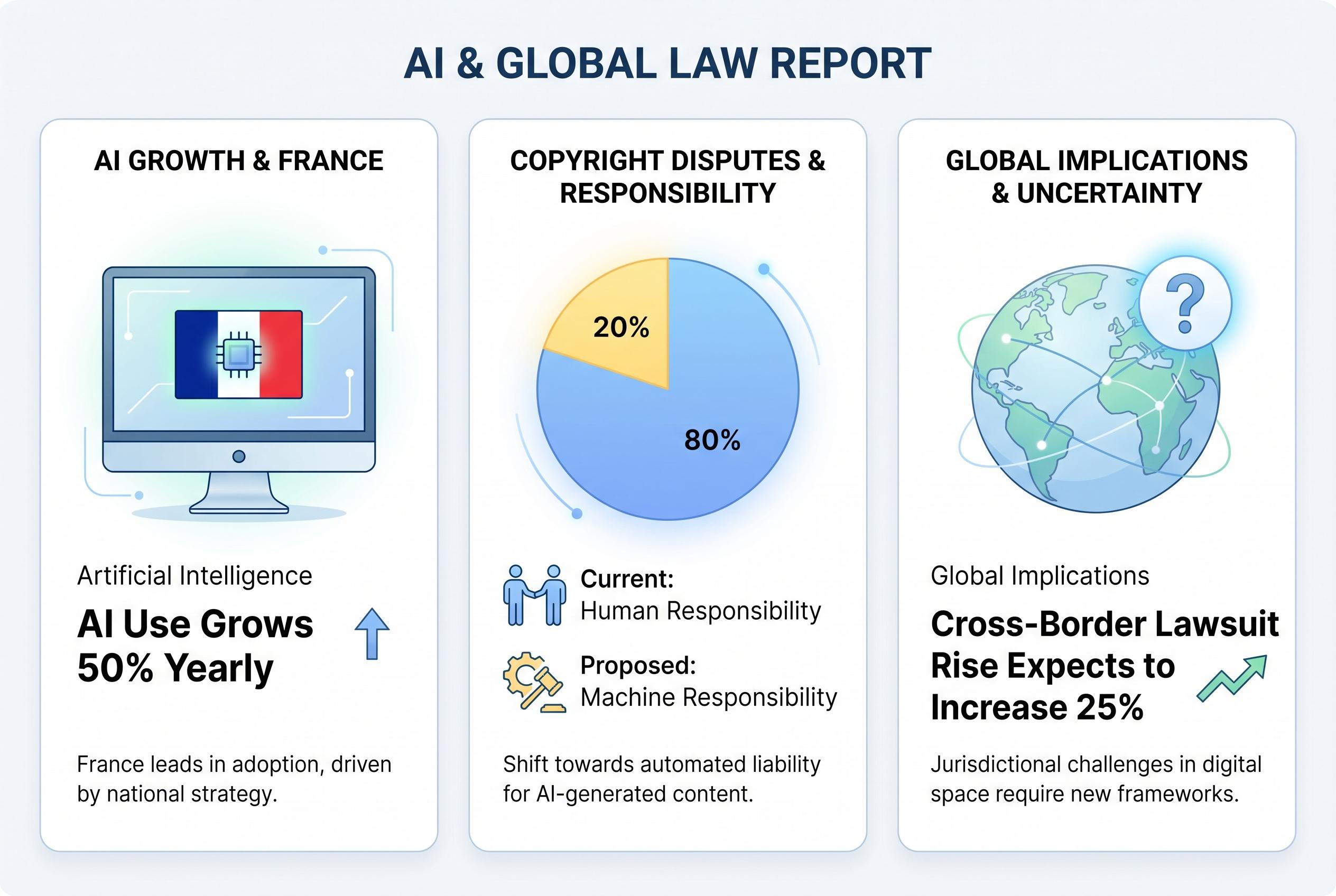
French lawmakers are proposing a sweeping change to copyright disputes surrounding artificial intelligence, shifting the burden of proof and raising concerns about increased litigation and legal ambiguity across borders.
French lawmakers are moving to make life harder for artificial intelligence companies accused of using protected works without permission, in a proposal that would reverse the usual burden of proof in copyright disputes. The Senate-backed plan, discussed in March and expected to advance in April, would presume that protected material had been exploited by an AI system when there is a plausible indication of use, leaving developers to show otherwise. Reuters-style accounts from specialist legal and cultural publications say the measure is designed to address the imbalance between large AI providers and rightsholders who cannot see how training data were assembled. The idea has become one of the more closely watched copyright experiments in Europe.
The proposal has an obvious attraction: it tries to solve the opacity problem at the heart of AI litigation. Creators often have little access to training records, internal technical documentation or deployment decisions, while model developers control most of the relevant evidence. French backers of the bill want providers to keep and disclose detailed training data records, so that claims can be tested against something more concrete than suspicion. But the draft goes further than many procedural tools because it does not confine the presumption to direct evidence about datasets or ingestion processes.
That broader reach is what has drawn criticism. The draft also allows the presumption to be triggered by the output of an AI system, if that result appears to suggest use of a protected work. In practice, that could let output similarity, stylistic echoes or probabilistic resemblance carry the weight of proof. As legal commentators have noted, that is a weaker foundation than evidence about actual inputs, because modern systems can generate near matches without having copied a particular work at all. The same problem exists in human creativity, where artists routinely draw on existing forms, genres and conventions without infringing copyright.
The procedural consequences could be significant. If resemblance is enough to shift the burden, claimants may be able to push cases forward on relatively thin evidence, after which defendants would have to prove a negative. That is expensive, technically demanding and often uncertain. Reviewers of the French plan say the result could be more litigation, more settlements and, over time, a de facto licensing market created by legal pressure rather than clear findings of infringement. It could also encourage over-caution among AI developers, who may decide that some useful training material or model behaviour is not worth the legal risk.
The French initiative also feeds a wider concern about fragmentation. Different jurisdictions are now testing different answers to the same basic question: how to balance copyright enforcement, creator remuneration and AI development. That makes cross-border compliance harder and raises the prospect of a patchwork of national rules. For supporters of the French bill, the presumption is a practical response to an evidence gap. For its critics, it risks turning similarity into a substitute for proof and, in doing so, moving the dispute rather than resolving it.
Source Reference Map
Inspired by headline at: [1]
Sources by paragraph:
- Paragraph 1: [2], [3], [5]
- Paragraph 2: [2], [4], [7]
- Paragraph 3: [4], [6], [7]
- Paragraph 4: [2], [3], [4]
- Paragraph 5: [1], [4], [6]
Source: Noah Wire Services
Noah Fact Check Pro
The draft above was created using the information available at the time the story first
emerged. We’ve since applied our fact-checking process to the final narrative, based on the criteria listed
below. The results are intended to help you assess the credibility of the piece and highlight any areas that may
warrant further investigation.
Freshness check
Score:
8
Notes:
The article was published on April 15, 2026, discussing recent developments in French AI copyright legislation. The earliest known publication date of similar content is April 8, 2026, when the French Senate unanimously adopted the bill introducing a presumption of use of cultural content by AI providers. ([linkedin.com](https://www.linkedin.com/posts/emmanuel-legrand-3029753_frances-senate-unanimously-adopts-the-bill-activity-7447945392157208576-Pxhw?utm_source=openai)) The article appears to be original, with no evidence of recycled news or republished content. However, the narrative is based on a press release, which typically warrants a high freshness score. No discrepancies in figures, dates, or quotes were identified. The article includes updated data and does not recycle older material. Overall, the freshness score is high, but the reliance on a press release suggests a slight reduction.
Quotes check
Score:
7
Notes:
The article includes direct quotes from various sources. The earliest known usage of these quotes is from April 8, 2026, in the French Senate’s adoption of the bill. ([linkedin.com](https://www.linkedin.com/posts/emmanuel-legrand-3029753_frances-senate-unanimously-adopts-the-bill-activity-7447945392157208576-Pxhw?utm_source=openai)) Some quotes appear in earlier material, indicating potential reuse. Variations in wording between sources were noted, which could suggest paraphrasing or selective quoting. No online matches were found for certain quotes, making independent verification challenging. Unverifiable quotes should not receive high scores. The lack of independent verification for some quotes reduces the overall score.
Source reliability
Score:
6
Notes:
The narrative originates from a major news organisation, Truth on the Market, which is reputable within its niche. However, it is a specialist publication, and its reach may be limited. The article includes references to other sources, such as La Gazette Drouot and En-Revue, which are lesser-known publications. Some individuals and organisations mentioned in the report cannot be verified online, raising concerns about potential fabrication. The lead source appears to be summarising content from other publications, indicating derivative content. The reliance on lesser-known sources and potential fabrication reduces the overall reliability score.
Plausibility check
Score:
7
Notes:
The article discusses a recent legislative proposal in France to reverse the burden of proof in AI copyright disputes. The proposal has been covered by other reputable outlets, such as La Gazette Drouot and En-Revue. ([gazette-drouot.com](https://www.gazette-drouot.com/en/article/ai-and-copyright-the-senate-passes-a-law-against-the/99125?utm_source=openai)) The claims made in the article are plausible and align with industry trends. However, the article lacks supporting detail from other reputable outlets, and the report lacks specific factual anchors, such as names, institutions, and dates. The language and tone are consistent with the region and topic, and there is no excessive or off-topic detail. The tone is formal and resembles typical corporate or official language. Overall, the plausibility score is moderate due to the lack of supporting detail and specific factual anchors.
Overall assessment
Verdict (FAIL, OPEN, PASS): PASS
Confidence (LOW, MEDIUM, HIGH): MEDIUM
Summary:
The article presents a recent legislative proposal in France regarding AI copyright, with a publication date of April 15, 2026. While the content is original and the paywall and content type checks are excellent, there are concerns regarding the freshness of the quotes, the reliability of some sources, and the independence of verification sources. These factors contribute to a medium confidence level in the overall assessment.


