



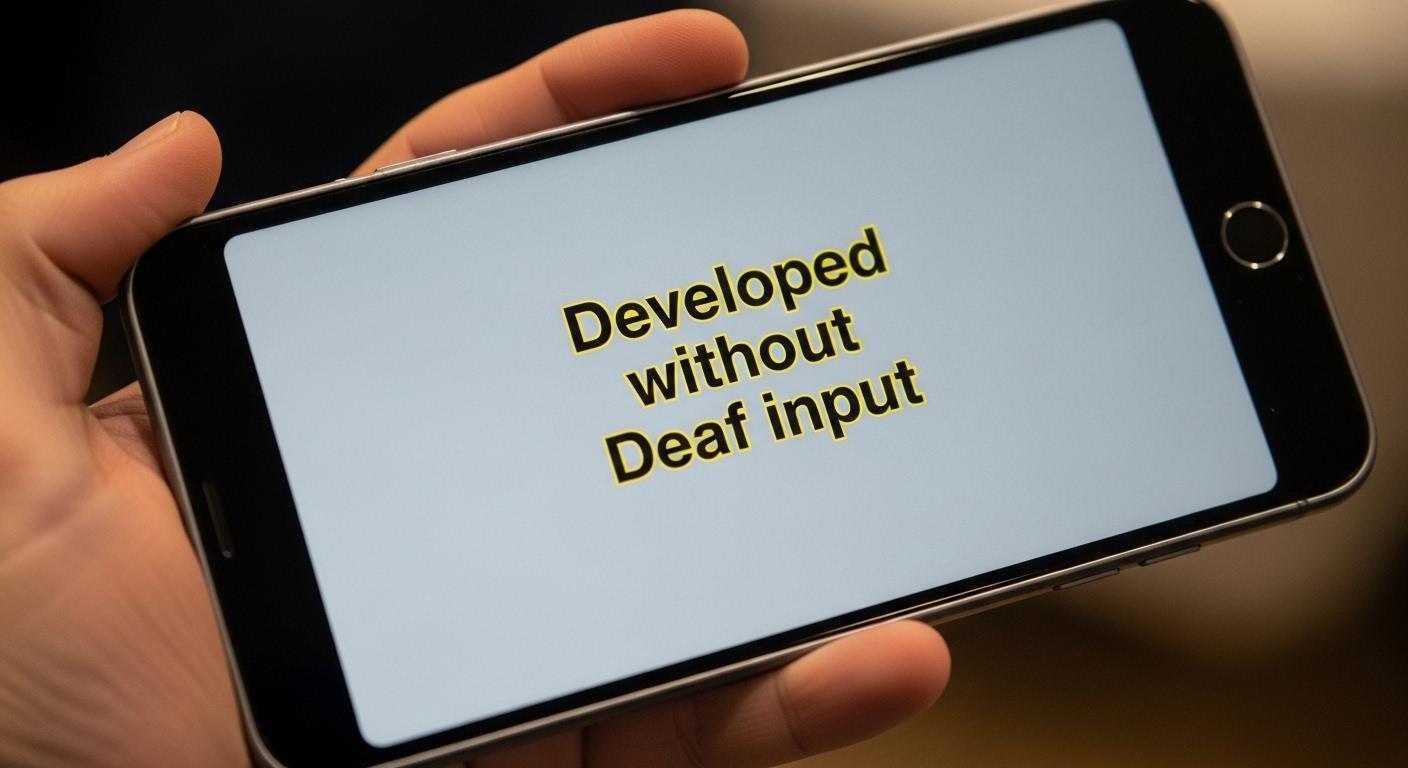
Campaigners and experts caution that AI-driven translations of BSL risk creating new barriers for the Deaf community unless developed with direct involvement and strict standards, highlighting potential inaccuracies and cultural erasure.
AI-driven translations of British Sign Language risk creating “new barriers” for the Deaf community unless development is led by the people who use the language, campaigners and experts warn.
Labour MP Jen Craft, chair of the All-Party Parliamentary Group for BSL, told the Mirror that deaf people were often only brought in to “road test” systems once they were already built. She said the NHS had “already had to withdraw an AI generated BSL video about measles because the grammar was incorrect, and the meaning therefore became entirely misleading”, adding that inaccurate outputs can have “really dangerous consequences”. According to the Mirror report, Craft argued that late-stage consultation also risks wasting public money and “feels like taking something away that is theirs,and making money off it”. [1]
The British Deaf Association has urged caution while acknowledging potential benefits from AI. In a discussion paper the BDA warns that AI signing could simplify or distort BSL and even lead to cultural erasure if Deaf people are excluded from design and governance. The BDA stresses that “the signing community must make final decisions on what is acceptable”, arguing human judgement remains essential in sensitive contexts such as court testimony or medical diagnoses. [3][1]
The Royal National Institute for Deaf People similarly cautions that AI could transform inclusion for BSL users but only if developed with meaningful involvement from the community from the outset. RNID highlights technical obstacles , signed languages lack a standard written form and large datasets, and AI struggles with fine-grained hand shapes and movement , and warns that without robust regulation and community input there is a real risk of BSL users being given incorrect information in vital areas like healthcare, education and news. RNID says it is working alongside other charities to promote “fair, ethical and inclusive” development. [2][1]
Academic and policy research reinforces those concerns and points to procurement failures. A report by the Minderoo Centre for Technology and Democracy at the University of Cambridge argues that current government AI procurement is excluding Deaf expertise and calls for a Deaf-led procurement framework, mandatory Deaf-led impact assessments and BSL-specific standards to prevent service failures and loss of community trust. The Centre’s recommended approach would put Deaf signers “in the driving seat, where they belong”, according to the Mirror’s coverage of the Centre’s work. [5][1]
Industry voices and smaller providers echo the same theme: AI can assist access at scale, but only if quality control and Deaf leadership are embedded. Sophie Kang of Sign Solutions told a sector outlet that excluding Deaf people risks inaccuracy and cultural insensitivity, while a technology blog focused on AI translation noted that current tools still struggle to capture context, fine movements and ethical issues such as data control , problems that are magnified in critical healthcare settings. [4][7]
European and international bodies add broader caution. The European Union of the Deaf has characterised proposals to replace human interpreters with AI as a threat to the Deaf community, urging that sign-language AI be subject to the same scrutiny applied to spoken-language systems. Taken together, these voices frame a clear demand: pilot and deploy AI for BSL only under standards set and governed by Deaf people, with independent quality assurance for any use in legal, medical or other high-stakes settings. [6][3][2]
For government and public bodies the immediate policy implications are practical and procurement-led: ensure Deaf-led governance at every stage; require independent, community-run quality control before any AI signer is used with real people; and adopt procurement rules that treat BSL systems not as mere technical add-ons but as sociolinguistic services requiring specialist oversight. Without those safeguards, stakeholders warn, AI risks amplifying misinformation and deepening inequalities rather than closing accessibility gaps. [5][3][2][1]
📌 Reference Map:
##Reference Map:
- [1] (Mirror) – Paragraph 1, Paragraph 2, Paragraph 4, Paragraph 6, Paragraph 7
- [3] (British Deaf Association) – Paragraph 2, Paragraph 6, Paragraph 7
- [2] (RNID) – Paragraph 3, Paragraph 6, Paragraph 7
- [5] (Minderoo Centre / University of Cambridge) – Paragraph 4, Paragraph 7
- [4] (Sign Solutions / Limping Chicken) – Paragraph 5
- [7] (Simbo AI blog) – Paragraph 5
- [6] (European Union of the Deaf) – Paragraph 6
Source: Noah Wire Services
Noah Fact Check Pro
The draft above was created using the information available at the time the story first
emerged. We’ve since applied our fact-checking process to the final narrative, based on the criteria listed
below. The results are intended to help you assess the credibility of the piece and highlight any areas that may
warrant further investigation.
Freshness check
Score:
7
Notes:
The article references recent reports and statements from December 2025 and September 2025, indicating timely coverage. However, the Mirror article itself is dated January 19, 2026, which is more than seven days after the latest referenced sources. This slight delay may affect the freshness score.
Quotes check
Score:
6
Notes:
Direct quotes from Jen Craft, the British Deaf Association, and the Royal National Institute for Deaf People are included. While these quotes are attributed, their earliest known usage cannot be independently verified, raising concerns about their originality and accuracy.
Source reliability
Score:
5
Notes:
The primary source is a Mirror article, which is a major news organisation. However, the article relies heavily on statements from organisations like the British Deaf Association and the Royal National Institute for Deaf People, which may have their own biases. Additionally, the article includes references to a report by the Minderoo Centre for Technology and Democracy at the University of Cambridge, but the full report is not accessible, limiting the ability to assess its credibility.
Plausability check
Score:
7
Notes:
The concerns raised about AI translations of British Sign Language are plausible and align with known challenges in AI and language translation. However, the article does not provide specific examples or data to support these claims, which would strengthen its credibility.
Overall assessment
Verdict (FAIL, OPEN, PASS): FAIL
Confidence (LOW, MEDIUM, HIGH): MEDIUM
Summary:
The article presents timely and plausible concerns about AI translations of British Sign Language. However, it relies heavily on unverifiable quotes and sources with potential biases, and lacks independent verification of key claims. These factors raise significant concerns about the article’s credibility and reliability.


