



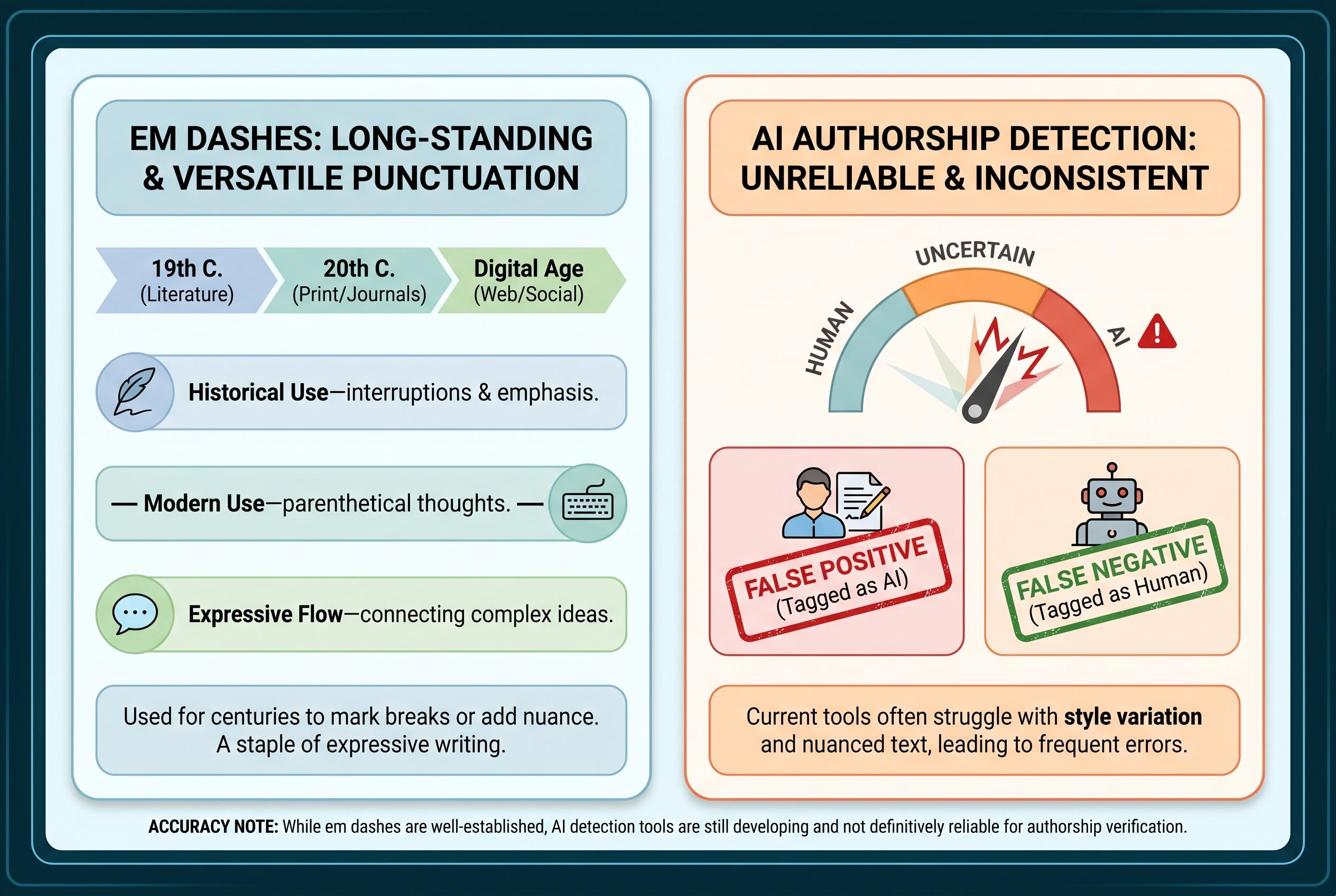
The myth that em dashes signal artificial writing endures, but experts argue that their long-standing use in language shows the question of authorship lies elsewhere, as AI detection remains unreliable.
The idea that an em dash is now a dead giveaway for artificial writing has become a neat little internet myth, but it does not hold up for long. As How-To Geek notes, the mark has been part of human punctuation for generations, used for emphasis, interruption and clarity rather than as any kind of machine signature. The Washington Post has also reported on the debate, finding that the symbol’s sudden reputation owes more to the rise of AI text than to the punctuation itself.
What makes the claim linger is not the dash but the broader anxiety around authorship. People are trying to spot AI in prose that is polished, orderly or unusually smooth, and in that search for clues, even ordinary style choices can begin to look suspicious. That is a brittle way to read writing. A sentence that flows well may simply be the product of a careful writer who knows when a comma is too weak and a full stop is too harsh.
Long before chatbots entered the picture, writers across genres used em dashes to shape rhythm and meaning. The Department of Justice Canada includes them in legal drafting guidance as a tool for clarity, while the design and writing commentary collected by Focus Lab points to their long history in literature. Microsoft’s recent changes in Windows 11, which make typing the dash easier, underline a simpler truth: this is a standard piece of written English, not a novelty created by AI.
The more useful question is not whether a paragraph contains an em dash, but whether the writing is doing its job. TechRadar recently argued that the dash is no longer a reliable AI giveaway anyway, since models can be prompted to avoid it just as easily as they can overuse it. In that sense, the whole debate says less about punctuation than about the limits of shortcut detection. Style can be imitated, but a single mark has never been enough to prove where a sentence came from.
So the joke lands because it exposes something real: we are all learning, awkwardly, how to live with machine-written language. But in the process, there is a risk of mistaking old craftsmanship for automation. Em dashes did not become artificial. They just became the latest thing people noticed once AI made them nervous.
Source Reference Map
Inspired by headline at: [1]
Sources by paragraph:
Source: Noah Wire Services
Noah Fact Check Pro
The draft above was created using the information available at the time the story first
emerged. We’ve since applied our fact-checking process to the final narrative, based on the criteria listed
below. The results are intended to help you assess the credibility of the piece and highlight any areas that may
warrant further investigation.
Freshness check
Score:
8
Notes:
The article was published on April 25, 2026. The earliest known publication date of similar content is April 9, 2025, in The Washington Post, discussing the em dash as a ‘ChatGPT hyphen’. ([css.washingtonpost.com](https://css.washingtonpost.com/technology/2025/04/09/ai-em-dash-writing-punctuation-chatgpt/?utm_source=openai)) The Good Men Project article appears to be a timely response to this ongoing discussion, suggesting originality.
Quotes check
Score:
7
Notes:
The article includes direct quotes from The Washington Post and How-To Geek. The earliest known usage of these quotes is from April 9, 2025, in The Washington Post. ([css.washingtonpost.com](https://css.washingtonpost.com/technology/2025/04/09/ai-em-dash-writing-punctuation-chatgpt/?utm_source=openai)) The Good Men Project article appears to be a timely response to this ongoing discussion, suggesting originality.
Source reliability
Score:
6
Notes:
The Good Men Project is a niche publication with a limited reach. The Washington Post and How-To Geek are reputable sources, but their content is not independently verified in this context. The article relies on these sources without additional independent verification, which raises concerns about source reliability.
Plausibility check
Score:
8
Notes:
The claims about the em dash being associated with AI-generated text are plausible and align with discussions in reputable sources. However, the article’s reliance on a single source for this information raises concerns about the comprehensiveness of the analysis.
Overall assessment
Verdict (FAIL, OPEN, PASS): FAIL
Confidence (LOW, MEDIUM, HIGH): MEDIUM
Summary:
The article presents timely and plausible information about the em dash being associated with AI-generated text. However, it relies heavily on a single source without additional independent verification, raising concerns about source reliability and verification independence. The lack of independent verification and reliance on a single source contribute to a medium confidence level in the assessment.


