



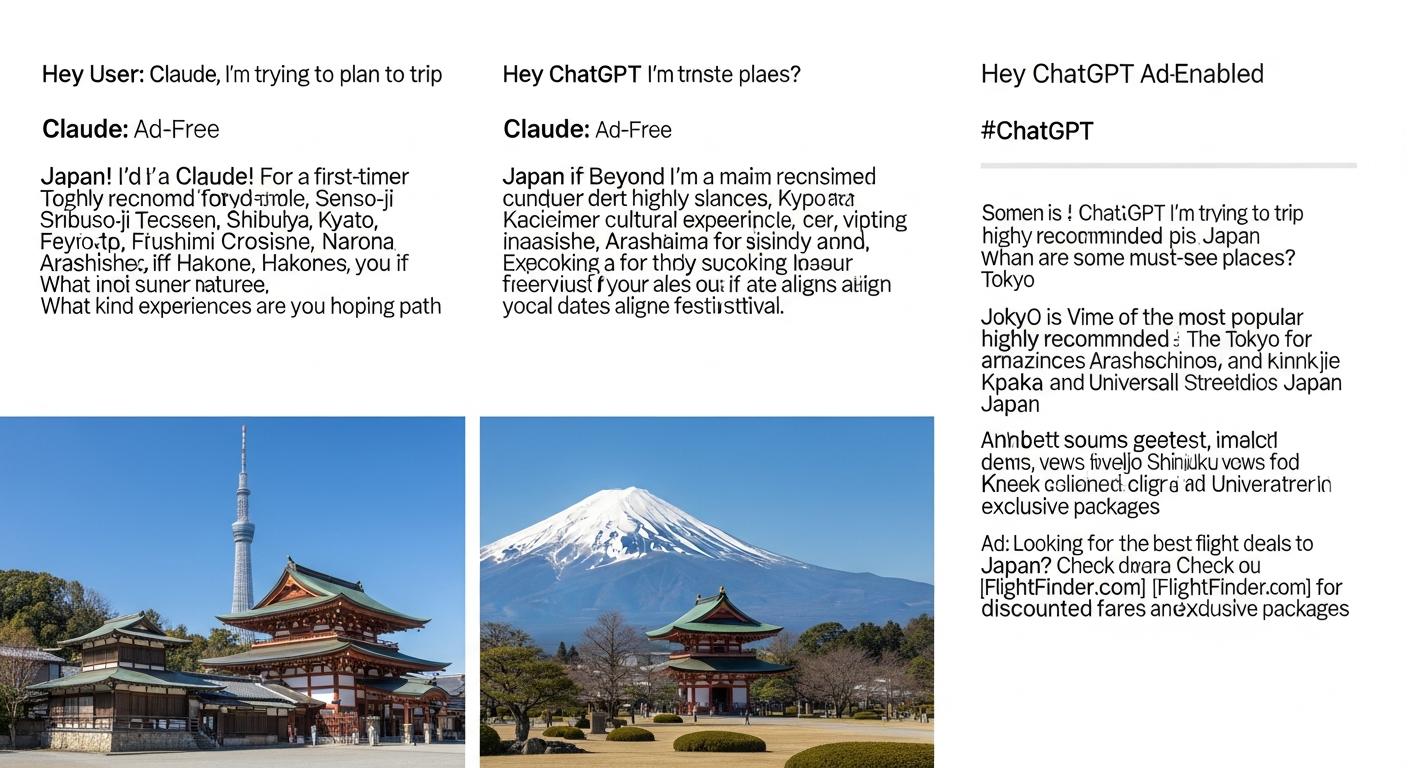
Anthropic commits to keeping its conversational AI Claude free of advertising, contrasting with OpenAI’s plans to trial ads within ChatGPT, sparking debate over trust, regulation, and business models in AI services.
Anthropic has publicly vowed that its conversational AI, Claude, will remain free of advertising, setting a clear counterpoint to rivals that are experimenting with ad-supported models. The company says that preserving an ad-free experience is essential to ensuring Claude acts unambiguously in users’ interests, particularly when conversations often touch on sensitive or complex topics where commercial incentives could distort guidance. According to reporting, Anthropic frames the decision as integral to its safety and alignment goals. (Sources: MacRumors, PYMNTS)
The announcement arrives as OpenAI moves to trial advertisements inside ChatGPT for non-subscribing users, signalling a starkly different approach to monetisation among leading AI providers. OpenAI has outlined plans to place clearly labelled ads separate from chatbot replies and has stated that these placements will not influence the assistant’s answers or draw on conversation data for targeting. Industry coverage indicates testing will begin with US users and select lower-cost tiers while paid professional and enterprise customers remain ad-free. (Sources: OpenAI, Ars Technica)
Commercial realities help explain the divide. Running large language models entails very large infrastructure costs, and advertising offers a route to broaden reach by underwriting free or lower-cost tiers. OpenAI has described ads as a means to expand access beyond subscription revenue, while Anthropic appears willing to rely primarily on subscriptions and enterprise contracts, supported by substantial strategic investment. These differing funding and growth pressures underpin the competing strategies. (Sources: WebProNews, Investing.com)
The user-experience implications are profound. Observers warn that embedding ads in a conversational assistant could create a “trust tax,” where users grow sceptical that recommendations stem from commercial arrangements rather than impartial utility. Anthropic argues that the conversational format, often used for work, decision-making and personal matters, differs fundamentally from search and social feeds where sponsorship is expected, and thus warrants a different monetisation ethic. (Sources: WebProNews, MacRumors)
Implementing advertising inside dialogue systems also raises novel technical and regulatory questions. How sponsored content should be disclosed in a conversational reply, whether advertisers may access conversational signals for targeting, and how existing disclosure rules apply remain unclear. OpenAI says ads will be separated and clearly marked, but analysts note regulators like the Federal Trade Commission may need to clarify how advertising law applies to AI-generated conversational outputs. (Sources: OpenAI, WebProNews)
Market segmentation may soften the trade-offs. Enterprise customers typically expect an uncompromised, ad-free service and represent a lucrative revenue stream; both Anthropic and OpenAI continue to court corporate licences that exclude advertising. For consumer audiences, however, ad-supported tiers could rapidly accelerate user growth and model learning, creating competitive pressure on firms that insist on paid-only access. The long-term viability of either route will hinge on how well each firm converts trust or scale into sustainable income. (Sources: WebProNews, Investing.com)
The choices made now could shape the broader trajectory of AI services. If ad-funded assistants prove financially dominant, product incentives may tilt toward maximising engagement and advertiser metrics; if subscription-first offerings attract premium users and enterprise adoption, a different set of priorities, privacy, accuracy and long-form utility, may prevail. Observers will be watching user uptake, regulatory responses and early revenue signals to judge which model fosters healthier long-term outcomes. (Sources: WebProNews, PYMNTS)
For the moment, the field is split between firms testing ad placements to broaden access and those making public commitments to forswear advertising to protect perceived neutrality and safety. The coming months of trials, user feedback and regulatory scrutiny should clarify whether advertising and conversational AI can be reconciled or whether the sector will bifurcate into free, ad-supported assistants and premium, ad-free alternatives. (Sources: Ars Technica, WebProNews)
Source Reference Map
Inspired by headline at: [1]
Sources by paragraph:
Source: Noah Wire Services
Noah Fact Check Pro
The draft above was created using the information available at the time the story first
emerged. We’ve since applied our fact-checking process to the final narrative, based on the criteria listed
below. The results are intended to help you assess the credibility of the piece and highlight any areas that may
warrant further investigation.
Freshness check
Score:
10
Notes:
The article is based on recent announcements from Anthropic and OpenAI, dated February 4, 2026, and January 16, 2026, respectively. No evidence of recycled or outdated content was found. The narrative appears original and timely.
Quotes check
Score:
8
Notes:
Direct quotes from Anthropic and OpenAI are used. While the exact earliest usage of these quotes couldn’t be determined, they are consistent with the respective companies’ recent public statements. No significant discrepancies or unverifiable quotes were identified.
Source reliability
Score:
7
Notes:
The article is published on WebProNews, a niche publication. While it references reputable sources like MacRumors, PYMNTS, OpenAI, and Ars Technica, the primary source is not a major news organisation. This raises concerns about the independence and potential biases of the reporting.
Plausibility check
Score:
9
Notes:
The claims align with recent developments in AI monetisation strategies. Anthropic’s commitment to an ad-free model contrasts with OpenAI’s plans to introduce ads in ChatGPT. The article provides specific details and references to support its claims, enhancing credibility.
Overall assessment
Verdict (FAIL, OPEN, PASS): PASS
Confidence (LOW, MEDIUM, HIGH): MEDIUM
Summary:
The article presents timely and plausible information regarding Anthropic’s ad-free pledge and OpenAI’s plans to introduce ads in ChatGPT. However, the reliance on a niche publication and sources that may not be entirely independent raises concerns about the depth and originality of the reporting. While the content is not paywalled and is of a factual nature, the source’s reliability and verification independence are moderate, leading to a medium confidence level in the assessment.


