



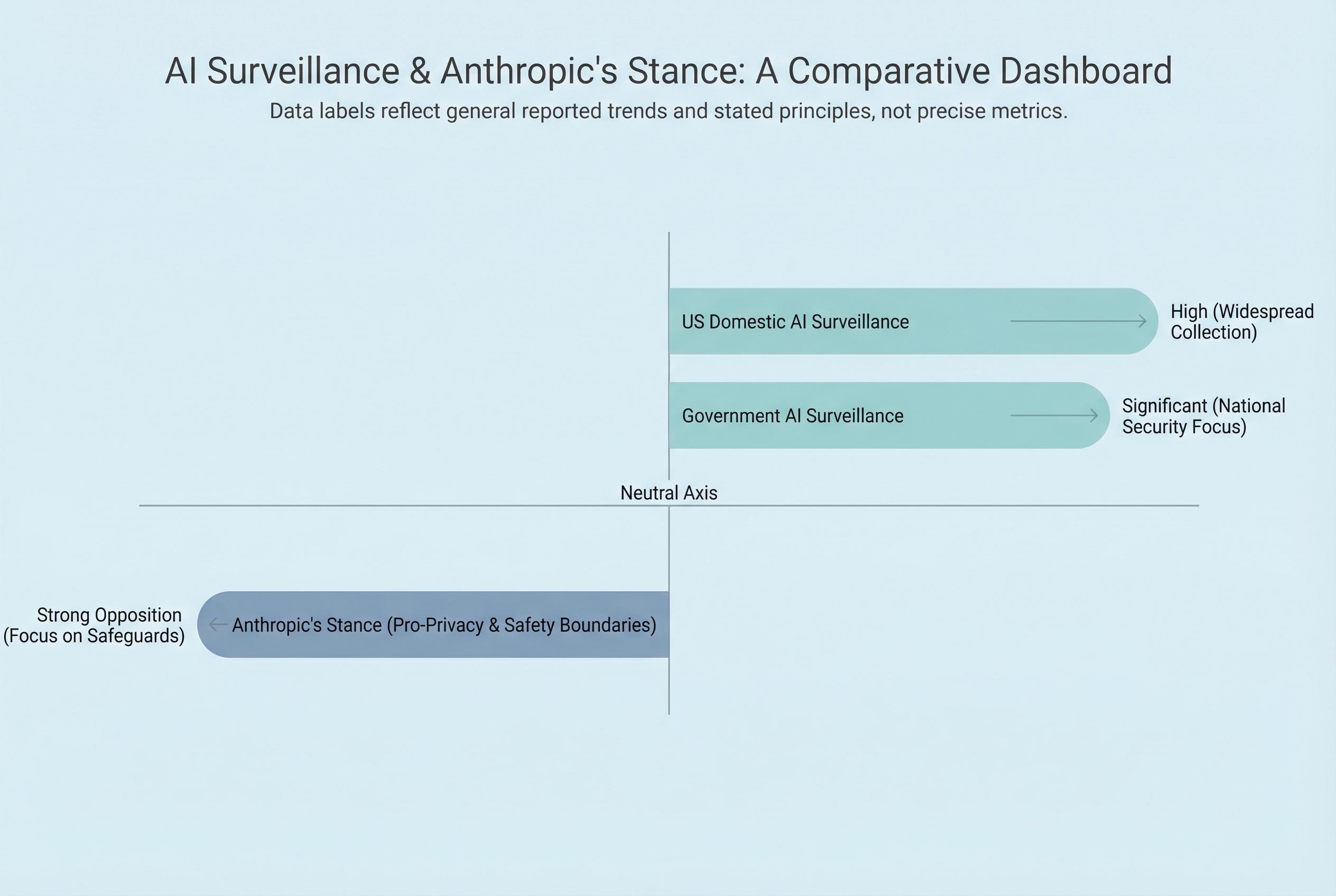
The clash between Anthropic and the Pentagon highlights the emerging battle over AI’s role in military and domestic surveillance, raising urgent legal and ethical questions about privacy and government power in the age of advanced artificial intelligence.
The Pentagon’s recent clash with Anthropic, the maker of the Claude chatbot, has exposed a stark choice at the intersection of national security and civil liberties: should powerful commercial AI be made fully available to US defence and intelligence agencies, or should companies be permitted to build in limits to prevent domestic surveillance and autonomous weapons use? According to the Associated Press, the Department of Defense has labelled Anthropic a “supply chain risk” and moved to bar its technology from military use after the company refused to remove safety guardrails that would prevent mass domestic surveillance and fully autonomous weapons.
Anthropic’s refusal, and its plan to challenge the designation in court, illustrates how private firms are now making de facto policy choices about whether and how AI can be used against Americans. The Washington Post reports that Defence Secretary Pete Hegseth gave the company an ultimatum to provide unrestricted military access to its systems or forfeit its contract, while Anthropic’s CEO, Dario Amodei, has framed the demand as an ethical red line the company cannot cross.
The dispute reaches beyond a single contract. Industry reporting and analysis show that federal agencies already acquire vast commercial datasets, location histories, web-browsing logs and license-plate records, that can reveal individuals’ movements, associations and online activity. The Washington Post and other outlets describe Pentagon demands to apply AI to “the collection and analysis of unclassified, commercial bulk data on Americans, such as geolocation and web browsing data”, a capability that would let models stitch together disparate feeds into granular profiles.
AI changes the scale and speed of analysis in ways that magnify longstanding legal and constitutional gaps. As commentators from civil liberties organisations have emphasised, modern datasets and inference techniques render decades-old Fourth Amendment doctrine ill equipped to police mass automated analysis of commercially acquired data. The Guardian opinion argues that without congressional action the government could plausibly claim many such uses are “lawful”, even where established privacy protections would previously have required judicial oversight.
Recent disclosures about government purchases of commercial data add urgency. Freedom of Information work and reporting have revealed that agencies such as ICE have repeatedly bought cellphone location information and other commercially available feeds, and that law-enforcement collectors have also been compiling license-plate records and facial templates from public protests. Those practices, when paired with AI capable of rapidly identifying patterns and linking anonymised trails to identities, raise clear risks of profiling and chilling of lawful dissent.
Major technology companies are reacting in different ways, underscoring the fragility of relying on corporate policy alone to protect rights. Forbes reports that OpenAI amended its agreement with the Pentagon to include language that forbids domestic surveillance of U.S. persons and nationals through procurement or use of commercially acquired personal or identifiable information, and that limits access by certain intelligence agencies absent a new deal. That contractual addendum, while meaningful, is contingent on changing corporate decisions and does not create durable public-law protections.
Legal experts and some former national security officials have criticised the Pentagon’s invocation of supply-chain statutes to compel access from a domestic firm, arguing the tool was designed to protect against foreign-actor threats rather than to force behavioural alignment from US companies. The Associated Press notes voices in Congress and the security community who view the designation as an overreach that sets a risky precedent for government control over private technology choices.
The upshot is a policy gap that only Congress can close. Advocacy groups and opinion writers are urging lawmakers to pass concrete limits, such as the bipartisan Fourth Amendment Is Not For Sale Act, to bar the government from buying data that would otherwise require a warrant and to place explicit constraints on the use of AI for domestic surveillance and automated targeting. Absent statutory safeguards, the balance between national security needs and everyday privacy will be left to shifting executive priorities and corporate bargaining, with profound consequences for free speech, association and equal protection.
Source Reference Map
Inspired by headline at: [1]
Sources by paragraph:
Source: Noah Wire Services
Noah Fact Check Pro
The draft above was created using the information available at the time the story first
emerged. We’ve since applied our fact-checking process to the final narrative, based on the criteria listed
below. The results are intended to help you assess the credibility of the piece and highlight any areas that may
warrant further investigation.
Freshness check
Score:
8
Notes:
The article was published on 9 March 2026, making it current. However, the events discussed have been reported in various outlets since late February 2026, indicating that the narrative has been in circulation for over a week. This raises concerns about the originality and freshness of the content.
Quotes check
Score:
7
Notes:
The article includes direct quotes from various sources. However, without access to the original sources, it’s challenging to verify the accuracy and context of these quotes. The lack of direct links to the original statements or interviews is a concern for verification.
Source reliability
Score:
9
Notes:
The article is published by The Guardian, a reputable news organisation. However, the piece is an opinion column, which may reflect the author’s personal views rather than objective reporting. This distinction is important for assessing the reliability of the information presented.
Plausibility check
Score:
8
Notes:
The claims made in the article align with reports from other reputable sources, such as the Associated Press and The Washington Post. However, the article’s reliance on a single opinion piece without corroboration from multiple independent sources raises questions about the comprehensiveness and balance of the reporting.
Overall assessment
Verdict (FAIL, OPEN, PASS): FAIL
Confidence (LOW, MEDIUM, HIGH): MEDIUM
Summary:
The article presents a perspective on the Pentagon’s designation of Anthropic as a ‘supply chain risk’ and the broader implications for AI surveillance. While it references reputable sources, the reliance on a single opinion piece without corroboration from multiple independent sources, the inability to verify direct quotes, and the lack of access to original statements or interviews raise significant concerns about the accuracy and reliability of the information presented. Additionally, the content type being an opinion piece further complicates the verification process. Given these factors, the content does not meet the necessary standards for publication under our editorial guidelines.


