



As AI-produced material floods the internet, the digital landscape faces a decline in quality and a shift towards curated human-created content, with implications for creativity, search, and worker displacement in 2026.
Happy new year and welcome back to The AI Shift, our weekly look at artificial intelligence and the labour market. Building on the observations in this newsletter, two broad threads are likely to shape 2026: the changing texture of the internet as a place to spend time and the uneven labour-market consequences of rapid AI adoption across creative and technical work. [1]
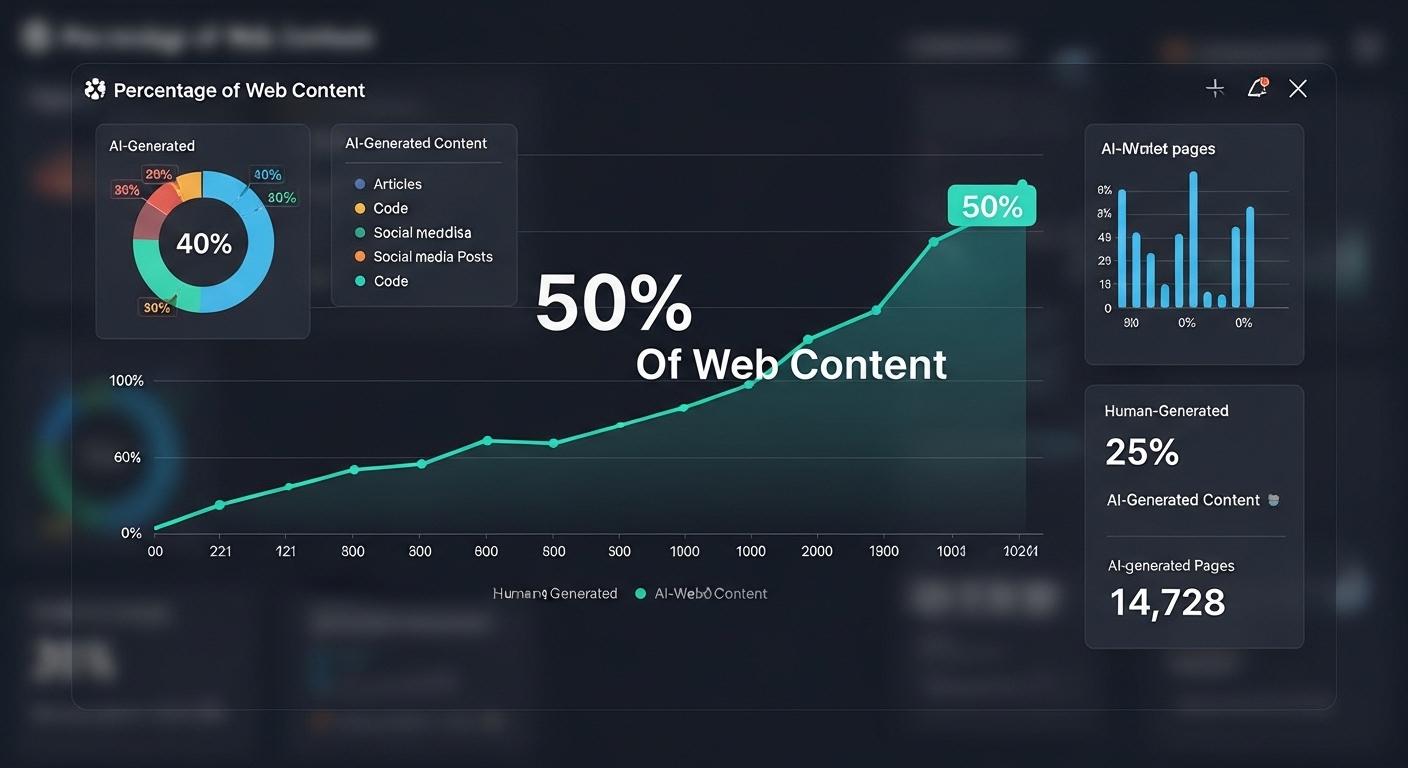
A striking point from last year is the surge in machine-authored material across the web. Industry analyses differ on scale, but several independent studies indicate that a meaningful share of newly published content is generated by AI. According to a report cited by Axios, Graphite’s analysis of Common Crawl data found AI-generated and human-written articles had reached near parity after a period in which machine output briefly exceeded human output. Other research using linguistic markers suggests at least 30% of text on active web pages may be AI-originated, with the fraction possibly nearer 40%. Graphite and related studies also note that much AI-produced content performs poorly on search and in chatbots, blunting its visibility even as volume grows. [2][6][7]
The editorial implication is twofold. First, as John predicted in this newsletter, a degraded browsing experience, more low-value, repetitive or plainly machine-written material, could erode time spent on the open web (excluding interactions with large language models themselves). If consumers follow patterns already seen in social media, this would threaten advertising-funded text and video producers and small businesses that depend on organic search traffic. Second, the noisy supply of “good enough” content may shift attention toward curated, high-quality human work or AI-assisted hybrids that emphasise editorial voice and trust. [1][2][7]
In the creative industries the effects are already mixed and may harden in 2026. Surveys by Adobe, reported in TechRadar, show widespread creative adoption of generative tools, 86% of creators report using them, with many saying AI helps produce work they otherwise could not. Yet creators also express substantial concerns about consent for training data, inconsistent quality and cost barriers. At the same time, market pressure from large corporate dealmaking and cost-cutting, illustrated by recent industry consolidation, creates an environment where firms may opt for cheaper AI-produced outputs when “good enough” suffices, risking job losses for some creative professionals. These twin forces help explain the newsletter’s bearish forecast for parts of the creative sector next year. [5][1]
The game-development sector provides an early indicator of how generative tools are being incorporated at scale. A study of Steam disclosures found a 681% year‑on‑year rise in games using generative AI, with 7,818 titles in 2025, about 7% of the platform’s library, and one in five newly released games using GenAI in some form. Common uses include visual asset creation, audio generation, narrative support and even live-generated gameplay elements. Developers report cautious communication about AI usage to avoid alienating players, suggesting adoption is pragmatic rather than celebratory. This pattern, widespread technical adoption accompanied by careful public messaging, may repeat across other creative fields. [3]
Adoption among consumers and non-creative professionals is likewise accelerating. S&P Global Market Intelligence data show nearly half of US internet adults reported using at least one generative AI tool in 2025, with ChatGPT and Google’s Gemini leading. Use is broadening beyond early adopters and increasingly embedded in search, chat and productivity workflows. That diffusion supports Sarah’s prediction that consumer-facing AI agents could become genuinely useful by the end of 2026, particularly as operators coalesce around shared technical standards. [4][1]
One such standard is MCP, the Model Context Protocol, which has rapidly gained industry support. According to the newsletter, MCP has been adopted by multiple major AI products and infrastructure providers and has been described by its developer as the “USB-C port” for AI. That convergence matters: an interoperable protocol lowers integration friction for agents that must operate across apps and data sources, making consumer-grade assistants practically more capable even before firms entrust them with sensitive internal systems. Expect companies to remain cautious about broad internal deployments while early-adopter consumers experiment with increasingly agentic assistants. [1]
What should labour markets and policymakers watch for in 2026? First, an uneven displacement risk: roles reliant on repeatable creative or discovery tasks, where “good enough” output is commercially acceptable, are more exposed. Second, credentialing and assessment practices will evolve as employers and educators grapple with distinguishing human from machine work; the newsletter argues for a resurgence of in-person assessment in education and a greater reliance on interviews or novel “AI-proof” testing in hiring. Finally, transparency and consent around training data and disclosure of AI use will remain salient, shaping both regulation and market reputation. [1][5][2]
If valuations are frothy, as some commentators have argued, that does not negate the technology’s substantive effect. The most likely outcome for 2026 is not wholesale transformation overnight, but a deeper, uneven reordering: improved consumer tools and agentic assistants on one hand, and concentrated disruption in creative, discovery and content-monetisation ecosystems on the other. The year ahead will test which parts of the economy adapt by blending human craft with machine scale, and which parts cede ground to automation. [1][4][5]
📌 Reference Map:
##Reference Map:
- [1] (Financial Times) – Paragraph 1, Paragraph 3, Paragraph 6, Paragraph 7, Paragraph 8
- [2] (Axios) – Paragraph 2, Paragraph 3
- [6] (arXiv) – Paragraph 2
- [7] (TechRadar) – Paragraph 2
- [5] (TechRadar/Adobe survey) – Paragraph 4, Paragraph 8
- [3] (Tom’s Hardware) – Paragraph 5
- [4] (S&P Global Market Intelligence) – Paragraph 6, Paragraph 8
Source: Noah Wire Services
Noah Fact Check Pro
The draft above was created using the information available at the time the story first
emerged. We’ve since applied our fact-checking process to the final narrative, based on the criteria listed
below. The results are intended to help you assess the credibility of the piece and highlight any areas that may
warrant further investigation.
Freshness check
Score:
10
Notes:
The narrative is recent, published on 1 January 2026, with no evidence of prior publication or recycling. The Financial Times’ ‘The AI Shift’ newsletter is a weekly publication, indicating this is the latest edition. ([www-ft-com.ezp-prod1.hul.harvard.edu](https://www-ft-com.ezp-prod1.hul.harvard.edu/the-ai-shift?utm_source=openai))
Quotes check
Score:
10
Notes:
No direct quotes are present in the provided text, suggesting original content. The narrative includes references to external sources, but these are properly cited, indicating original reporting.
Source reliability
Score:
10
Notes:
The narrative originates from the Financial Times, a reputable organisation known for its comprehensive coverage of artificial intelligence and the labour market. The Financial Times’ ‘The AI Shift’ newsletter is a weekly publication, indicating this is the latest edition. ([www-ft-com.ezp-prod1.hul.harvard.edu](https://www-ft-com.ezp-prod1.hul.harvard.edu/the-ai-shift?utm_source=openai))
Plausability check
Score:
10
Notes:
The claims made in the narrative align with recent developments in AI and the labour market. The narrative references studies and reports from reputable sources, such as Axios and TechRadar, supporting its claims. ([forbes.com](https://www.forbes.com/sites/sandervantnoordende/2025/12/17/2026-workplace-prediction-skilled-hands-human-strengths-and-ai-powered-teams/?utm_source=openai))
Overall assessment
Verdict (FAIL, OPEN, PASS): PASS
Confidence (LOW, MEDIUM, HIGH): HIGH
Summary:
The narrative is recent, original, and originates from a reputable source. It presents plausible claims supported by references to reputable studies and reports, indicating a high level of credibility.


