Listen to the article
Dry fire has become one of the most important parts of my daily training, not only because it’s convenient or inexpensive, but because it can build technical precision and mental discipline to provide consistency on the range and CONSISTENCY is king. What I personally love about dry fire is that it strips everything down to pure mechanics, awareness, and intention.
The biggest advantage of dry fire, which I have found isn’t talked about as often, is the shift in the shooter’s mindset. Too many shooters “go through the motions” and can end up practicing sloppiness. Dry fire only works when you’re actively engaged in the process, your eyes, hands, stance, and mental focus fully locked in. Every rep must have a purpose. And in return, when your mind is in the drill, the value skyrockets. Dry fire can be a direct communication between your conscious mind and your subconscious performance system.
Let’s break down what “dry fire” actually is before we get into a few drills I would recommend. Dry fire is a way a firearm owner can practice compound or isolated skills related to shooting, carrying, competition practice, or really just getting familiar with a firearm and how it functions. In fact, the first thing I do when I purchase a new gun is I like to become very familiar with how the gun functions and how I can best manipulate it based on the functions of the gun, such as where the trigger “breaks” the shot (isolating how the trigger functions in this particular firearm). So dry fire is when you “practice” these skills, whether on the range or off the range, indoors or outdoors, and functions of the gun are manipulated safely because there is no ammo in the gun, nor in the magazines. This allows you to safely practice your technique,s such as drawing the gun, loading the gun, trigger manipulations, and more, without using any live-fire ammunition. There is so much that can be developed within your inner skillset with a firearm, and then of course can test these techniques when you do head to the range to practice with live rounds. Below are my top 3 dry fire drills and focused skillsets I would recommend to any level of experienced shooter to try.
Transitions
Transition work has probably been the single biggest game-changer in my training. Transitions demand vision, timing, discipline, and grip control. And dry fire gives you the perfect environment to refine all of it. The key principle is simple: the eyes lead, the gun follows. You snap your eyes to the exact point you want to hit on the next target, then the gun drives there with purpose.
This is where the discipline of “only breaking the shot (aka pulling the trigger) when the sights are truly there” comes in. Acceptable sight confirmation doesn’t mean perfect; it means appropriate for the target. At close distances, you may need nothing more than a flash of the dot (if you are running a dot, or a little variance in your irons if irons only). At longer distances or tighter targets, you may need to see more, depending on you as the shooter and what you have practiced. Dry fire can teach your eyes to recognize the difference and your trigger finger to wait for it. It is a good way to start to understand (or a great daily refresher!) on exactly what your dot needs to look like before you fire. That awareness alone can shave seconds off your transitions and dramatically improve accuracy which can greatly benefit anyone whether a competition shooter or for defensive purposes.
My favorite drill to do for this, is I will set up between 2-6 (or more) targets (like THESE) in a room, and I will set a par time on my timer (can use your phone, or I like to use the Shooters Global one, with the dry fire function) for a few seconds, depending, and will try to “shoot” or pull the trigger at an acceptable area of the target on each target and try to beat the par time. If I beat the par time, then I will decrease it by .20 +/- seconds.
Again, the key being to quickly transition between the targets but to maintain the level of sight confirmation before simulating pulling through trigger and calling the shot (determining if I pulled the trigger at the exact spot my eyes were at for that acceptable area on the target). Give this one a try and let me know what you think. Try using multiple targets and even ones of different sizes and shapes!
Draws
A powerful draw isn’t about being flashy; it’s about building a repeatable, predictable movement you can trust. Dry fire allows you to dial in the mechanics of this. My goal is simple: every draw should feel like the last one, and to stay CONSISTENT. My hands go to the same place, my grip builds the same way, the gun drives into my eyeline, and the sights land where I expect them to.
The timer matters here. I use the Shooters Global timer because it picks up dry-fire reps accurately. But speed is only one layer. What matters more is that your grip in dry fire matches your grip on the range. People get lazy when there’s no recoil; they soften the grip, especially in the support hand, so remember to maintain that same grip pressure even when not performing live fire. Dry fire forces you to become extremely familiar with your holster, your grip pressure, your gun’s texture, your hand placement, and the way your sights settle. The more familiar you are with your gun, the more automatic this entire sequence becomes.
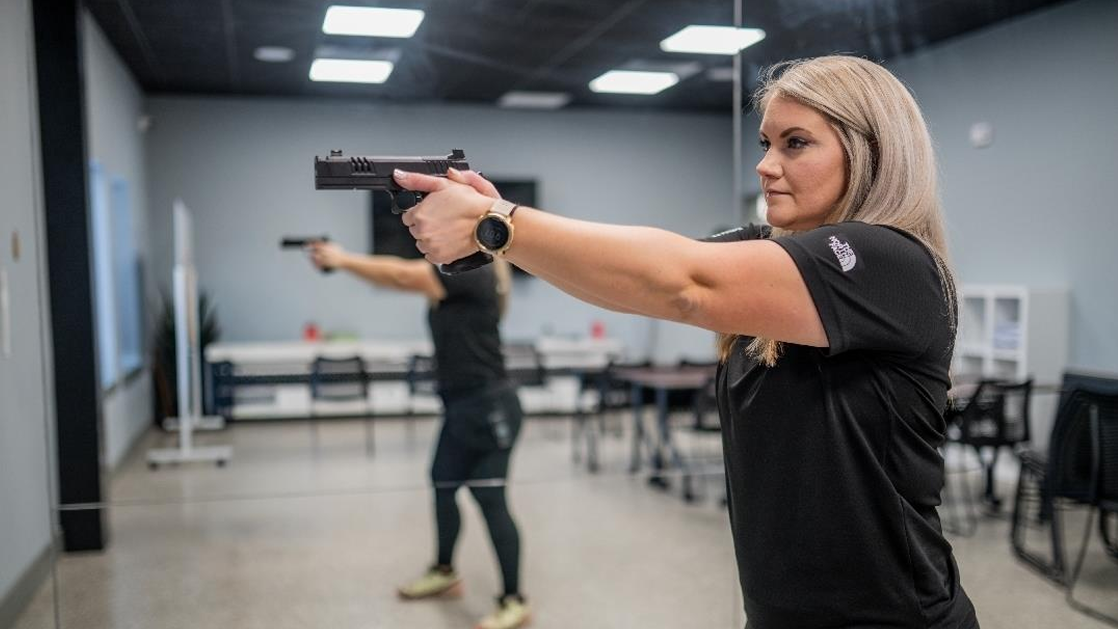
An effective drill I found to help establish a consistent and strong draw, is to stand stationary in front of one target and put the target on a mirror. Maintaining your stance, practice drawing out on the target on the mirror and forcing the gun and sights to your eyeline and where you are looking at. Something to watch for is to see if there are any “extra” movements that are inefficient for the draw such as an exaggerated rolling of the shoulder, or leaning out when drawing, or moving your head like moving it down into the gun instead of moving the gun to your eyes.
First point of contact with your firing hand should be in a position that you do not have to modify the grip once you draw it out of the holster, like if you position your hand too far below the beavertail or on top of the back of the slide. Build into your conscious mind a repeatable and consistent area to index each time on the gun to set you up for success each time you draw. Add another level to this by looking at the target, then closing your eyes, then drawing out the gun and opening your eyes to see where the sights are. Did you have to adjust them? How did you adjust them? Correct it and obtain the feel of this, and repeat this over and over, so you develop the feel of a draw that consistently is driving the gun to the spot you are looking at on the target. I love this drill!
Reloads
Reloads are a skill you can improve dramatically with dry fire because they rely on muscle memory, feel, and consistency. Without ammo, you can focus on indexing the magazine correctly, bringing the gun into your workspace (in front of your line of sight, not down low near your stomach area), feeling the magwell, and seating the magazine consistently. Reloads should never feel like a “search.” They should feel like a straight-line connection. Adjusting how you bend your elbow or how far up or away your gun needs to seat can depend on what works best for you. I also highly recommend to watch yourself reload, versus staring at the target and guessing where the magazine is going towards. It is worth it to look at what you are doing and then back to the target versus guessing, in my opinion.
I also track reload times with the timer. Not because the number defines anything, but because it forces me to continue to improve. A smooth, clean reload in dry fire usually becomes a reliable reload in live fire. When you put these reps in with intention, your reload stops being a stressor and becomes a strength.
One of my favorite drills for practicing the reload is setting a par time for “shot to shot” with the timer and at the sound of the beep, pull the trigger on a target, step in a direction while pulling out a new magazine and seating it, then taking another “shot” at the target. I will step in every direction and imagine a clock on the floor. So, I will step at my 1 o’clock position, then 2 o’clock, then 3 o’clock, and so forth, making my way around the clock, moving forward back and left and right while reloading.
Dry Fire on the Range
One of the most powerful habits I built was adding dry fire during my live-fire sessions. When I set up a drill or a mini stage, I don’t start loading mags right away. I dry fire it first. I visualize the target order, rehearse my transitions, confirm with my sight pictures, practice the reload, and walk the movement. Dry fire before live fire can help to primes the mindset. You give your conscious mind the exact reps it needs so that your subconscious has a template to work from. What magic!
And when those dry reps feel dialed in, that’s when it’s time to take it live. Go grab your ammo from AmmoSquared, load up, and run the drill exactly how you practiced it. Live fire is where you confirm what you built in dry fire, and where you get instant feedback about what’s working and what still needs refinement. That connection between dry and live reps is where real progress happens.
How Often Should One Dry Fire?
Dry fire frequency matters more than duration. You don’t need hours, really only about 20-30 minutes in a session, but above all… consistency.
Dry fire twice per week, and you’ll see improvement. Dry fire three or four times per week, and your mechanics will sharpen faster. Dry fire daily, even just 20 minutes, and you will reach a n extremelyhigh level of familiarity with your gun.
Daily dry fire creates a connection with your gun that shows up in everything you do: your transitions, your draw, your reloads, your movement, your confidence, and your ability to call your shots. You begin to move like a shooter who knows exactly what their gun will do before it does it.
To recap.. dry fire is where real skill is built. It is the bridge between intention and performance in my opinion. It demands mental engagement, disciplined reps, and total focus. Transitions, draws, reloads, and on-range dry-fire sessions shaped my own development more than anything else. If you want to improve your shooting capabilities, make dry fire part of your routine, and put purpose behind every rep.
If you want a structured dry-fire program, personalized coaching, or help building your performance roadmap, reach out to me. I help shooters build confidence, mechanical precision, and mental discipline on and off the range.
Let’s elevate your training, starting today!
-Marcee Finn
Read the full article here

16 Comments
I’ve been using dry fire to practice my drawing and loading techniques, and I’ve noticed a significant improvement in my speed and accuracy, which is great for competition practice.
The fact that dry fire allows you to practice skills without using live-fire ammunition is a huge advantage, especially for those of us who don’t have access to a range all the time.
The concept of refining vision, timing, discipline, and grip control through dry fire is really interesting, and I’d like to know more about how to incorporate this into my existing training routine.
I’ve found that incorporating dry fire into my routine has helped me develop a more consistent grip and improved my overall control, which has translated to better performance on the range.
I’ve never thought about using dry fire to get familiar with a new gun, but it makes sense to practice skills like drawing, loading, and trigger manipulations without live ammo, and I’ll definitely be trying this with my next purchase.
I’m skeptical about the idea that dry fire can be as effective as live-fire practice, but I’m willing to give it a try and see if it can really make a difference in my performance.
The concept of dry fire as a way to safely practice skills without live ammo is really important, especially for new gun owners, and I appreciate the emphasis on safety in your article.
I’ve found that dry fire drills, as you mentioned, can help build technical precision and mental discipline, which is crucial for consistency on the range, and I’m excited to try the transition work you recommended to improve my skills.
I’m curious about the safety aspects of dry fire, as you mentioned manipulating the functions of the gun without live ammo, and I’d like to know more about how to ensure a safe practice environment.
You mentioned that dry fire can be a direct communication between the conscious mind and the subconscious performance system, which makes sense given the focus required for each rep to have a purpose, and I’d love to explore this concept further in my own practice.
I’ve experienced this firsthand, and it’s amazing how much of a difference it makes when you’re fully engaged in the process, with your eyes, hands, stance, and mental focus all locked in.
You mentioned that dry fire can help build mental discipline, which is something I’ve been struggling with, and I’m excited to try the drills you recommended to improve my focus and control.
You mentioned that dry fire can help develop skills like trigger manipulations, and I’m wondering if you have any specific drills or exercises for improving trigger control.
The key principle of ‘the eyes lead, the gun follows’ in transition work is something I’ve struggled with, and I appreciate the clarification that acceptable sight confirmation doesn’t mean perfect, but rather appropriate for the target.
I’m curious about the different types of dry fire drills you recommend, and I’d love to hear more about your top 3 drills and how they can help improve my skills.
The idea that dry fire strips everything down to pure mechanics, awareness, and intention resonates with me, as I’ve often found myself ‘going through the motions’ during practice, and I’m looking forward to applying this mindset shift to my training.