
Listen to the article
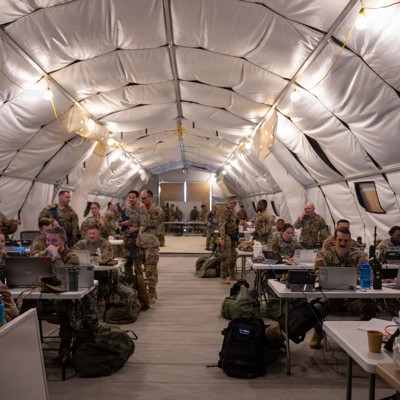
Air Force officials are reviving a deployment scheme introduced in the mid-1990s and abandoned three years ago. But while the original Air Expeditionary Wing concept quickly assembled airmen and aircraft from across the service to deploy for conflicts, AEW 2.0 aims to give the team up to 18 months to train together.
“AEW 2.0 builds upon successes and lessons learned from previous [Unit of Action] evolutions,” an Air Force spokesperson told Defense One on Friday evening. “It also accounts for dynamic operational requirements and aligns with senior leader priorities.”
The move, announced in a Friday-evening press release, is the latest Trump-administration shift away from Biden-era efforts to orient the force to confront China.
Set to launch in October, AEW 2.0 reflects the Trump administration’s Western Hemisphere focus, the spokesperson said, by striking “the balance in preserving capacity to fulfill the in-garrison mission and defend the homeland while the [Unit of Action] trains and deploys.”
The new AEW 2.0 concept will keep some existing ideas, like keeping deliberately teamed groups together for training and deployment.
“A key strength of this unit of action model is the deliberate training and teaming that improves collaboration and readiness across the service,” said Lt. Gen. Case Cunningham, the Air Force’s deputy chief of staff for operations, in the news release. “It’s imperative we continue empowering wings and commanders with necessary resources and guidance to be the agile, decisive force our nation demands.”
But the concept discards the Biden-era plan to run deployed forces with a leadership structure called the A-staff.” Air Force officials said last month they would keep the existing group-level organization “to minimize change-fatigue to airmen and enable commanders to concentrate on readiness, lethality, and mission accomplishment.”
The AEW 2.0 concept will work within the service’s 24-month deployment cycle known as AFFORGEN. The schedule, which was established in 2022, has been criticized by commanders and government watchdogs for leaving bases overworked and understaffed. In November 2024, the Government Accountability Office reported that major commanders had torched the service’s AFFORGEN-related guidance as “policy by PowerPoint presentations and emails,” described it as a “concept ahead of Air Force processes,” and claimed it moved at the “speed of change faster than speed of communication.”
In the press release, Air Force Chief of Staff Gen. Ken Wilsbach praised the AEW revival as “the next step in evolving our readiness.” More than a decade ago, Wilsbach led the 9th Air and Space Expeditionary Task Force in Afghanistan.
Read the full article here

16 Comments
I’m excited to see how the AEW 2.0 concept will impact the Air Force’s ability to respond to emerging threats and crises, and I believe that the deliberate training and teaming approach will be a key factor in its success.
The fact that the AEW 2.0 concept will work within the existing AFFORGEN framework is a positive step, but I’m concerned that it may not be enough to address the underlying issues with the deployment cycle.
Lt. Gen. Case Cunningham’s statement about the importance of deliberate training and teaming is spot on, and I believe that this approach will be crucial in improving collaboration and readiness across the service.
The key to success will be ensuring that commanders have the necessary resources and guidance to empower their teams and make informed decisions.
The revival of the Air Expeditionary Wing concept, now known as AEW 2.0, is a significant shift in the Air Force’s deployment strategy, and I’m curious to see how the 18-month training period will impact readiness and collaboration among airmen.
The 24-month deployment cycle, known as AFFORGEN, has been criticized for leaving bases overworked and understaffed, and I hope that the AEW 2.0 concept will address these concerns and provide a more sustainable solution.
The decision to keep the existing group-level organization and discard the Biden-era A-staff leadership structure is interesting, and I’d like to know more about how this will impact command and control during deployments.
I’m skeptical about the Trump administration’s Western Hemisphere focus, as it seems to be a departure from the previous efforts to confront China, and I wonder how this will affect the Air Force’s overall strategic priorities.
The shift in focus may be a response to changing global dynamics, but it’s crucial to ensure that the Air Force remains adaptable and prepared to address emerging threats.
The AEW 2.0 concept’s emphasis on empowering wings and commanders with necessary resources and guidance is a positive step, and I believe that this approach will be crucial in improving readiness and lethality across the service.
The AEW 2.0 concept’s focus on preserving capacity to fulfill the in-garrison mission and defend the homeland while the Unit of Action trains and deploys is a critical aspect, and I’d like to know more about how this will be achieved in practice.
The fact that the AEW 2.0 concept will launch in October provides a clear timeline for implementation, and I’m curious to see how the Air Force will measure the effectiveness of this new approach.
The Government Accountability Office’s criticism of the AFFORGEN-related guidance as ‘policy by PowerPoint presentations and emails’ is telling, and I hope that the Air Force will take a more comprehensive approach to implementing the AEW 2.0 concept.
Air Force Chief of Staff Gen. Ken Wilsbach’s experience leading the 9th Air and Space Expeditionary Task Force in Afghanistan will likely inform his perspective on the AEW revival, and I’m interested in hearing more about his vision for the future of the Air Force.
The Air Force’s decision to revive the AEW concept is a recognition that the previous approach was not effective, and I hope that the new approach will address the underlying issues and provide a more sustainable solution for the service.
The key to success will be ensuring that the Air Force learns from its past experiences and incorporates those lessons into the AEW 2.0 concept.