

Listen to the article
The Marine Corps will pay Overland AI $19.7 million to produce more than a dozen autonomous ground vehicles by early 2027.
The vehicles, due to be delivered in about nine months, will be part of the Marine Air Defense Integrated Systems program, which is part of the service’s counterdrone approach, and support resupply missions.
“Ground autonomy matters now more than ever. We’re seeing the proliferation of uncrewed ground vehicles in conflicts like the one in Ukraine, and tech maturity is really there,” Byron Boots, Overland AI’s CEO told reporters. “We’re registering extremely high demand from U.S. operational units who want to incorporate this technology into their concepts of operation.”
Overland recently demonstrated its autonomous offerings with the Marine Corps on a prototype for the Remotely Operated Ground Unit for Expeditionary Fires, or ROGUE Fires, program.
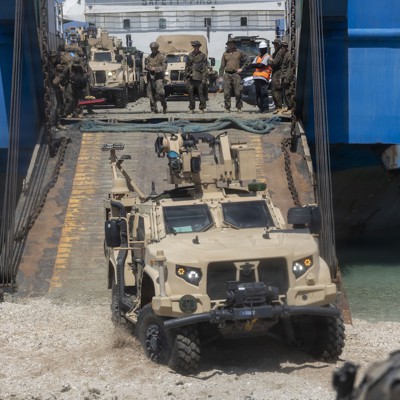
The robot vehicle is expected to integrate with existing Marine Corps platforms, such as the Joint Light Tactical Vehicle, or JLTV.
“We’re going to start by integrating the [autonomous ground] vehicle into the system, providing a resupply capability for the other vehicles…and we may build on it from there,” Boots said.
The platform could potentially be used for other purposes, such as intelligence and surveillance.
“We’ve used our autonomous ground vehicles for a wide variety of different mission sets, everything from resupply to ISR to breaching,” he said. “Our understanding is that they’ll initially be used for resupply, but we believe that there’ll be many different possible use cases and ways to integrate this vehicle into the program.”
The company declined to specify the exact number of vehicles that would be produced or other contract details, including the type of vehicle, payload capacity, and other specifications. The contract was awarded through a rapid acquisition tool called an other transaction authority through the Accelerate the Procurement and Fielding of Innovative Technologies, or APFIT, program under the Pentagon’s research and engineering shop.
The vehicles are designed to be fully autonomous, which means they can “perceive the environment, represent it, plan through it, and control the vehicle. So you can tell it where to go, and it will make the decisions on board in order to get there,” Boots said.
A military operator can also take over the vehicle remotely. The system is designed with open architecture.
The announcement comes as military services look to incorporate autonomous systems across domains. Integrating autonomous vehicles could improve troop safety by putting robots in their place for routine and potentially hazardous missions.
“We look forward to incorporating the Overland AI capability into the Marine Corps’ Ground Based Air Defense portfolio,” Joe Klocek, the Marine Corps’ program manager for ground-based air defense, said in a news release announcing the contract. “Pairing the autonomous platforms with our Marine Air Defense Integrated System will greatly extend the operational reach and lethality of our air defense units.”
Read the full article here

5 Comments
Solid analysis. Will be watching this space.
This is very helpful information. Appreciate the detailed analysis.
I’ve been following this closely. Good to see the latest updates.
Great insights on Defense. Thanks for sharing!
Good point. Watching closely.