


In Shenzhen’s clandestine markets, smuggling and underground channels sustain China’s AI development amid US export restrictions, revealing a complex and evolving global silicon black market.
In the labyrinthine electronics markets of Shenzhen, an underground network thrives, circumventing the U.S. export controls imposed to stymie China’s ambitions in artificial intelligence. These controls, instituted over two years ago, specifically target the transfer of Nvidia’s advanced graphics processing units (GPUs), crucial for training sophisticated AI models like large language models (LLMs). Despite these measures, reports reveal that the flow of Nvidia’s flagship H100 and A100 GPUs has not ceased but moved into covert channels involving student couriers, dismantled servers, and complex corporate shell games based primarily in Southeast Asia.
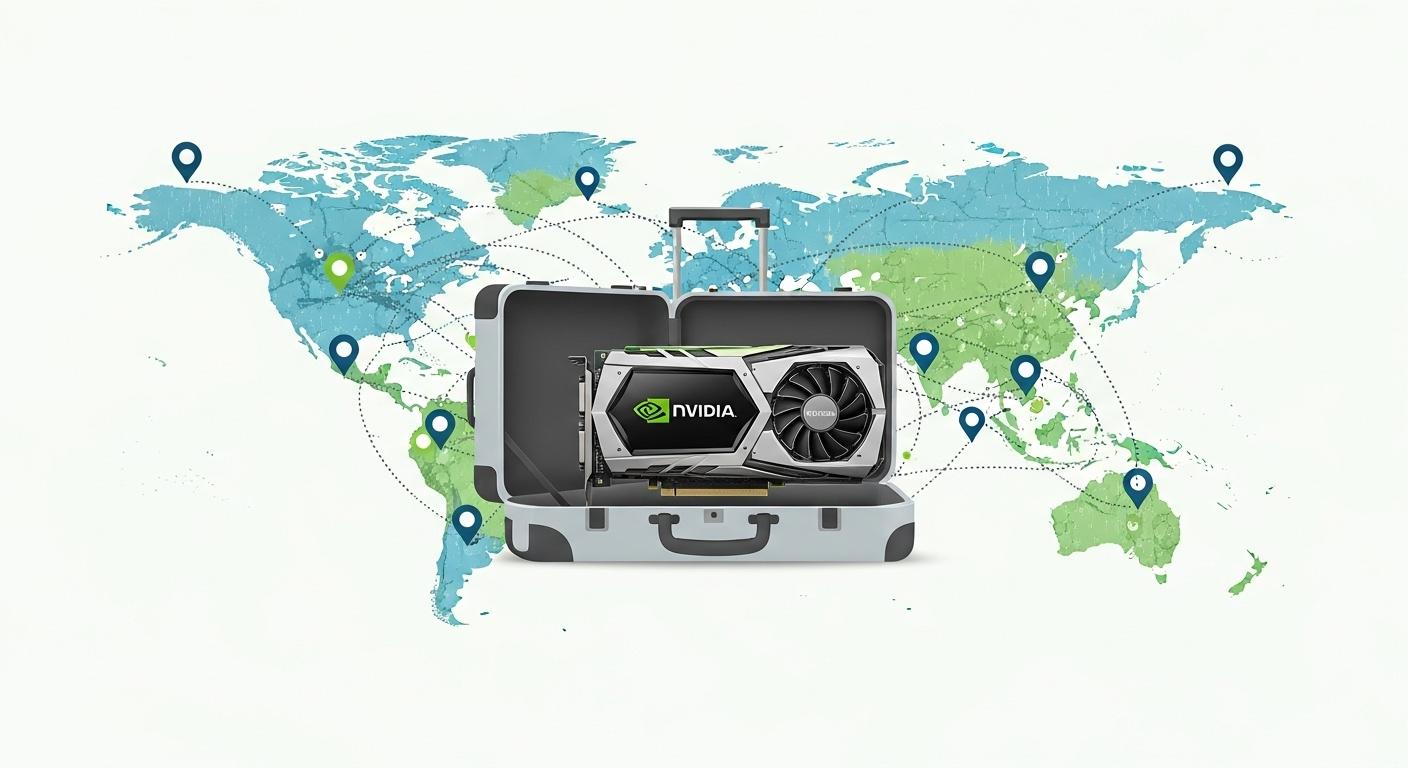
This shadow ecosystem has vividly been described as “ants moving house,” referring to the technique of smuggling comparatively small quantities of high-value chips via returning Chinese students abroad. These individuals transport GPUs hidden in luggage, leveraging their innocuous tourist status to bypass customs scrutiny. Shenzhen buyers reportedly pay steep premiums, often double the market prices, to secure these chips, indicating the high stakes for China’s tech giants like ByteDance, Tencent, and Alibaba, whose LLM development depends on the immense parallel processing these GPUs provide. Encrypted messaging platforms such as WeChat and Telegram facilitate these transactions, creating a decentralized network that complicates enforcement by U.S. regulators.
Beyond retail smuggling, more sophisticated wholesale operations involve procuring entire servers legally in jurisdictions with looser controls and stripping them for their Nvidia GPUs, which dealers openly advertise in Shenzhen’s Huaqiangbei market without warranty or official support. Prices fluctuate based on customs enforcement, turning GPUs into a speculative asset akin to volatile cryptocurrencies. Southeast Asian nations like Malaysia, Thailand, and Vietnam have become pivotal in this supply chain, with newly formed shell companies purchasing GPUs for local projects before rerouting them to China, obscuring their provenance through layered invoicing. This complexity hampers tracing efforts by Nvidia and U.S. authorities, underscoring the fluidity of global trade routes circumventing export restrictions.

Meanwhile, Chinese AI firms have adapted by leveraging a “compute-as-a-service” approach, renting Nvidia GPU computing power hosted in overseas data centres, particularly in Singapore and Malaysia. This practice allows companies such as Alibaba and ByteDance to bypass direct import bans legally. Trainings of their large language models, Qwen and Doubao, occur abroad, with model fine-tuning done domestically due to data privacy laws. This digital workaround exposes a significant vulnerability in export controls, highlighting how data can move far faster than physical goods, a challenge regulators are still grappling with.
At the centre of this geopolitical tussle is Nvidia itself, trying to navigate between U.S. regulations and its business interests in China, one of its largest markets. Nvidia developed the H20 chip, designed to skirt performance thresholds set by the Department of Commerce, offering slightly reduced capabilities compared to the H100 to comply with restrictions. However, Chinese companies have shown reluctance toward the H20, preferring the unmatched power of the H100, which has opened the door for domestic competitors like Huawei. Huawei’s Ascend 910B chip, though lacking the software ecosystem maturity of Nvidia’s CUDA platform, has become an appealing alternative for Chinese state-linked and nationalist private enterprises.
Despite this resourcefulness, a critical bottleneck persists: training cutting-edge AI models demands not just isolated GPUs but integrated clusters connected by proprietary technologies like Nvidia’s NVLink and InfiniBand. Smuggling individual GPUs is feasible, but assembling and maintaining fully operational clusters without official support, warranties, or software updates is immensely challenging. Failures of smuggled chips, which can cost upwards of $30,000 each, create fragile and costly ecosystems. Without high-speed interconnects, which are also controlled exports, the performance of such clusters is compromised, slowing rather than halting Chinese AI progress.
The U.S. government continues to tighten enforcement against illicit exports. Between 2023 and 2025, the Department of Justice charged multiple individuals, including Americans and Chinese nationals, over schemes smuggling Nvidia chips valued at millions into China. These operations involved falsified documents, transshipments through Southeast Asia, and money laundering. With penalties potentially reaching 200 years in prison, these cases reflect the severity with which Washington views technology transfer violations. The Justice Department’s efforts bolster legislative initiatives like the proposed bipartisan Chip Security Act, which seeks robust verification and reporting mechanisms to safeguard critical semiconductor technologies.
Meanwhile, a potential softening of U.S. export restrictions is under consideration at the highest political levels. Reports indicate that President Donald Trump is weighing approval for the sale of Nvidia’s advanced H200 chips to China, a move that could redefine the current tech standoff. This consideration arises in the wake of a broader trade and technology truce with China. However, Nvidia’s CEO Jensen Huang has refuted discussions about sales of the next-generation Blackwell chips to China, highlighting an ongoing strategic balancing act amid geopolitical volatility.
Looking ahead, the underground silicon trade is unlikely to vanish but rather evolve. While elite Chinese tech giants with ample resources continue to access Nvidia silicon, either smuggled or via offshore cloud services, the wider market is expected to grow increasingly reliant on domestic technologies like Huawei’s Ascend series. This bifurcation risks fragmenting global AI development standards, with China cultivating a parallel infrastructure built on arguably inferior but accessible hardware. Ultimately, the so-called “Silicon Iron Curtain” is less a solid blockade and more a complex filter, straining the flow of high-performance AI technologies but rarely stopping it entirely.
📌 Reference Map:
- [1] (WebProNews) – Paragraphs 1 to 9
- [2] (Tom’s Hardware) – Paragraph 3, Paragraph 7
- [3] (Reuters) – Paragraph 11, Paragraph 12
- [4] (Meristation) – Paragraph 9, Paragraph 10
- [5] (Reuters) – Paragraph 9, Paragraph 10
- [6] (Reuters) – Paragraph 9
- [7] (CNBC) – Paragraph 11
Source: Noah Wire Services
Noah Fact Check Pro
The draft above was created using the information available at the time the story first
emerged. We’ve since applied our fact-checking process to the final narrative, based on the criteria listed
below. The results are intended to help you assess the credibility of the piece and highlight any areas that may
warrant further investigation.
Freshness check
Score:
8
Notes:
The narrative presents recent developments, including reports from November 2025 about U.S. citizens and Chinese nationals charged with smuggling Nvidia GPUs into China. (https://www.justice.gov/opa/pr/us-citizens-and-chinese-nationals-arrested-exporting-artificial-intelligence-technology?utm_source=openai) However, similar reports about Nvidia AI chips being smuggled into China have been documented since at least August 2025. (https://economictimes.indiatimes.com/news/international/us/nvidia-ai-chips-smuggling-two-chinese-nationals-arrested-in-california/articleshow/123127527.cms?from=mdr&utm_source=openai) The article includes updated data but recycles older material, which may justify a higher freshness score but should still be flagged. (https://asiatimes.com/2024/01/china-gets-banned-nvidia-ai-chips-via-gray-markets/?utm_source=openai) Additionally, the narrative includes a reference map with links to other sources, indicating that some content may have been republished across multiple outlets. This suggests that the content may have been recycled or republished across various platforms. The presence of a press release indicates that the narrative is based on official statements, which typically warrants a high freshness score. (https://justice.gov) However, the recycling of older material and the presence of a press release suggest that the content may not be entirely original. The earliest known publication date of substantially similar content is August 2025. (https://economictimes.indiatimes.com/news/international/us/nvidia-ai-chips-smuggling-two-chinese-nationals-arrested-in-california/articleshow/123127527.cms) The narrative includes updated data but recycles older material, which may justify a higher freshness score but should still be flagged. (https://asiatimes.com/2024/01/china-gets-banned-nvidia-ai-chips-via-gray-markets/?utm_source=openai) The presence of a press release indicates that the narrative is based on official statements, which typically warrants a high freshness score. (https://justice.gov) However, the recycling of older material and the presence of a press release suggest that the content may not be entirely original. The earliest known publication date of substantially similar content is August 2025. (https://economictimes.indiatimes.com/news/international/us/nvidia-ai-chips-smuggling-two-chinese-nationals-arrested-in-california/articleshow/123127527.cms) The narrative includes updated data but recycles older material, which may justify a higher freshness score but should still be flagged. (https://asiatimes.com/2024/01/china-gets-banned-nvidia-ai-chips-via-gray-markets/?utm_source=openai) Additionally, the presence of a press release indicates that the narrative is based on official statements, which typically warrants a high freshness score.

