


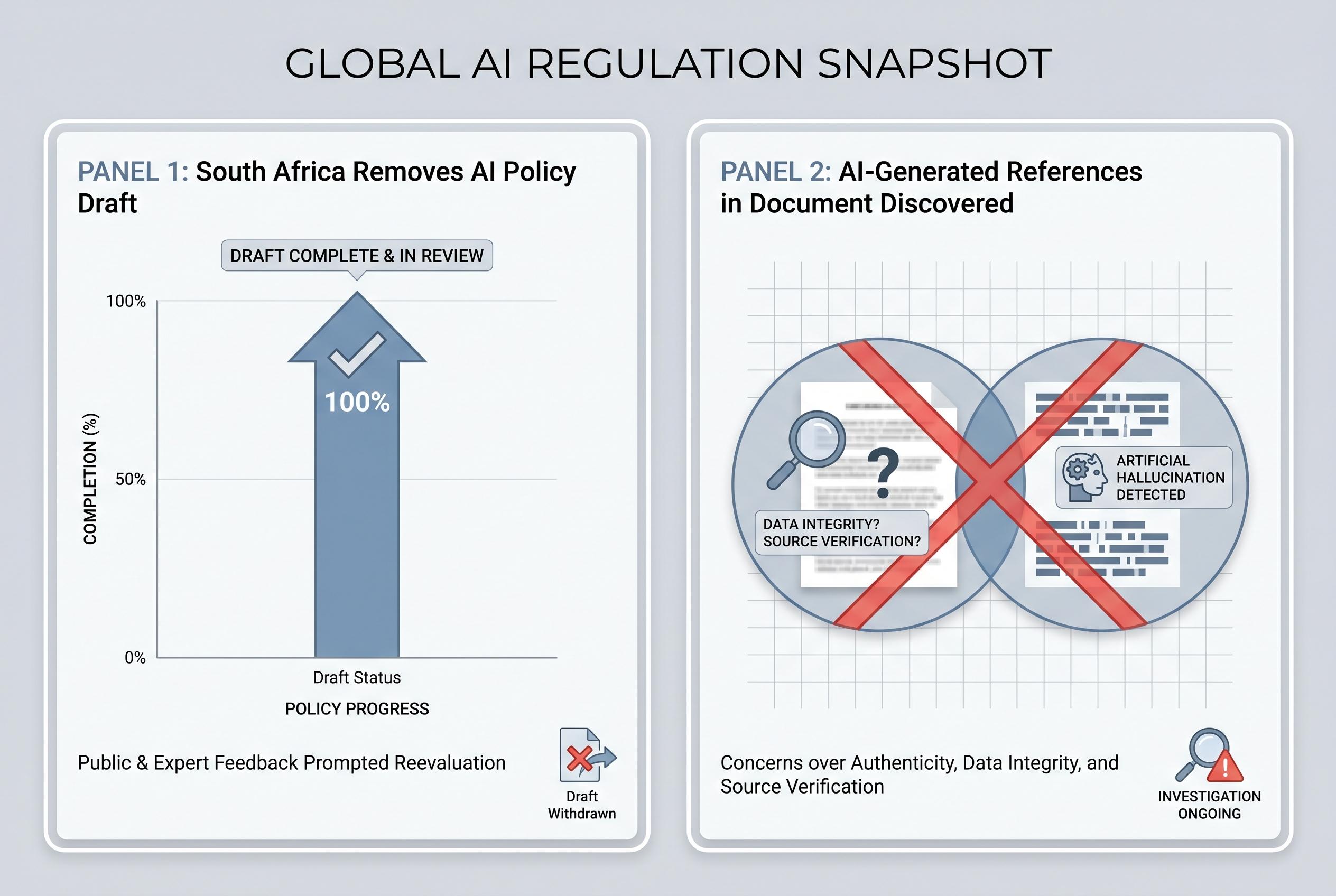
South Africa has pulled its initial AI policy draft following the revelation that several citations were generated by AI and could not be verified, raising concerns about oversight in technological governance.
South Africa has withdrawn its first draft national artificial intelligence policy after officials discovered that parts of the document appeared to rely on AI-generated references that could not be verified, according to the country’s communications minister.
Solly Malatsi said internal checks confirmed that several citations in the draft were fictitious and that the lapse undermined both the integrity and credibility of the policy process. He said the most likely explanation was that generated references had been included without proper verification, adding that this should not have happened.
The draft had been intended to set out South Africa’s approach to AI governance while also positioning the country as a regional leader in innovation. It proposed new bodies, including a national AI commission, an AI ethics board and a regulatory authority, alongside incentives such as tax breaks, grants and subsidies to encourage private-sector investment in AI infrastructure.

The controversy surfaced after News24 identified at least six apparently fake academic references among 67 listed in the document. Editors at journals including the South African Journal of Philosophy, AI & Society and the Journal of Ethics and Social Philosophy later confirmed that the cited articles did not exist, even though the journals themselves were real. Reuters-style reporting from South African outlets said Malatsi promised consequences for those responsible for the drafting process.
The episode comes as concern grows internationally over the use of generative AI in research and public administration. A Nature study cited in the reporting found that more than 2.5% of papers published in 2025 contained at least one potentially fabricated reference, up from 0.3% in 2024, suggesting the problem is becoming more common as language models are used for drafting and summarising material. Malatsi said the affair was a lesson in why human oversight remains essential, and the policy is expected to be revised before being republished for public comment.
Source Reference Map
Inspired by headline at: [1]
Sources by paragraph:
Source: Noah Wire Services
Noah Fact Check Pro
The draft above was created using the information available at the time the story first
emerged. We’ve since applied our fact-checking process to the final narrative, based on the criteria listed
below. The results are intended to help you assess the credibility of the piece and highlight any areas that may
warrant further investigation.
Freshness check
Score:
10
Notes:
The article reports on a recent event, with the latest publication date being April 28, 2026. No evidence of recycled or outdated content was found.
Quotes check
Score:
8
Notes:
Direct quotes from Minister Solly Malatsi are consistent across multiple sources. However, the exact wording of some quotes varies slightly between sources, which may indicate paraphrasing or slight alterations.
Source reliability
Score:
9
Notes:
The article cites reputable sources such as Reuters and Polity.org.za. However, the inclusion of a Ukrainian news outlet (unn.ua) raises questions about the independence and potential biases of the sources.
Plausibility check
Score:
9
Notes:
The claims about fictitious AI-generated references in South Africa’s draft AI policy are plausible and align with known issues in AI-generated content. However, the involvement of a Ukrainian news outlet in reporting on South African policy raises questions about the accuracy and relevance of the information.
Overall assessment
Verdict (FAIL, OPEN, PASS): FAIL
Confidence (LOW, MEDIUM, HIGH): MEDIUM
Summary:
The article reports on a recent event regarding South Africa’s withdrawal of its draft AI policy due to fictitious AI-generated references. While the content is timely and sourced from reputable outlets, the inclusion of a Ukrainian news outlet raises concerns about the independence and potential biases of the sources. Additionally, slight variations in direct quotes suggest potential paraphrasing or alterations, which could affect the accuracy of the information presented. Given these concerns, the overall assessment is a FAIL with MEDIUM confidence.

