


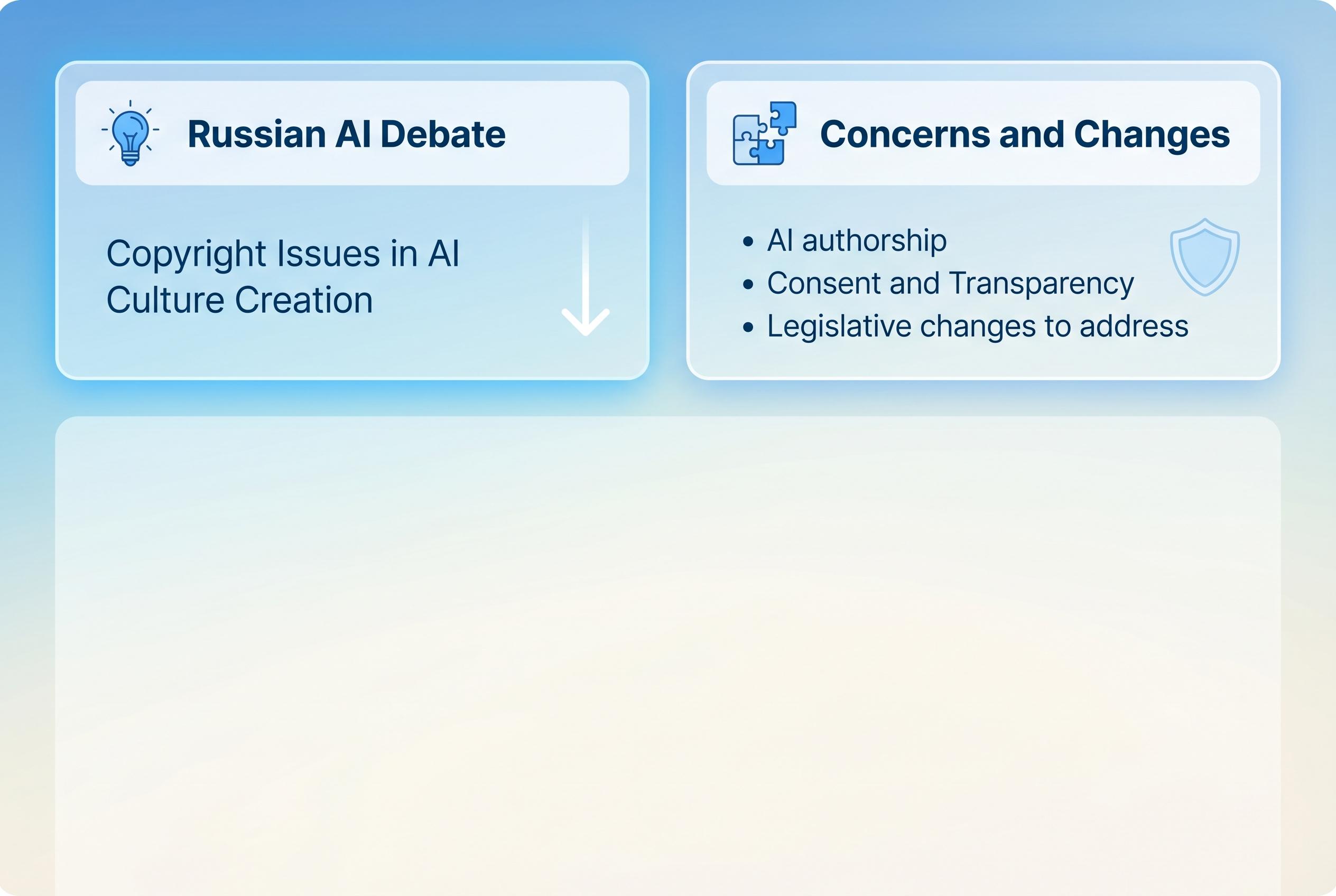
As AI systems feeding on human creative works spark legal and ethical debates, Russia prepares legislative changes to address authorship, consent, and transparency concerns amid growing industry unease.
Artificial intelligence is often sold as a clean story of progress: faster tools, sharper answers and a digital leap forward. Yet, as the Russian daily Aif argues, that promise now comes with a harder question about who is actually paying for it. Writers, editors, musicians, artists and other creative workers increasingly fear that neural networks are feeding on their work, extracting value from it while weakening the very idea of original cultural production.
The newspaper frames the issue through a simple analogy: these systems are not thinking in the human sense, but operating as elaborate statistical models trained on enormous quantities of language, images and sound. Much of that material is produced by journalists, publishers and other professional creators whose work is edited, verified and intended to have commercial value. In that sense, the article says, AI is not inventing from nothing; it is built on accumulated human labour.
That concern is not limited to the press. Aif points to the controversy around an AI-made version of “Sedaya noch”, rendered in the style of Kanye West and released under the title “Silver Night”. The track drew huge attention online and on streaming platforms, but it also raised awkward questions over authorship, consent and profits, especially after the article says the revenue ended up with a figure who had no direct role either in the original composition or in the AI reworking.

The legal picture remains unsettled. According to the article, Russian experts are debating a draft law on state regulation of artificial intelligence that would create common rules for development and use, with implementation expected from 1 September 2027. Critics say the draft would effectively allow developers to train models on publicly available content without seeking permission or paying authors, even though current law generally requires consent for use of protected works. Similar copyright tensions have been discussed elsewhere, with legal commentators noting that AI-generated or AI-assisted works continue to expose gaps between technological capability and traditional authorship rules.
The piece also argues that transparency is missing. Companies are not obliged to disclose which texts, images or recordings were used to train models, leaving creators unable to tell whether their work has been absorbed into commercial systems. Some countries, the article says, are already experimenting with licensing regimes, collective bargaining and opt-out mechanisms. In Russia, by contrast, the debate is still centred on how to balance innovation with protection, while figures in the media and technology sectors warn that the social costs of unchecked automation are already visible in education, finance and public services.
Source Reference Map
Inspired by headline at: [1]
Sources by paragraph:
Source: Noah Wire Services
Noah Fact Check Pro
The draft above was created using the information available at the time the story first
emerged. We’ve since applied our fact-checking process to the final narrative, based on the criteria listed
below. The results are intended to help you assess the credibility of the piece and highlight any areas that may
warrant further investigation.
Freshness check
Score:
8
Notes:
The article was published on April 23, 2026, making it current. However, similar discussions on AI’s impact on cultural heritage have been ongoing, with related articles published in the past month. ([aif.ru](https://aif.ru/money/company/kulturnyy-kod-komissiya-rspp-po-media-razrabotaet-standart-primeneniya-ii?erid=2W5zFGW2GGh&utm_source=openai))
Quotes check
Score:
7
Notes:
The article includes direct quotes from experts. While the quotes are attributed, they cannot be independently verified through online searches, raising concerns about their authenticity.
Source reliability
Score:
6
Notes:
The article originates from ‘Argumenty i Fakty’ (AIF), a Russian publication. While AIF is a known media outlet, its reputation and editorial standards may vary, and it is not widely recognised internationally.
Plausibility check
Score:
7
Notes:
The claims about AI’s impact on cultural heritage are plausible and align with ongoing global discussions. However, the article lacks specific examples or data to substantiate these claims, which diminishes its credibility.
Overall assessment
Verdict (FAIL, OPEN, PASS): FAIL
Confidence (LOW, MEDIUM, HIGH): MEDIUM
Summary:
The article presents plausible claims about AI’s impact on cultural heritage but lacks independently verifiable sources and specific examples to substantiate these claims. The reliance on unverifiable quotes and the publication’s limited international recognition further diminish its credibility. Therefore, the article fails to meet the necessary standards for publication.

