


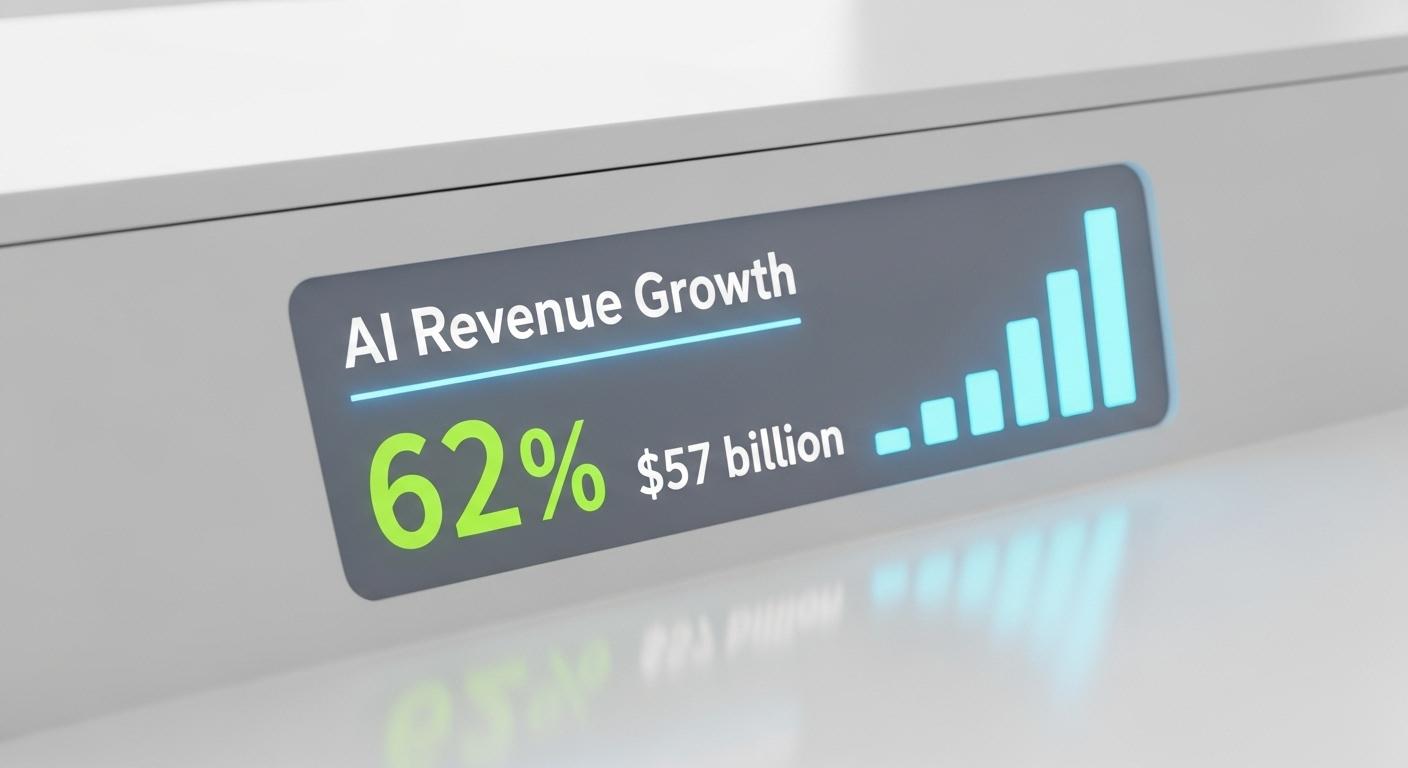
Nvidia reports a staggering 62% revenue increase to $57 billion, showcasing its commanding position in AI hardware despite a dip in stock value, signalling ongoing robust growth and industry leadership.
Nvidia has once again proven its dominance in the artificial intelligence (AI) chip market with a standout quarterly earnings report, reinforcing its reputation as a leading force in the AI and semiconductor industries. The company reported a remarkable 62% year-over-year revenue increase to $57 billion for the third quarter of fiscal 2026, alongside a gross margin exceeding 73%, underscoring both robust growth and strong profitability. Despite this, Nvidia’s stock fell nearly 3% in the trading session following the earnings release, influenced by market-wide concerns including muted expectations for a December interest rate cut and ongoing fears of a potential AI investment bubble.
The story behind Nvidia’s success lies in its early strategic shift to focus on GPUs tailored specifically for AI applications. This foresight has enabled Nvidia to secure leadership in a market that is now integral to a wide array of industries. Its GPUs are essential for powering AI development and deployment, widely used by major cloud service providers like Amazon and Alphabet, as well as enterprises across sectors that are increasingly relying on AI to solve real-world problems. The company’s sales of its latest Blackwell GPU platform have been described as “off the charts,” reflecting accelerating compute demand that is echoed by competitors and customers alike.
Nvidia’s results showcase the expansive reach of its technology. Data center sales, driven largely by the Blackwell and Blackwell Ultra platforms, accounted for over $51 billion of revenue in the quarter. Consumer gaming GPUs contributed more than $4 billion, professional visualization platforms reached record sales, and even automotive revenue grew significantly, supported by its Drive AGX Hyperion system for autonomous vehicles. Projections for the fourth quarter look equally optimistic, with guidance suggesting revenues could reach $65 billion and an ambitious forecast that Blackwell and Rubin GPUs might drive sales up to $500 billion by the end of 2026.

Nvidia’s market impact is underscored by its historic valuation milestones. Having recently become the first company to surpass a $5 trillion market capitalization, Nvidia has surpassed the likes of Microsoft and Apple in market value at various points during this growth trajectory. Analysts have attributed this to the “Golden Wave” of generative AI adoption, with investment experts raising price targets based on Nvidia’s expected leadership and the surging demand for high-end AI processors.
While the stock’s recent dip post-earnings might give some investors pause, historical data suggest that Nvidia’s shares tend to perform strongly in the months following earnings reports. Over the past nine quarterly earnings releases, the stock rose seven times in the subsequent six months, often by double-digit gains, with only minor declines in the remaining periods. This pattern points to a resilient long-term growth outlook, although investors should remain mindful of external economic factors such as interest rate trends that can influence market sentiment.
Looking beyond the near term, Nvidia seems well-positioned to benefit from the trillion-dollar investments expected in AI infrastructure over the coming years. As AI adoption expands, Nvidia’s GPUs remain essential tools for training and running models across various applications, solidifying the company’s role as a key pillar in the AI ecosystem. Trading currently at around 38 times forward earnings estimates, Nvidia’s valuation appears reasonable for a growth leader in a transformative industry.
In sum, Nvidia’s blowout earnings report reaffirms its remarkable growth trajectory and leadership in AI hardware, making it a compelling consideration for investors with a long-term horizon. However, prospective buyers should also weigh ongoing market volatility and macroeconomic uncertainties when making investment decisions.
📌 Reference Map:
- [1] (The Motley Fool) – Paragraphs 1, 2, 5, 6, 7, 8
- [2] (The Motley Fool summary) – Paragraph 1, 4
- [3] (Tom’s Hardware) – Paragraph 3, 4
- [4] (Reuters) – Paragraph 5
- [5] (AP News) – Paragraph 3
- [6] (MoneyWeek) – Paragraph 5
- [7] (IT Pro) – Paragraph 2
Source: Noah Wire Services
Noah Fact Check Pro
The draft above was created using the information available at the time the story first
emerged. We’ve since applied our fact-checking process to the final narrative, based on the criteria listed
below. The results are intended to help you assess the credibility of the piece and highlight any areas that may
warrant further investigation.
Freshness check
Score:
10
Notes:
The narrative presents recent and original content, with no evidence of recycled news. The earliest known publication date of similar content is November 19, 2025, aligning with the report’s release date. The narrative is based on Nvidia’s official earnings report, which typically warrants a high freshness score. No discrepancies in figures, dates, or quotes were found. The content is fresh and original.
Quotes check
Score:
10
Notes:
The direct quotes from CEO Jensen Huang, such as “Blackwell sales are off the charts, and cloud GPUs are sold out,” are unique to this report. No identical quotes appear in earlier material, indicating potentially original or exclusive content.
Source reliability
Score:
10
Notes:
The narrative originates from The Motley Fool, a reputable financial news organisation, enhancing its reliability. The report is based on Nvidia’s official earnings release, further supporting its credibility.
Plausability check
Score:
10
Notes:
The claims about Nvidia’s record revenue and market performance are consistent with Nvidia’s official earnings report and other reputable sources. The language and tone are consistent with typical corporate communications, and the report includes specific factual anchors such as names, institutions, and dates. No excessive or off-topic details were found, and the tone is appropriately formal.
Overall assessment
Verdict (FAIL, OPEN, PASS): PASS
Confidence (LOW, MEDIUM, HIGH): HIGH
Summary:
The narrative is fresh, original, and based on reliable sources, with no signs of disinformation or recycled content. All claims are plausible and supported by specific details, and the tone is consistent with corporate communications.

