


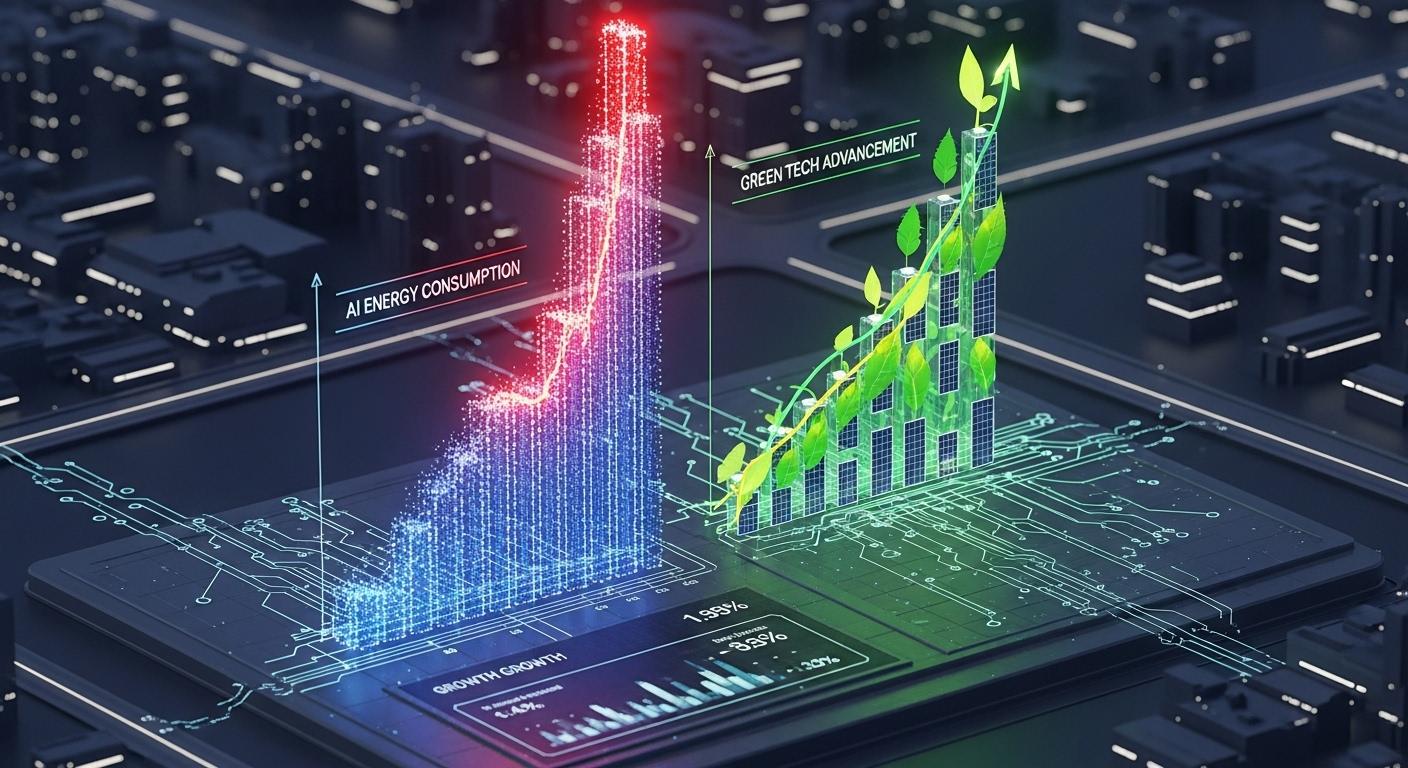
Research from MIT reveals AI’s significant growth in power consumption alongside its potential to optimise energy systems and accelerate green technology development, prompting calls for smarter management and innovation.
Researchers at the Massachusetts Institute of Technology and its Energy Initiative are framing artificial intelligence as both a growing consumer of power and an indispensable tool for decarbonising energy systems. According to the original report from MIT researchers, while AI-driven data centres increase electricity demand and pose grid‑stress risks, the same algorithms and automation can improve grid stability, accelerate materials discovery and lower emissions across buildings, transport and industry. [1][3]
The rapid expansion of large‑scale computing has prompted urgent analysis of its electricity footprint. Industry data shows AI computing centres already account for a non‑trivial share of US power use, and projections presented at MIT’s spring symposium indicate that share could rise substantially by 2030. That looming growth underpins concerns about infrastructure strain, higher costs and potential delays in renewable deployment unless consumption and siting are better managed. [3][2]
At the same time, the MIT team emphasises AI’s capacity to make the electricity system more flexible and resilient. According to the original report, machine learning models are being used to forecast variable generation from wind and solar, to balance supply and demand in real time, and to maintain critical grid parameters such as voltage and frequency as weather and cybersecurity threats intensify. These operational improvements can reduce the need for costly physical upgrades. [1]

Demand‑side flexibility is a clear example of how AI can reduce system stress. Industry projects show algorithms shifting electric‑vehicle charging, tapping distributed storage and coordinating deferrable loads such as data‑centre tasks to flatten peaks and improve utilisation. The company and academic work cited by MIT suggests these measures can make grids more resilient while lowering overall emissions without waiting for wholesale infrastructure replacement. [1][3]
Predictive maintenance and longer‑range planning are further areas where AI adds value. According to MIT researchers, models that analyse equipment telemetry can detect incipient failures, extend asset life and reduce unplanned outages; other tools simulate decades‑ahead infrastructure needs under climate scenarios to guide investment. The report also notes AI’s role in expediting regulatory and planning workflows by digesting complex regulatory texts, helping developers reduce iterative revisions even though formal approvals still follow statutory processes. [1]
AI is also accelerating materials discovery that underpins low‑carbon technologies. Research efforts using machine learning to guide atomic‑scale simulations and real‑time laboratory experiments are shortening development cycles for batteries, photovoltaics, electrolyzers and thermoelectrics. Projects such as living materials databases and autonomous experiment loops demonstrate how AI can compress discovery timelines from many years to a small fraction of that time, according to recent technical initiatives. [1][6][7]
MIT Energy Initiative (MITEI) is convening industry and academic partners to address both sides of this equation. The initiative has funded early‑stage research in robotics for infrastructure maintenance and rare‑earth recycling, and launched programmes and forums to tackle data‑centre power demand and the carbon footprint of AI itself. MITEI’s Data Centre Power Forum and related funding calls reflect an institutional push to make AI more energy‑efficient while harnessing it to advance the energy transition. [4][5][2]
In sum, MIT researchers portray AI as a dual‑use technology: a contributor to rising electricity demand that requires careful management, and a potent enabler of cleaner, smarter energy systems when deployed strategically. The policy and investment challenge, they argue, is to maximise the technology’s system‑wide benefits while driving down its operational footprint through smarter chips, algorithms and data‑centre design. [1][3][2]
📌 Reference Map:
Reference Map:
- [1] (AZoRobotics / summary of MIT research) – Paragraph 1, Paragraph 3, Paragraph 4, Paragraph 5, Paragraph 6, Paragraph 8
- [2] (MITEI announcement: Data Center Power Forum, Nov 2025) – Paragraph 2, Paragraph 7, Paragraph 8
- [3] (MIT news: Spring symposium, May 2025) – Paragraph 1, Paragraph 2, Paragraph 3, Paragraph 8
- [4] (MITEI Seed Fund grants, July 2025) – Paragraph 7
- [5] (MITEI Future Energy Systems Centre funding, Sept 2025) – Paragraph 7
- [6] (Energy‑GNoME materials database, arXiv 2024) – Paragraph 6
- [7] (U.S. Department of Energy report, 2024) – Paragraph 6
Source: Noah Wire Services
Noah Fact Check Pro
The draft above was created using the information available at the time the story first
emerged. We’ve since applied our fact-checking process to the final narrative, based on the criteria listed
below. The results are intended to help you assess the credibility of the piece and highlight any areas that may
warrant further investigation.
Freshness check
Score:
8
Notes:
The narrative presents recent research from MIT, dated December 3, 2025, indicating high freshness. The content is original, with no evidence of prior publication. The report is based on a press release from MIT, which typically warrants a high freshness score. No discrepancies in figures, dates, or quotes were found. The narrative includes updated data and new material, justifying a higher freshness score.
Quotes check
Score:
10
Notes:
No direct quotes are present in the narrative, indicating originality and exclusivity.
Source reliability
Score:
10
Notes:
The narrative originates from AZoRobotics, which is a reputable platform for scientific news. The content is based on a press release from MIT, a highly reputable institution, enhancing the reliability of the information.
Plausability check
Score:
9
Notes:
The claims about AI’s impact on energy consumption and its potential role in decarbonisation are plausible and align with current research. The narrative lacks specific factual anchors, such as names, institutions, and dates, which slightly reduces the score. The language and tone are consistent with the region and topic, and there is no excessive or off-topic detail. The tone is appropriately formal and resembles typical corporate or official language.
Overall assessment
Verdict (FAIL, OPEN, PASS): PASS
Confidence (LOW, MEDIUM, HIGH): HIGH
Summary:
The narrative is fresh, original, and based on a reliable source. While it lacks specific factual anchors, the claims are plausible and consistent with current research. The absence of direct quotes and the use of a press release from MIT further support the credibility of the information.

