


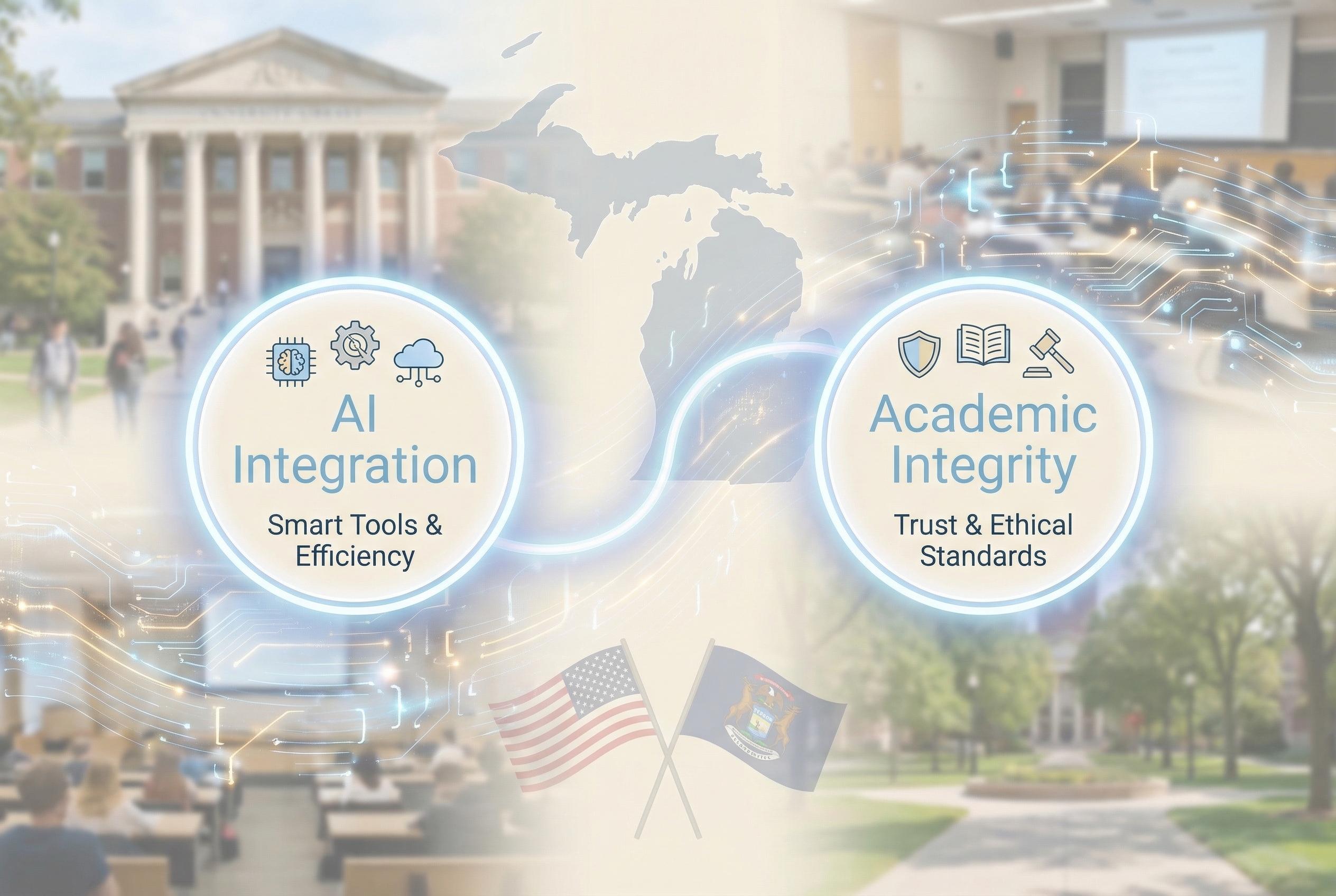
Michigan’s public universities are navigating a patchwork of AI regulations as they seek to integrate generative artificial intelligence into research and teaching, balancing innovation with academic integrity and environmental concerns.
Michigan’s public universities are enthusiastically incorporating generative artificial intelligence into research and teaching while wrestling with how to regulate its classroom use and protect academic standards. According to reporting by The Detroit News, students and faculty at campuses including the University of Michigan, Michigan State University and Grand Valley State University describe a landscape where institutional initiatives and individual instructors’ practices diverge sharply. (Sources: Michigan State University guidance; MSU teaching centre).
On the ground, students such as Michigan State Ph.D. candidates are using large language models to build tools that augment clinical care, illustrating the pedagogic and research value university leaders cite when promoting AI literacy and innovation. Michigan State’s published guidelines and the university’s teaching centre both stress that AI can support learning and research but should be used responsibly, with instructor permission and transparent documentation of AI-generated work. (Sources: MSU guidelines; MSU teaching guidance).
Yet instructors report that some undergraduates now rely on generative systems to produce assignments without developing the underlying disciplinary skills to judge or fix flawed output. Faculty who teach coding and digital studies say this dependence can leave students unable to recognise basic mistakes when an AI’s response is incorrect, undermining learning outcomes. (Sources: MSU teaching guidance; Grand Valley AI policy).

That unevenness is compounded by a patchwork of departmental rules. Several Michigan institutions have created campus-level AI frameworks that emphasise ethical, privacy and academic-integrity concerns, but they often leave decisions about classroom enforcement to individual professors. Grand Valley’s policy, for example, permits AI as an aid in scholarship while requiring disclosure of AI contributions, yet still allows faculty to determine acceptable uses in their courses. (Sources: Grand Valley AI policy; Michigan Technological University policy).
The disparity between centrally stated principles and divergent classroom practices has prompted calls for clearer, more consistent guidance. At the University of Michigan, faculty have urged university leadership to produce a comprehensive generative-AI strategy; administrators have responded by convening advisory groups to craft recommendations rather than issuing a single compulsory regime. Observers say that approach aims to balance instructors’ disciplinary needs with the imperative to develop students’ practical AI skills. (Sources: GradPilot coverage of UM contradictions; MSU guidelines).
Faculty experimenting with integrated assessment models are offering a possible compromise. Some instructors encourage students to treat AI as a collaborator but supplement assignments with oral or practical checks that force learners to explain their reasoning and demonstrate mastery. Proponents argue these hybrid measures mimic workplace expectations, where employees often use AI tools but must still justify technical decisions to human colleagues. (Sources: MSU teaching guidance; MSU guidelines).
Universities are also beginning to address broader impacts beyond classroom integrity. Administrators and researchers have flagged environmental and governance concerns tied to large-scale AI use, including the high energy and water demands of data centres that underpin current-generation models, and emphasise privacy and intellectual-property safeguards in campus policies. (Sources: Michigan Technological University policy; Grand Valley AI policy).
Several Michigan campuses are investing in infrastructure and formal programmes to teach responsible AI use. Initiatives cited by university officials include AI-readiness curricula, federal funding for responsible-AI research, and plans for on-campus data centres and institutes intended to support training and oversight while preserving institutional control over sensitive data. Advocates contend that early, structured instruction could equip students with both critical judgment and technical competence. (Sources: MSU guidelines; Grand Valley AI policy; Michigan Technological University policy).
Even as institutions build frameworks and launch initiatives, some faculty worry about a “whiplash” effect as students move between courses with incompatible rules, while others fear the loss of entry-level opportunities as employers adopt automation. Educators and administrators interviewed in regional reporting agree on one priority: teaching AI literacy so graduates can employ these tools ethically and effectively rather than be defined by them. (Sources: GradPilot analysis of intra-university contradictions; MSU teaching guidance).
Source Reference Map
Inspired by headline at: [1]
Sources by paragraph:
- Paragraph 1: [2], [3]
- Paragraph 2: [2], [3]
- Paragraph 3: [3], [4]
- Paragraph 4: [4], [5]
- Paragraph 5: [7], [2]
- Paragraph 6: [3], [2]
- Paragraph 7: [5], [4]
- Paragraph 8: [2], [4], [5]
- Paragraph 9: [7], [3]
Source: Noah Wire Services
Noah Fact Check Pro
The draft above was created using the information available at the time the story first
emerged. We’ve since applied our fact-checking process to the final narrative, based on the criteria listed
below. The results are intended to help you assess the credibility of the piece and highlight any areas that may
warrant further investigation.
Freshness check
Score:
8
Notes:
The article was published on March 6, 2026, and discusses recent developments in Michigan’s public universities’ adoption of artificial intelligence (AI) in research and teaching. Similar topics have been covered in the past, such as Michigan Virtual’s AI guidance for K-12 educators released in April 2024 ([michiganvirtual.org](https://michiganvirtual.org/about/news/michigan-virtuals-statewide-workgroup-releasing-ai-guidance-for-k-12-educators/?utm_source=openai)) and St. Joseph Public Schools’ AI usage project initiated in July 2025 ([wndu.com](https://www.wndu.com/2025/07/28/st-joseph-public-schools-develop-3-year-project-a-i-usage/?utm_source=openai)). However, the specific focus on higher education institutions’ AI integration and regulatory challenges appears to be a recent development, indicating a high level of freshness. ([govtech.com](https://www.govtech.com/education/higher-ed/university-of-michigan-professors-still-mixed-on-ai-use?utm_source=openai))
Quotes check
Score:
7
Notes:
The article includes direct quotes from Michigan State University’s guidelines and teaching centre, as well as Grand Valley State University’s AI policy. These sources are accessible online, allowing for verification. However, the article does not provide direct links to these sources, which could hinder independent verification. Additionally, the article references ‘GradPilot coverage of UM contradictions’ without providing a direct link, making it challenging to verify the specific claims made.
Source reliability
Score:
6
Notes:
The article originates from The Detroit News, a reputable news organisation. However, the specific URL provided leads to a European edition of the publication, which may have different editorial standards or oversight compared to the US edition. The article cites various sources, including university guidelines and policies, but does not provide direct links to these documents, which could affect the ability to independently verify the information. ([govtech.com](https://www.govtech.com/education/higher-ed/university-of-michigan-professors-still-mixed-on-ai-use?utm_source=openai))
Plausibility check
Score:
8
Notes:
The claims made in the article align with known trends in higher education, where universities are increasingly integrating AI into their curricula and research. For instance, the University of Michigan has been developing AI literacy programs for students and faculty ([govtech.com](https://www.govtech.com/education/higher-ed/university-of-michigan-professors-still-mixed-on-ai-use?utm_source=openai)). However, the article mentions ‘GradPilot coverage of UM contradictions’ without providing a direct link, making it difficult to assess the credibility of this specific claim. ([govtech.com](https://www.govtech.com/education/higher-ed/university-of-michigan-professors-still-mixed-on-ai-use?utm_source=openai))
Overall assessment
Verdict (FAIL, OPEN, PASS): PASS
Confidence (LOW, MEDIUM, HIGH): MEDIUM
Summary:
The article provides a timely and relevant overview of Michigan’s public universities’ adoption of AI in research and teaching, highlighting both the benefits and challenges associated with this integration. While the information aligns with known trends and the sources cited are generally reliable, the lack of direct links to primary sources and the mention of ‘GradPilot coverage of UM contradictions’ without a direct link raise concerns about the ease of independent verification and the potential for bias. Therefore, the overall assessment is a PASS with MEDIUM confidence, contingent upon further verification of the specific claims made.

