


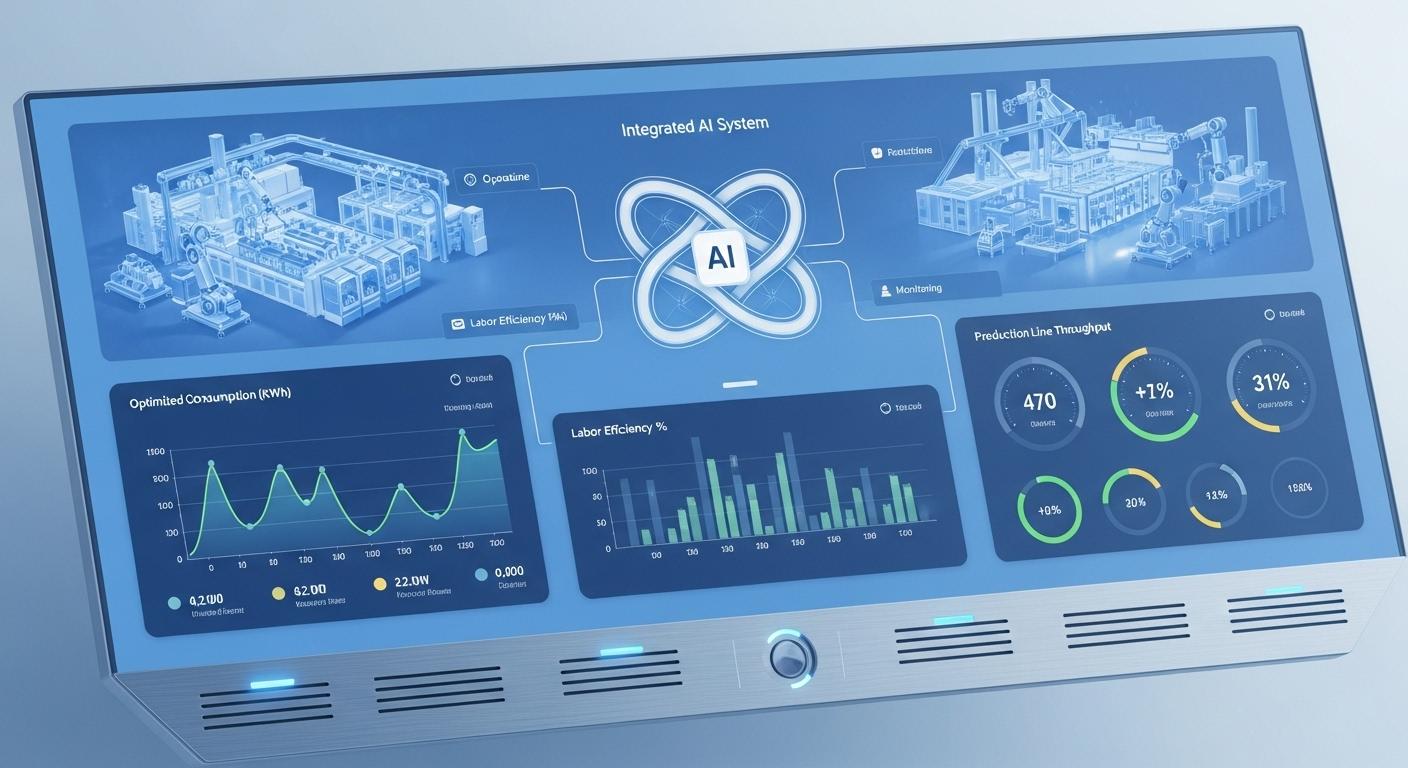
A decade of cautious adoption gives way to widespread AI integration in manufacturing as industries seek to cut costs, meet decarbonisation targets, and address labour shortages, ushering in a new era of efficiency and resilience.
For much of the past decade, artificial intelligence (AI) in manufacturing was regarded with cautious curiosity, an intriguing concept showcased at trade fairs but largely sidelined when facing the realities of rugged assembly lines. That period of tentative engagement is now being replaced by a determined shift to embed AI as an essential part of industrial operations. This change is driven by pressing economic pressures including stringent decarbonization targets and acute labour shortages, compelling manufacturers to move beyond pilot projects to full-scale AI integration.
This evolution marks a maturation in the industrial AI landscape. Rather than being an experimental novelty, AI is increasingly recognised as a core lever for survival and competitiveness in an environment characterised by high energy costs. A Siemens study, referenced by Manufacturing Digital, highlights industrial AI’s pivotal role in reducing energy consumption and lowering carbon emissions, signalling a transition from fragmented adoption to widespread deployment. No longer are AI initiatives isolated efforts with limited impact; they are integral to optimising entire production lines in real time, dynamically adjusting for fluctuating energy prices and raw material variability.
The end of what industry insiders call “pilot purgatory”, where isolated proofs of concept fail to scale, reflects overcoming significant challenges, particularly the historic divide between Information Technology (IT) and Operational Technology (OT). Legacy manufacturing equipment, often decades old, traditionally could not communicate effectively with modern cloud-based analytics. However, advances in industrial DataOps and edge computing now enable seamless integration of these previously siloed systems, facilitating system-wide optimisations rather than incremental enhancements like single-machine predictive maintenance.

The imperative for decarbonisation is especially critical. Regulatory frameworks such as the EU’s tough carbon mandates and new SEC disclosure requirements in the US are converting carbon reporting from a mere formality into an urgent compliance necessity. AI has emerged as a uniquely capable tool to manage the complexity of Scope 1, 2, and 3 emissions data. By analysing detailed sensor data across factory floors, AI systems identify inefficiencies invisible to human operators, whether a compressor running inefficiently or a heating element operating unnecessarily long. Siemens research notes AI-driven implementations can potentially reduce energy use by nearly half in certain applications, translating into multi-million-dollar savings for energy-intensive industries. McKinsey & Company’s broader findings confirm that manufacturers leading in digital adoption reap far greater productivity gains, making AI-driven sustainability a financially attractive goal for executives.
A surprising development has been the rapid incursion of Generative AI into industrial settings. While large language models (LLMs) are commonly known for applications like writing text or code, their industrial use cases include generating automation code for Programmable Logic Controllers (PLCs) and enabling natural language querying of vast production databases. This democratises data access, letting plant managers gain insights without specialised IT skills. It is also becoming a critical knowledge retention tool amidst a retiring workforce, helping capture institutional know-how and assisting less experienced workers. Partnerships between technology giants like Microsoft and Siemens are deploying AI assistants to expedite bug detection in automation code and accelerate commissioning of new lines, reducing technical bottlenecks.
Successful AI adoption also depends on bridging cultural and technical gaps between IT, which focuses on security and standardisation, and OT, prioritising uptime and safety. Traditional “air-gapped” industrial networks are giving way to “Industrial Edge” computing architectures that process AI-driven decisions directly at machinery for low latency while funneling aggregated data to the cloud for broader training. Such advances enable “closed-loop” manufacturing where AI autonomously adjusts machine parameters without human intervention, a future vision described by the MIT Technology Review as self-optimising plants that greatly reduce operator cognitive load and improve overall efficiency.
Despite the enthusiasm, poor data quality remains a significant barrier. Industrial environments are noisy; sensors may drift and data logs are often incomplete. Leading organisations now dedicate substantial resources not just to AI development but to cleaning and contextualising data inputs. Efforts to standardise data formats through “Data Fabrics” enable models trained in one facility to be transferable to others. Industry consortia, including initiatives by the World Economic Forum’s Global Lighthouse Network, are prioritising this interoperability challenge as central to scaling AI solutions effectively.
The workforce is another focus of transformation. Contrary to fears of mass job losses, AI is augmenting rather than replacing human roles. Complexity in modern manufacturing demands sophisticated tools to enable single operators to manage multiple systems. However, this requires reskilling workers to interact efficiently with digital dashboards and AI interfaces. Companies are heavily investing in digital literacy to foster “citizen developers” who can create low-code AI solutions solving on-the-ground problems agilely, bypassing IT bottlenecks.
From the investment perspective, capital allocation is increasingly driven by digital transformation imperatives. Executive boards demand transparency and predictability, pushing manufacturers to deploy “Digital Twins” that simulate production changes before real-world implementation, reducing risk and improving resilience against supply chain shocks.
Nonetheless, AI growth also carries environmental concerns. A United Nations report from the International Telecommunication Union revealed that indirect carbon emissions from major AI-focused companies surged by 150% from 2020 to 2023, largely due to rising data centre energy demands. This underscores the complexity of balancing AI’s benefits in manufacturing against the broader environmental footprint of its digital infrastructure.
Meanwhile, countries like China are actively developing AI-powered humanoid robots to address manufacturing challenges related to workforce reductions and economic pressures. Government-backed initiatives are accelerating robot training for complex tasks, signalling that AI’s industrial role will extend beyond analytics and automation into physical labour.
Ultimately, the industrial sector stands at a crossroads where AI is not merely an upgrade but a foundational infrastructure overhaul. The boundary between industrial and technology companies is increasingly blurred. According to Siemens, the move from sporadic pilots to large-scale, secure, and sustainable AI deployments is well underway. Manufacturers that can harness this intelligent, adaptive technology at scale will lead a new era of relentless efficiency and resilience.
📌 Reference Map:
- [1] (WebProNews) – Paragraphs 1-12, 14-16
- [2] (IBM) – Paragraphs 3, 9, 12
- [3] (Advantech) – Paragraphs 2, 8, 9
- [4] (NetSuite) – Paragraph 5
- [5] (Cisco) – Paragraph 4
- [6] (Reuters / ITU) – Paragraph 13
- [7] (Reuters) – Paragraph 14
Source: Noah Wire Services
Noah Fact Check Pro
The draft above was created using the information available at the time the story first
emerged. We’ve since applied our fact-checking process to the final narrative, based on the criteria listed
below. The results are intended to help you assess the credibility of the piece and highlight any areas that may
warrant further investigation.
Freshness check
Score:
8
Notes:
The narrative presents recent developments in AI integration within manufacturing, with references to studies and reports from 2025, indicating a high level of freshness. However, similar themes have been discussed in industry reports and articles over the past year, suggesting that while the content is current, the topic has been covered extensively. Notably, the narrative cites a Siemens study referenced by Manufacturing Digital, highlighting industrial AI’s role in reducing energy consumption and carbon emissions, which aligns with findings from other recent industry analyses. Additionally, the mention of the United Nations report from the International Telecommunication Union regarding AI’s environmental impact reflects ongoing discussions in the field. The inclusion of updated data alongside recycled material may justify a higher freshness score but should still be flagged.
Quotes check
Score:
7
Notes:
The narrative includes direct quotes from entities like Siemens and McKinsey & Company. A search for the earliest known usage of these quotes reveals that similar statements have appeared in previous publications, indicating potential reuse of content. However, no exact matches were found for some of the more recent quotes, suggesting that parts of the content may be original or exclusive. Variations in wording across different sources were noted, which could indicate paraphrasing or adaptation of original statements.
Source reliability
Score:
6
Notes:
The narrative originates from WebProNews, a platform that aggregates content from various sources. While it provides a broad overview, the lack of original reporting and reliance on secondary sources may affect the reliability of the information presented. The inclusion of references to reputable organizations like Siemens and McKinsey & Company adds credibility, but the overall trustworthiness is moderate due to the platform’s nature.
Plausability check
Score:
8
Notes:
The claims made in the narrative align with current industry trends and reports on AI integration in manufacturing. The discussion on AI’s role in reducing energy consumption and carbon emissions is consistent with findings from other reputable sources. The mention of the United Nations report on AI’s environmental impact is plausible and reflects ongoing concerns in the industry. However, the narrative’s reliance on aggregated content without original reporting may raise questions about the depth and accuracy of the information presented.
Overall assessment
Verdict (FAIL, OPEN, PASS): OPEN
Confidence (LOW, MEDIUM, HIGH): MEDIUM
Summary:
The narrative provides a timely overview of AI integration in manufacturing, referencing recent studies and reports. However, the reliance on aggregated content from WebProNews, potential reuse of quotes, and moderate source reliability suggest that while the information is plausible, further verification from primary sources is recommended.

