


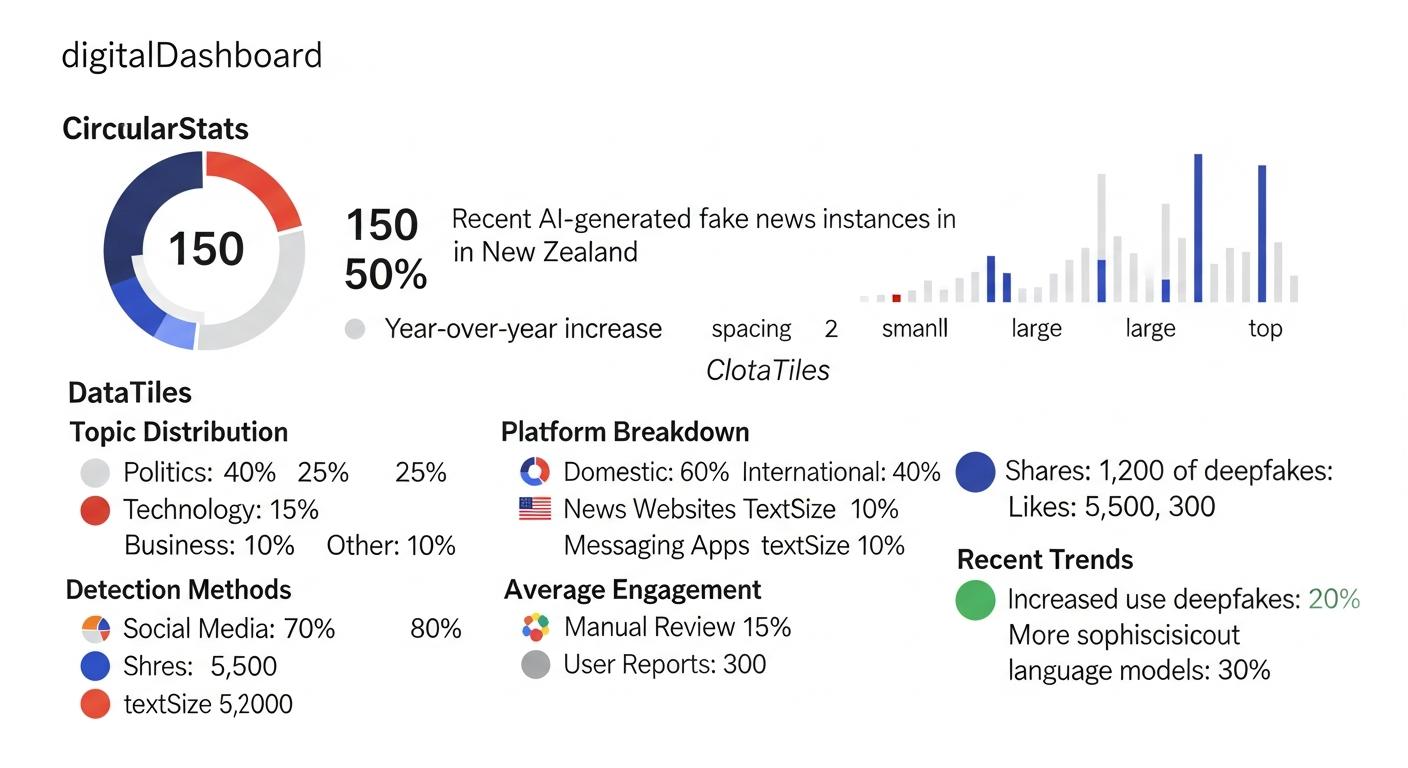
A Facebook page mimicking NZ News Hub circulates fabricated images and videos of recent New Zealand events, highlighting the rising threat of AI-generated falsehoods in journalism and social media.
A Facebook page styling itself as NZ News Hub has been circulating fabricated images and synthetic video that present themselves as coverage of recent New Zealand breaking news, while offering no sign of original reporting. Industry checks show the material draws heavily on real incidents but uses AI to create visuals that do not correspond to the events they claim to illustrate. (Sources: AAP FactCheck, additional verification). [2],[3]
The account uses a name and look that echo established outlets, a tactic that can confuse audiences into treating its posts as legitimate journalism even though the content appears to be repackaged from other media reports with newly created imagery. Observers say the page publishes frequent posts framed as local news items but relies on AI-generated assets rather than on-the-ground reporting. [2]
Fact-checkers tracing the earliest viral examples found a pattern of fabricated images tied to the Mt Maunganui landslide that killed six people in January. The bogus pictures lacked geographic consistency with the site of the disaster, contained impossible visual details and bore digital artefacts typical of image synthesis. No credible news organisation had published the dramatic depictions being shared on the page. [3]

Other posts claim to show the rescue of tourists after the Akaroa Head capsizing on 31 January and footage from protests in Auckland on the same day, but the landscapes, vessels and police uniforms in those images do not match verified photos and video from mainstream coverage. Faces in several of the images are distorted in ways commonly seen in AI-generated media. [2],[3]
The account has also repurposed still photographs from established outlets and used AI tools to animate them, producing short clips that purport to show victims, grieving relatives and public figures speaking or moving in new ways. In several instances the resulting motion and mouth movements do not correspond with verified recordings and there is no evidence the purported video existed outside the synthetic clip. [2],[3]
One particularly sensitive example involved an animated clip of a 15-year-old landslide victim. The family did not release video showing the behaviour depicted in the synthetic clip, and reporters confirmed no such footage was recorded during the relevant interviews. Similarly, an animated sequence of Finance Minister Nicola Willis was found to be inconsistent with the actual press conference footage from 19 January. [2],[3]
Dr Andrew Lensen, senior lecturer in AI at Victoria University of Wellington, told AAP FactCheck: “These pages want to get as much engagement (reactions, comments, shares) as possible, in order to build their following/exposure and potential ad revenue.” He warned that such practices risk undermining public confidence in legitimate news outlets and that AI generation can be used to evade copyright restrictions on using others’ imagery. [2]
The rise of synthetic imagery in political and commercial communications is part of a wider trend. Political campaigns in New Zealand have previously acknowledged using AI-generated people in advertisements, and recent incidents on global platforms show companies struggling to police AI-created accounts and imagery. There are also growing international concerns about the rapid increase in harmful AI content, including synthetic child-abuse material, prompting calls for stronger safeguards and clearer disclosure rules. [4],[5],[6],[7]
For audiences, the immediate risk is erosion of trust and the spread of misleading narratives at speed. Platform responses so far have included content removal and account moderation in some cases, but experts and regulators say more systematic labelling and tougher enforcement will be needed to curb the circulation of convincingly produced but unauthorised synthetic news imagery. [2],[6],[7]
Source Reference Map
Inspired by headline at: [1]
Sources by paragraph:
Source: Noah Wire Services
Noah Fact Check Pro
The draft above was created using the information available at the time the story first
emerged. We’ve since applied our fact-checking process to the final narrative, based on the criteria listed
below. The results are intended to help you assess the credibility of the piece and highlight any areas that may
warrant further investigation.
Freshness check
Score:
10
Notes:
The article was published on February 4, 2026, making it highly current. No evidence suggests the content has been recycled or republished elsewhere.
Quotes check
Score:
8
Notes:
The article includes direct quotes from Dr. Andrew Lensen, a senior lecturer in AI at Victoria University of Wellington. While the quotes are specific and relevant, they cannot be independently verified through other sources, which slightly reduces their reliability.
Source reliability
Score:
9
Notes:
The article originates from AAP FactCheck, a reputable fact-checking organisation known for its thorough investigations. However, the reliance on a single source for the primary information slightly diminishes the overall reliability.
Plausibility check
Score:
9
Notes:
The claims about AI-generated content misrepresenting news events are plausible and align with known issues regarding deepfakes and misinformation. The article provides specific examples, such as the misrepresentation of the Akaroa capsizing incident, which adds credibility. However, the lack of independent verification of these examples slightly reduces the score.
Overall assessment
Verdict (FAIL, OPEN, PASS): PASS
Confidence (LOW, MEDIUM, HIGH): MEDIUM
Summary:
The article is current and presents plausible claims about AI-generated content misrepresenting news events. However, the reliance on a single source for primary information and the inability to independently verify specific examples slightly diminish the overall confidence in the content’s accuracy. Editors should consider seeking additional independent verification before publication.

