


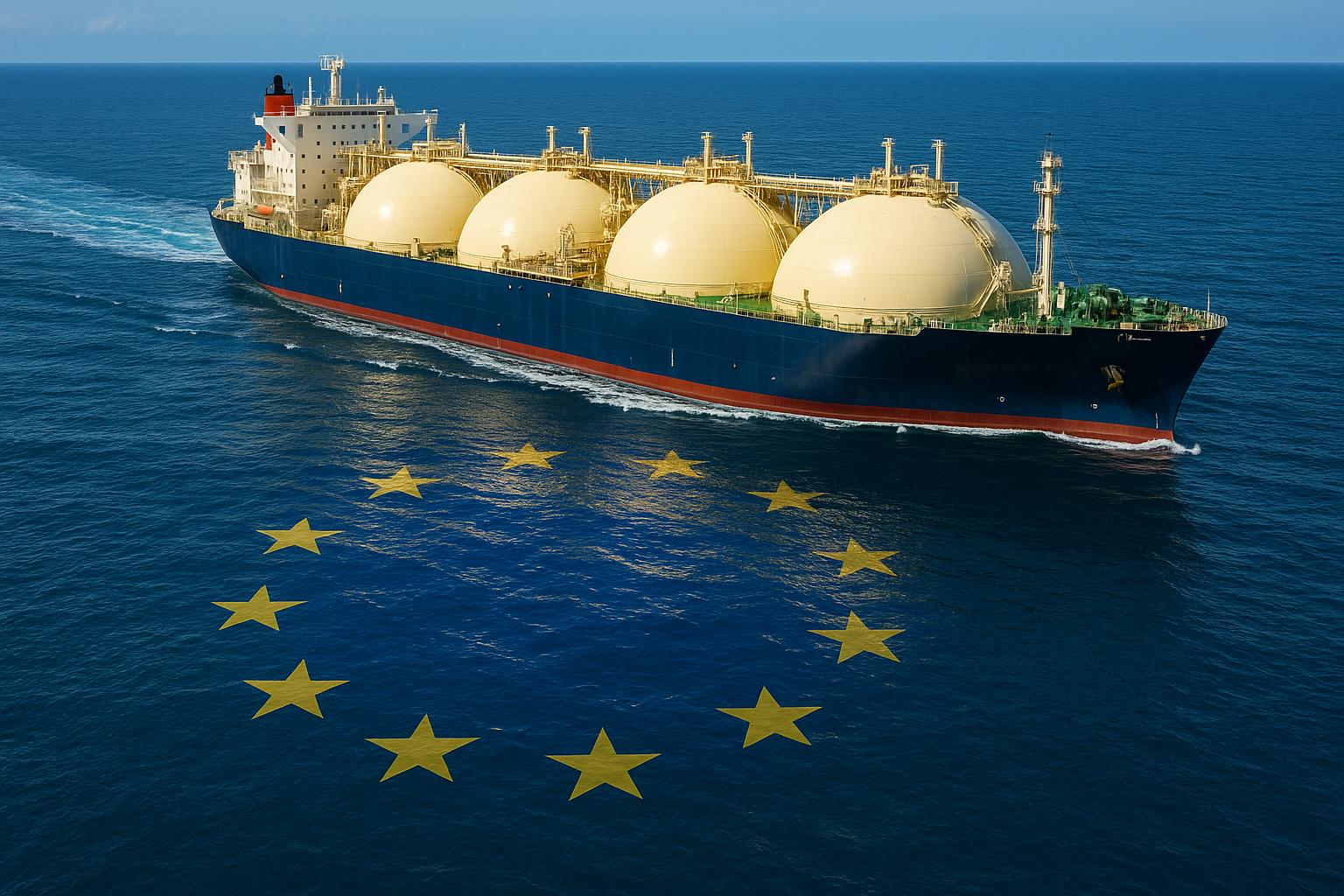
The European Union’s proposed Corporate Sustainability Due Diligence Directive risks disrupting LNG supplies from Qatar and the US, as key exporters warn that stringent climate and labor standards could prompt a strategic exodus from European markets, jeopardising energy security amid ongoing geopolitical shifts.
The European Union’s proposed Corporate Sustainability Due Diligence Directive (CSDDD) has ignited significant concerns over energy security by risking the continuity of vital liquefied natural gas (LNG) supplies from two of the world’s largest exporters, Qatar and the United States. As Europe reduces its reliance on Russian pipeline gas, which plummeted from 150 billion cubic meters (bcm) in 2021 to less than 52 bcm in 2023, it has increasingly turned to LNG imports from Qatar and the US to fill the supply gap. Qatar alone accounted for approximately 8.4 bcm of LNG exports to Europe in 2024, while the US provided around 57 bcm, nearly a quarter of the EU’s gas imports. This shift underpins the EU’s fragile energy landscape, which could be jeopardized by the stringent new legislative requirements set to be phased in between 2027 and 2029.
At the heart of the controversy is the CSDDD’s requirement that companies selling products into the EU demonstrate compliance not only with net-zero emissions targets but also rigorous labor standards, with penalties proposed at up to 5 percent of a company’s global revenues for non-compliance. Despite the European Commission moderating some aspects of the Directive earlier this year, Qatar’s Energy Minister Saad Al-Kaabi, alongside U.S. Energy Secretary Chris Wright, issued an open letter in October 2025 cautioning EU leaders about the legislation’s unintended consequences. They argued that the Directive could undermine LNG export competitiveness and risk the availability of affordable and reliable energy for European consumers. This joint stance reflects broader opposition within the energy industry, with leaders from multinational companies like ExxonMobil and TotalEnergies publicly decrying the Directive as excessive regulatory overreach that might render European markets less attractive.
For Qatar, the stakes are particularly high. Since the EU began phasing out Russian gas imports in response to geopolitical tensions following Russia’s 2022 invasion of Ukraine, Qatari LNG has become a cornerstone of European energy security. Al-Kaabi has been unequivocal in both public and private warnings that Qatar may withdraw from European markets if the CSDDD’s penalties and methane emission rules remain unaltered. Speaking to Al Jazeera, he expressed a readiness to “keep it in the ground” rather than incur substantial fines, underscoring the gravity of the situation. Such a move would align with Qatar’s strategy to redirect LNG volumes toward Asian markets, where demand growth is higher and carbon regulations less prescriptive, though not all of Qatar’s planned production expansions have been fully allocated.

The EU’s attempts to embed climate compliance into global supply chains through the CSDDD and parallel measures like the Carbon Border Adjustment Mechanism (CBAM) reflect a broader aim to enforce decarbonization standards on imports. However, the uncertainty surrounding the Directive is causing unease among exporters, especially given natural gas’s ongoing role in balancing renewable energy generation in Europe. According to the International Energy Agency (IEA), while European gas demand is expected to decline by about 10 percent by 2030, natural gas will remain indispensable for grid stability. Sudden disruptions in LNG supply could destabilize energy prices and erode confidence in Europe’s energy transition.
The timing of this regulatory clash coincides with a marked downturn in LNG project investment globally. The International Gas Union’s 2025 World LNG Report shows that only 14.8 million tons per annum (MTPA) of new liquefaction capacity reached a final investment decision in 2024, the lowest since 2020 and substantially less than the 58.8 MTPA approved in 2023. Notably, many of these new projects incorporate low-carbon technologies such as renewable-powered compressors and carbon capture and storage (CCS). Qatar, for example, is investing in expanding its carbon capture capacity at Ras Laffan, aiming to increase from 2.1 million tons of CO₂ captured annually today to 11 million tons by 2035, positioning itself as a leader in “low-carbon LNG.” Yet the absence of a universally accepted low-carbon LNG certification system complicates the path for Gulf exporters, risking higher compliance costs and potential exclusion from European markets despite their emissions reduction efforts.
Gulf producers are increasingly aware that the global energy transition demands more than just competitive pricing and reliable supply; carbon footprint across the entire value chain has become a critical criterion. Major energy hubs in Saudi Arabia, the UAE, and Qatar are actively developing carbon certification schemes and integrating carbon capture, utilization, and storage (CCUS) into national strategies. Currently, the Gulf accounts for roughly 10 percent of the world’s CO₂ capture capacity, led by facilities in Jubail, Abu Dhabi, and Ras Laffan, with ambitious plans to scale this significantly by 2035. This shift represents an effort to convert decarbonization infrastructure into a competitive advantage amid evolving market demands.
The potential regulatory discord risks accelerating a pivot of LNG trade towards Asia, where economic growth prospects are vibrant and environmental regulations more flexible. Asian markets are projected to drive 60 percent of global GDP growth through 2030, compared with just 7 percent for the EU, offering lucrative opportunities for LNG exporters seeking growth and regulatory certainty. Nevertheless, the EU’s demand, although shrinking, remains significant enough to influence global LNG pricing and contract terms. Hence, maintaining flexible market options between Asia and Europe will be vital for producers like Qatar.
European energy security experts, including industry voices like OMV CEO Alfred Stern, have cautioned that losing Qatar as a supplier would have severe economic and geopolitical repercussions. Stern has called for pragmatism in the EU’s regulatory approach to avoid alienating crucial partners. This point resonates strongly given the EU’s goal to completely halt Russian gas imports by late 2027, a transition that depends heavily on maintaining alternative supply lines from reliable LNG exporters.
The controversy surrounding the CSDDD thus epitomises the broader tension between the EU’s ambitious climate objectives and its immediate energy security needs. Qatar’s threats to halt LNG exports if the Directive’s penalties remain in place represent a serious geopolitical gamble. With Qatar approximately responsible for 12-14 percent of European gas supply since 2022, the risk of supply disruptions could destabilise Europe’s energy transition and economic stability. The standoff highlights the complex challenge of aligning global decarbonization goals with the practical realities of energy market dynamics and geopolitical dependencies.
📌 Reference Map:
- [1] Economy Middle East – Paragraphs 1, 2, 3, 4, 5, 6, 7, 8, 9, 10
- [2] Reuters – Paragraphs 2, 3, 4
- [3] Reuters – Paragraphs 2, 3
- [4] Reuters – Paragraph 7
- [5] Reuters – Paragraph 4
- [6] Reuters – Paragraph 5
Source: Noah Wire Services
Noah Fact Check Pro
The draft above was created using the information available at the time the story first
emerged. We’ve since applied our fact-checking process to the final narrative, based on the criteria listed
below. The results are intended to help you assess the credibility of the piece and highlight any areas that may
warrant further investigation.
Freshness check
Score:
8
Notes:
The narrative presents recent developments regarding the EU’s Corporate Sustainability Due Diligence Directive (CSDDD) and its impact on LNG exports from Qatar and the United States. The earliest known publication date of similar content is October 16, 2025, when Reuters reported on Qatar’s Energy Minister Saad al-Kaabi warning that the EU law could deter business in Europe. ([reuters.com](https://www.reuters.com/business/energy/qatars-energy-minister-warns-eu-law-could-deter-business-europe-2025-10-16/?utm_source=openai)) The report also references a joint letter from Qatar and the U.S. urging the EU to reconsider sustainability rules for LNG trade, dated October 22, 2025. ([reuters.com](https://www.reuters.com/business/energy/qatar-us-urge-eu-reconsider-sustainability-rules-lng-trade-2025-10-22/?utm_source=openai)) Additionally, a report from November 4, 2025, highlights OMV CEO Alfred Stern’s warning that the EU risks losing Qatari gas over the sustainability law. ([reuters.com](https://www.reuters.com/business/energy/omv-ceo-warns-eu-risks-losing-qatari-gas-over-sustainability-law-2025-11-04/?utm_source=openai)) The narrative includes updated data, such as Qatar’s LNG export volumes to Europe in 2024 and the EU’s gas demand projections, which may justify a higher freshness score. However, the core content appears to be based on previously published reports, indicating a moderate level of freshness. The inclusion of updated data suggests an attempt to provide current information, but the reliance on earlier reports and the absence of new, exclusive insights limit the freshness score.
Quotes check
Score:
7
Notes:
The narrative includes direct quotes from Qatar’s Energy Minister Saad al-Kaabi, such as his readiness to “keep it in the ground” rather than incur substantial fines. This specific quote was reported by Reuters on October 16, 2025. ([reuters.com](https://www.reuters.com/business/energy/qatars-energy-minister-warns-eu-law-could-deter-business-europe-2025-10-16/?utm_source=openai)) The same source also includes his warning that the EU law could deter business in Europe. These quotes appear to be reused from earlier reports, indicating a moderate level of originality. The presence of identical quotes in earlier material suggests that the content may not be entirely original.
Source reliability
Score:
6
Notes:
The narrative originates from Economy Middle East, a regional news outlet. While it provides detailed coverage of the topic, the outlet’s reputation and editorial standards are not widely known, which raises questions about its reliability. The report references information from reputable organizations, such as Reuters, which adds credibility to the content. However, the reliance on a less established source for the primary narrative introduces some uncertainty regarding the overall reliability.
Plausability check
Score:
8
Notes:
The claims made in the narrative align with recent developments reported by reputable sources. For instance, Qatar’s Energy Minister Saad al-Kaabi’s warning about the EU law’s impact on LNG exports was reported by Reuters on October 16, 2025. ([reuters.com](https://www.reuters.com/business/energy/qatars-energy-minister-warns-eu-law-could-deter-business-europe-2025-10-16/?utm_source=openai)) Similarly, the joint letter from Qatar and the U.S. urging the EU to reconsider sustainability rules for LNG trade, dated October 22, 2025, is consistent with the narrative’s claims. ([reuters.com](https://www.reuters.com/business/energy/qatar-us-urge-eu-reconsider-sustainability-rules-lng-trade-2025-10-22/?utm_source=openai)) The inclusion of updated data, such as Qatar’s LNG export volumes to Europe in 2024 and the EU’s gas demand projections, further supports the plausibility of the narrative. The language and tone are consistent with typical corporate and official communications, and there are no excessive or off-topic details unrelated to the claim. The narrative does not exhibit unusual drama or vagueness, and the structure is coherent and focused on the main topic.
Overall assessment
Verdict (FAIL, OPEN, PASS): OPEN
Confidence (LOW, MEDIUM, HIGH): MEDIUM
Summary:
The narrative presents a timely and plausible account of the EU’s Corporate Sustainability Due Diligence Directive and its potential impact on LNG exports from Qatar and the United States. While the content is based on previously published reports, the inclusion of updated data and references to reputable sources suggest a moderate level of originality and reliability. The reliance on a less established source for the primary narrative introduces some uncertainty regarding the overall reliability. Given the moderate freshness, originality, and source reliability, the overall assessment is OPEN with medium confidence.

