


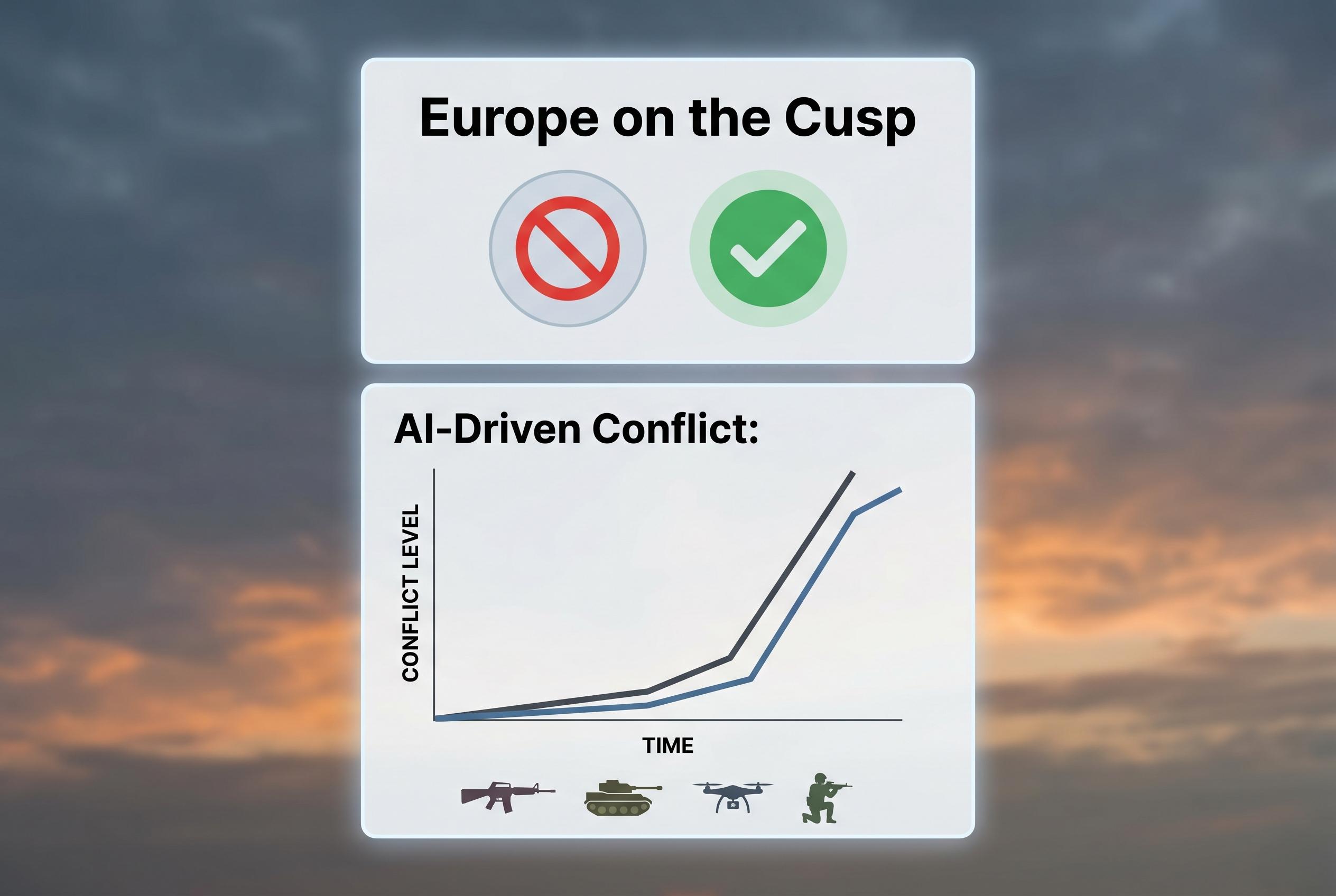
As artificial intelligence reshapes conflict zones from Ukraine to Gaza, Europe must decide whether to impose strict limits on automated decision-making or risk normalising a new era of rapid, uncertain warfare driven by machine certainty.
Artificial intelligence is reshaping modern conflict, but not in the clean, decisive way its champions once promised. Instead of eliminating the uncertainty that has always shadowed warfare, it is creating a new kind of confusion: one driven not by a shortage of information, but by an excess of machine-generated certainty. That shift is now visible in conflicts from Ukraine and Gaza to the recent fighting involving Iran, where AI has been used to speed targeting, coordinate defences and compress decision-making into ever shorter windows. According to recent commentary from Carnegie, the central question for Europe is no longer whether AI will enter war, but whether democracies can impose limits before automated judgement becomes routine.
The military appeal is obvious. AI can sift huge volumes of sensor data, support air defence against incoming missiles and help commanders move faster than an adversary. Reporting from Kiplinger said the U.S. military has embraced systems for mission planning, threat detection, logistics and cyber defence, reflecting a broader doctrine that speed itself is a battlefield advantage. That logic has also shaped the current wave of defence innovation, from the Pentagon’s experimentation with AI-assisted systems to the use of commercial tools in intelligence analysis. Yet the same sources warn that rapid adoption is running ahead of ethical safeguards, raising questions about civilian protection and accountability.
Recent wars have made those concerns concrete. Chatham House said the U.S.-Israeli campaign against Iran showed how AI-supported targeting systems are increasingly woven into live operations, while Brookings described the deployment of generative AI in Operation Epic Fury as part of a broader shift toward machine-assisted strike planning. Al Jazeera reported that U.S. Central Command acknowledged using advanced AI tools to process vast quantities of data in the war against Iran. In parallel, Time has documented how Israel’s use of systems such as Lavender, The Gospel and Where’s Daddy? in Gaza enabled extremely rapid targeting, while also fuelling worries about civilian harm and automation bias.

The deeper problem is that AI does not merely accelerate the old fog of war; it can manufacture an illusion of clarity. Probabilistic targeting lists, algorithmic scores and automated recommendations may look authoritative, but they can also outpace the ability of human operators to challenge them meaningfully. Carnegie argued that this creates a new accountability gap, with responsibility diffused across developers, data specialists, procurement officials and commanders until no single actor fully owns the decision to strike. The result is a human presence in the loop that may be legally visible but operationally hollow.
For Europe, the strategic dilemma is urgent. On one hand, it wants to build a defence industrial base that can compete with the United States and China, and Brussels has begun laying groundwork through initiatives aimed at drones, counter-drone systems and wider military innovation. On the other, it risks copying a model in which speed eclipses judgement. The more ambitious path, Carnegie suggested, would be to make deliberation itself a feature of military design: slowing some targeting cycles, hard-wiring human review into the AI lifecycle and setting enforceable red lines on autonomous weapons and mass surveillance. Whether Europe does so may determine not only how it fights, but what kind of warfare it is willing to normalise.
Source Reference Map
Inspired by headline at: [1]
Sources by paragraph:
Source: Noah Wire Services
Noah Fact Check Pro
The draft above was created using the information available at the time the story first
emerged. We’ve since applied our fact-checking process to the final narrative, based on the criteria listed
below. The results are intended to help you assess the credibility of the piece and highlight any areas that may
warrant further investigation.
Freshness check
Score:
8
Notes:
The article was published on April 16, 2026, making it current. However, the topic of AI in warfare has been extensively covered in recent months, with similar discussions appearing in March 2026. ([chathamhouse.org](https://www.chathamhouse.org/2026/03/iran-war-highlights-creeping-use-ai-warfare?utm_source=openai)) This suggests that while the article is fresh, the subject matter is not entirely new.
Quotes check
Score:
7
Notes:
The article includes direct quotes from Admiral Brad Cooper regarding the use of AI tools in military operations. ([aljazeera.com](https://www.aljazeera.com/news/2026/3/11/us-military-confirms-use-of-advanced-ai-tools-in-war-against-iran?utm_source=openai)) These quotes are verifiable and have been reported by multiple reputable sources. However, the article does not provide direct links to these sources, which could enhance transparency and trustworthiness.
Source reliability
Score:
9
Notes:
The article is published by the Carnegie Endowment for International Peace, a well-respected think tank. The author, Raluca Csernatoni, is affiliated with Carnegie Europe, indicating expertise in European security and defense matters. The sources cited within the article, such as Al Jazeera and Chatham House, are also reputable. However, the article relies heavily on secondary sources, which may introduce biases or inaccuracies.
Plausibility check
Score:
8
Notes:
The claims regarding the use of AI in military operations, particularly in the Iran conflict, are plausible and align with reports from other reputable outlets. ([aljazeera.com](https://www.aljazeera.com/news/2026/3/11/us-military-confirms-use-of-advanced-ai-tools-in-war-against-iran?utm_source=openai)) The article also discusses the implications for European defense policy, which is a relevant and timely topic. However, the article does not provide new evidence or insights beyond existing reports, which may limit its originality.
Overall assessment
Verdict (FAIL, OPEN, PASS): PASS
Confidence (LOW, MEDIUM, HIGH): MEDIUM
Summary:
The article is current and published by a reputable source. It discusses the use of AI in military operations, a topic covered by other outlets in March 2026. The quotes are verifiable, and the content is factual. However, the reliance on secondary sources and the lack of direct links to primary sources raise concerns about verification independence. While the article provides valuable insights, the absence of new evidence or perspectives beyond existing reports limits its originality. Editors should consider these factors when deciding to publish.

