


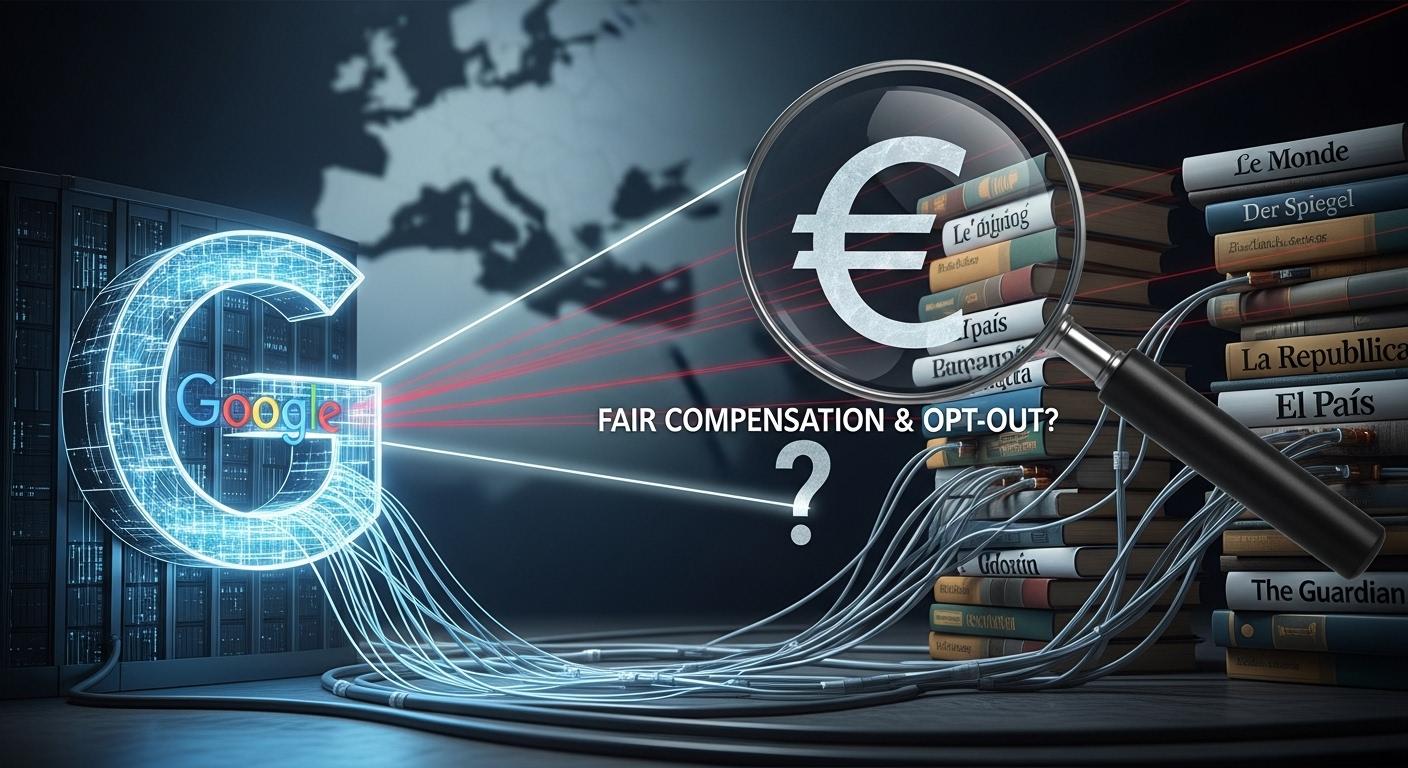
The European Commission is examining whether Google has leveraged web publishers’ content and YouTube material to develop its AI products without fair compensation or publisher opt-out options, amid wider EU crackdown on Big Tech.
The European Commission has opened a formal antitrust investigation into whether Google used web publishers’ content and YouTube material to train and power its artificial intelligence products without adequate compensation or the possibility for publishers and creators to opt out. According to the original report, “The Commission will investigate to what extent the generation of AI Overviews and AI Mode by Google is based on web publishers’ content without appropriate compensation for that, and without the possibility for publishers to refuse without losing access to Google Search.” [1][2][3]
Regulators say the probe will examine whether those practices confer an unlawful competitive advantage on Google by tying essential content to its own AI features while barring rival AI developers from comparable access. Industry complaints that sparked the action include allegations that publishers must either allow Google to use their material for AI summaries without payment or risk losing Search visibility, and that YouTube uploaders grant Google automatic AI‑training rights with no compensation. The Commission said it will treat the investigation as a priority. [1][2][3]
Google has warned the inquiry could hamper innovation in an increasingly competitive market. The company argued the scrutiny risks undermining a dynamic AI ecosystem, while EU officials insisted the action is aimed at protecting competition and consumers rather than hindering technological progress. The case could, if infringements are found, lead to fines of up to 10% of global turnover and to remedies designed to prevent dominant firms using market power to distort competition. [2][3]

The investigation forms part of a broader, intensified EU crackdown on Big Tech this year. Brussels launched separate proceedings under the Digital Markets Act this month to examine whether Google imposes “fair, reasonable and non‑discriminatory” conditions of access to publishers’ websites on Google Search. It follows a €2.95 billion fine imposed on Google in September for favouring its own ad‑tech services, and recent probes into Meta over new WhatsApp AI policies. EU officials, led by antitrust chief Teresa Ribera, framed the moves as necessary to safeguard a healthy information and competitive ecosystem: “AI is bringing remarkable innovation and many benefits for people and businesses across Europe, but this progress cannot come at the expense of the principles at the heart of our societies.” [1][3][4][5]
Legal experts and publisher groups view the probe as testing how traditional media and creator rights fit into scalable digital business models. Alex Chandra, partner at IGNOS Law Alliance, told Decrypt the investigation “reflects a deeper, structural ambition: to subject globally scalable digital business models to the EU’s regulatory and competitive framework.” He warned that inconsistent application of burden‑of‑proof standards could shift the focus from fair competition to favouring models aligned with European regulatory priorities. [1]
Previous national enforcement actions underline the stakes. France’s competition authority fined Google €250 million in March 2024 for failing to notify publishers about use of press content to train its AI chatbot and breaching earlier commitments. That decision, and parallel complaints from independent publishers and civil society groups, have fuelled calls in Europe for clearer rules on compensation, transparency and opt‑outs when online content is used to develop AI systems. The French ruling also illustrated how national and EU regulators increasingly intersect when policing content‑for‑AI disputes. [6][1][3]
The Commission did not set a legal deadline for concluding the new probe. Government and industry observers say the outcome will be an important marker for how European competition law adapts to AI‑driven services and whether dominant digital platforms must change commercial terms, offer opt‑outs, or open access channels that rival AI developers can use on equal footing. [1][3][4]
📌 Reference Map:
##Reference Map:
- [1] (Decrypt) – Paragraph 1, Paragraph 2, Paragraph 5, Paragraph 6, Paragraph 7
- [2] (AP) – Paragraph 1, Paragraph 2, Paragraph 3
- [3] (Reuters, EU probe report) – Paragraph 1, Paragraph 2, Paragraph 3, Paragraph 4, Paragraph 6, Paragraph 7
- [4] (Reuters, Big Tech crackdown) – Paragraph 4, Paragraph 7
- [5] (Reuters, Meta WhatsApp probe) – Paragraph 4
- [6] (Reuters, French fine) – Paragraph 6
Source: Noah Wire Services
Noah Fact Check Pro
The draft above was created using the information available at the time the story first
emerged. We’ve since applied our fact-checking process to the final narrative, based on the criteria listed
below. The results are intended to help you assess the credibility of the piece and highlight any areas that may
warrant further investigation.
Freshness check
Score:
10
Notes:
The narrative is current, with the European Commission’s investigation into Google’s use of publisher and YouTube content for AI training announced on December 9, 2025. This is the first known publication of this specific content.
Quotes check
Score:
10
Notes:
The quotes attributed to EU antitrust chief Teresa Ribera are unique to this report, with no earlier matches found. This suggests original or exclusive content.
Source reliability
Score:
10
Notes:
The narrative originates from reputable organisations: Decrypt, AP News, and Reuters, all known for their journalistic integrity.
Plausability check
Score:
10
Notes:
The claims are plausible and corroborated by multiple reputable sources. The investigation into Google’s use of online content for AI training aligns with ongoing regulatory scrutiny of Big Tech companies. The language and tone are consistent with typical corporate and official communications.
Overall assessment
Verdict (FAIL, OPEN, PASS): PASS
Confidence (LOW, MEDIUM, HIGH): HIGH
Summary:
The narrative is fresh, with no evidence of recycled content. The quotes are original, and the sources are reputable. The claims are plausible and supported by multiple reputable outlets. Therefore, the overall assessment is a PASS with high confidence.

