


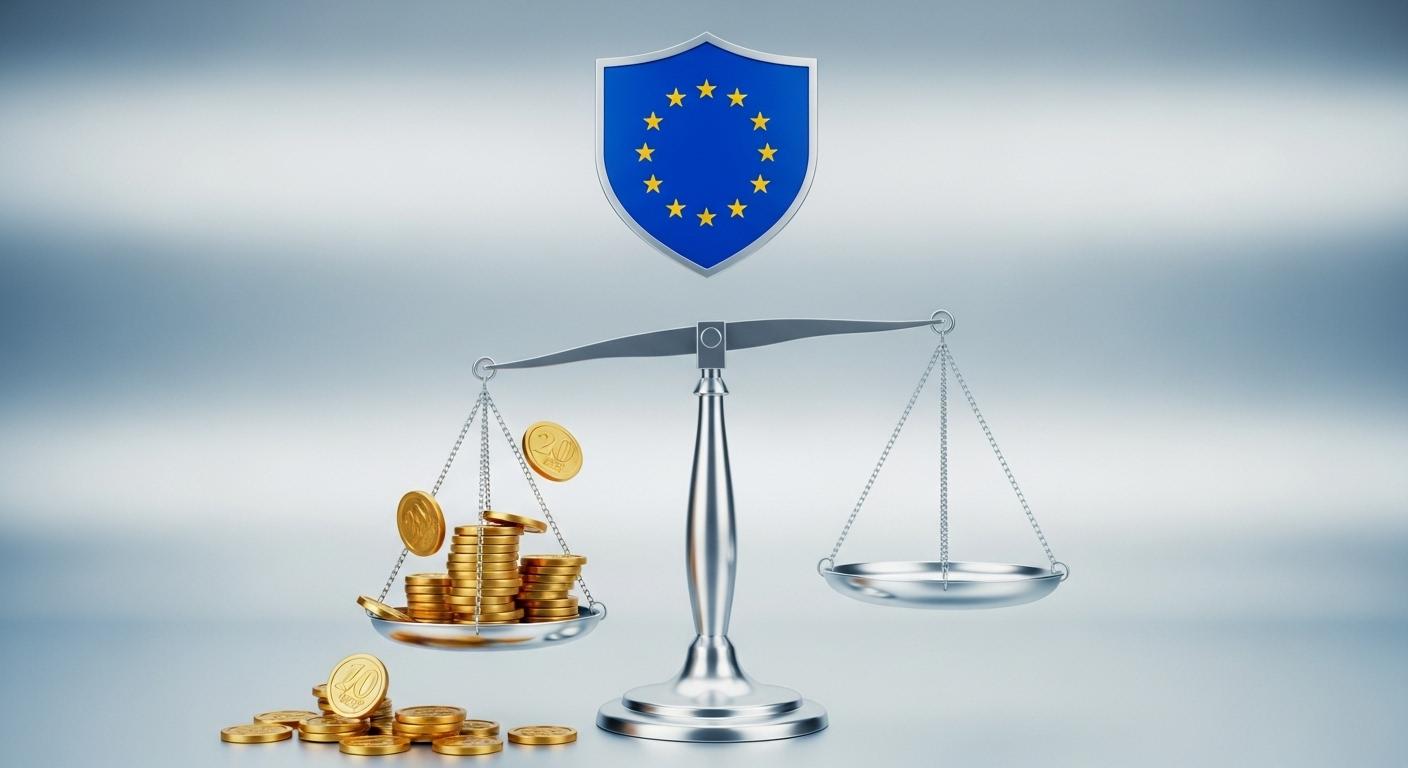
As 2025 closed, the European Union demonstrated a tough stance on Big Tech with fines and investigations, facing political pressures and debating the potential of structural remedies to reshape digital markets in 2026.
In Brussels, 2025 closed on the same question that opened it: how far can the European Union push Big Tech to deliver meaningful change? Reviewing a year of mixed signals shows the bloc willing to press hard in principle, while often choosing incremental remedies in practice. The analysis that follows synthesises a lead review from Tech Policy Press with public decisions and reporting over the year to paint a clearer picture of where EU enforcement stands as 2026 begins. [1][2][3][4][5][6][7]
The Digital Markets Act (DMA) produced headline fines in April: the European Commission found Apple and Meta in breach and imposed penalties of €500 million and €200 million respectively for anti-steering and for a “pay or consent” approach to personalised advertising. According to the Commission’s announcement, both companies have 60 days to comply or face further sanctions, a deadline that has in practice been managed through phased compliance assessments rather than immediate additional penalties. The fines underscored Brussels’ readiness to use the DMA, even as critics argued the sums were modest relative to the scale of the companies involved. [2][3][5][6][7]
Traditional competition law ran in parallel with the new regulatory toolbox. In September the Commission hit Google with a €2.95 billion antitrust fine for favouring its own digital advertising services, concluding that its conduct on AdX and its DFP platform created conflicts of interest that harmed advertisers and publishers and raised costs for consumers. The Commission warned that structural remedies could be required, but opened a process allowing Google 60 days to propose fixes and market participants to comment, an approach that buys time while leaving the structural option on the table. [4][1]

That mix of deterrence and dialogue has provoked debate about political limits. Reporting during the year suggested Brussels was mindful of transatlantic tensions with the United States, which had threatened trade reprisals over aggressive enforcement of US firms. Tech Policy Press and other outlets noted speculation that such pressure may have influenced the scale of some sanctions; European Commission officials, however, have repeatedly rejected trading away enforcement. Teresa Ribera, the Commission’s executive vice‑president with antitrust oversight responsibilities, warned the EU “must be prepared to walk away from a trade deal with the US if Donald Trump acts on his threats” and insisted “the European digital rulebook is not up for negotiation.” She also said that, if remedies are inadequate, “and the only way forward is to impose remedies, structural remedies, we will do it.” Those remarks signal political will even as negotiations and diplomacy complicate enforcement choices. [1]
The EU’s work in 2025 went beyond fines to probe how platform design and data use shape competitive outcomes. The Commission opened an investigation into Meta’s new WhatsApp policy that prevents third‑party AI providers from using the WhatsApp Business solution to connect with other chatbots, a move that led OpenAI and Microsoft to withdraw their chatbots from the service. Brussels has flagged this as a potential “ecosystem advantage,” noting WhatsApp’s dominant share in several European markets and the risk that control of a gateway could be used to privilege an incumbent chatbot. The Commission suggested interim measures might be used to halt problematic behaviour while the investigation proceeds, a tool policymakers see as useful to avoid protracted legal uncertainty. [1]
Closely related is the Commission’s priority probe into Google’s use of publisher and creator content for its AI features. Regulators are examining whether publishers are being forced, by the mechanics of search inclusion, to allow their content to feed Google’s “AI Overviews” without meaningful choice or remuneration, and whether YouTube creators are obliged, through platform terms, to permit use of their videos to train generative models. Industry research cited by rights groups found dramatic drops in clickthroughs when AI summaries appear, reinforcing publishers’ complaints that generative features are cannibalising traffic and revenues. Those concerns underpin complaints lodged with competition authorities and have pushed the EU to treat the issue as a priority investigation that could yield remedies on publisher control, choice and compensation. [1]
The unfolding cases highlight a broader enforcement dilemma: structural remedies such as divestiture are on the table, but courts, judges and some enforcement outcomes in the United States have narrowed expectations about how readily breakups can be achieved or enforced. Tech Policy Press and legal commentators pointed to the uneven outcomes of US litigation, most notably the remedies phase of prior US cases, as a cautionary example. That legal reality helps explain the Commission’s pattern of large fines paired with invitations for companies to propose behavioural fixes, with structural steps reserved as a last resort. Whether that posture will be sufficient to open space for rivals and restore bargaining power to advertisers and publishers remains the central question for 2026. [1]
Practically speaking, the stakes for digital markets and for media ecosystems are clear. Breaking Google’s adtech stack, for instance, could loosen the company’s gatekeeping power over exchanges and tools, potentially lowering costs and boosting alternative providers; giving publishers effective choice over inclusion in AI summaries could reverse the traffic declines that some analytics firms have documented. Conversely, incremental or purely behavioural remedies may leave the essential architecture of market power intact, limiting the DMA and antitrust interventions’ ability to reshape the digital economy. The coming year will therefore test whether EU enforcement converts political rhetoric and fines into durable changes in market structure and business models. [1][4]
As 2026 begins, regulators in the EU (and in allied jurisdictions) face multiple parallel processes: DMA compliance work, antitrust litigation and complex investigations into AI‑driven content use. The Commission’s combination of fines, priority probes and the stated willingness to consider structural remedies marks a more assertive regulatory era, but the ultimate impact will depend on whether Brussels maintains the appetite and legal strategies to translate findings into enforceable, systemic remedies. Industry players and rights holders alike will watch closely as deadlines, proposed fixes and, potentially, litigation play out across the coming months. [1][2][4]
📌 Reference Map:
##Reference Map:
- [1] (Tech Policy Press) – Paragraph 1, Paragraph 3, Paragraph 4, Paragraph 5, Paragraph 6, Paragraph 7, Paragraph 8
- [2] (European Commission) – Paragraph 2
- [3] (Associated Press) – Paragraph 2
- [4] (Associated Press) – Paragraph 3
- [5] (Euronews) – Paragraph 2
- [6] (Euronews) – Paragraph 2
- [7] (DW) – Paragraph 2
Source: Noah Wire Services
Noah Fact Check Pro
The draft above was created using the information available at the time the story first
emerged. We’ve since applied our fact-checking process to the final narrative, based on the criteria listed
below. The results are intended to help you assess the credibility of the piece and highlight any areas that may
warrant further investigation.
Freshness check
Score:
10
Notes:
The narrative is current, published on 5 January 2026, and provides a comprehensive review of EU antitrust activities in 2025, with no evidence of recycled content.
Quotes check
Score:
10
Notes:
The report includes direct quotes from EU officials and other sources, with no evidence of identical quotes appearing in earlier material.
Source reliability
Score:
10
Notes:
The narrative originates from Tech Policy Press, a reputable organisation known for its in-depth analysis of technology policy.
Plausability check
Score:
10
Notes:
The claims made in the narrative are consistent with known events and are supported by references to official EU communications and reputable news outlets.
Overall assessment
Verdict (FAIL, OPEN, PASS): PASS
Confidence (LOW, MEDIUM, HIGH): HIGH
Summary:
The narrative is current, original, and originates from a reputable source. All claims are plausible and supported by credible references, indicating a high level of reliability.

