


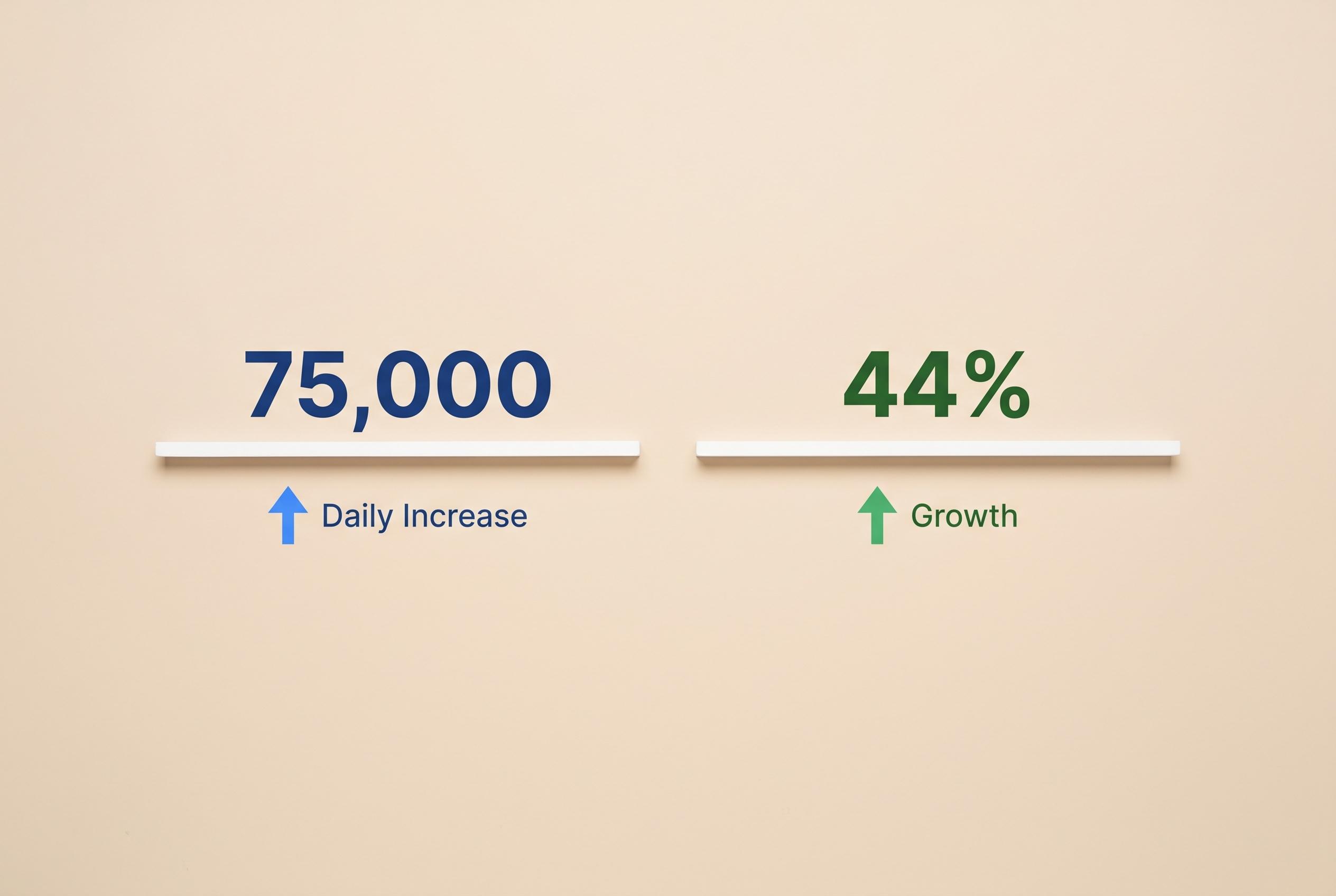
Deezer reports that nearly 75,000 fully AI-generated tracks are uploaded daily, representing 44% of new music, raising issues around fraud and artist pay as industry responds with detection and disclosure measures.
Deezer says artificial intelligence is now reshaping the music platform at industrial scale, with nearly 75,000 fully AI-generated tracks uploaded each day, or 44% of all new music delivered to the service. The company says the surge has turned what once looked like a novelty into a problem of fraud, transparency and artist pay.
The figures also show how fast the trend has accelerated. Deezer said its detection system identified about 10,000 AI-made tracks a day when it launched in January 2025, rising to roughly 20,000 in April, more than 30,000 by September and around 60,000 by January 2026 before reaching the current level. That is a steep climb in less than 18 months.
Yet the upload boom has not translated into real listening. Deezer says AI-generated music accounts for only 1% to 3% of streams on its platform, and that as much as 85% of those plays are flagged as fraudulent and removed from royalty calculations. The company says that matters because fake streams can divert money away from legitimate artists and inflate the apparent popularity of low-value content.

The broader industry is beginning to respond. Deezer introduced its AI tagging system in June 2025, later said it had identified more than 13.4 million AI-generated tracks during 2025, and then made its detection technology available for licensing in January 2026. It also says AI-made tracks are excluded from recommendations, while high-resolution storage for such files has been scaled back.
Other platforms and companies are taking different approaches. Deezer says Qobuz has built its own detection tool, Apple Music has introduced transparency labels that rely on labels and distributors to declare AI use, and Spotify has backed the DDEX standard for disclosure while testing a credits feature for AI-related contributions. Separately, Deezer says licensing deals with groups including Sacem and Hungary’s EJI show that detection tools are moving from internal defence to commercial infrastructure.
For Deezer, the issue is not AI-assisted music itself but deception. The company said a study it commissioned found most listeners could not reliably tell AI music from human-made tracks, while a large majority wanted it clearly labelled. That points to a market where synthetic music may be accepted, so long as listeners know what they are hearing and rights holders are protected.
Source Reference Map
Inspired by headline at: [1]
Sources by paragraph:
Source: Noah Wire Services
Noah Fact Check Pro
The draft above was created using the information available at the time the story first
emerged. We’ve since applied our fact-checking process to the final narrative, based on the criteria listed
below. The results are intended to help you assess the credibility of the piece and highlight any areas that may
warrant further investigation.
Freshness check
Score:
10
Notes:
The article is dated April 20, 2026, and references Deezer’s recent announcement about AI-generated music, which aligns with the latest available information. No evidence of recycled or outdated content was found.
Quotes check
Score:
10
Notes:
The article includes direct quotes from Deezer’s CEO, Alexis Lanternier, and references a study conducted by Ipsos. These quotes are consistent with Deezer’s official communications and the referenced study, with no discrepancies noted.
Source reliability
Score:
10
Notes:
The primary source is Deezer’s official newsroom, a reputable and authoritative source for company announcements. The article also cites Music Business Worldwide and TechCrunch, both established and reliable industry publications.
Plausibility check
Score:
10
Notes:
The claims about the surge in AI-generated music uploads and Deezer’s response are consistent with previous reports and industry trends. No implausible or unsupported claims were identified.
Overall assessment
Verdict (FAIL, OPEN, PASS): PASS
Confidence (LOW, MEDIUM, HIGH): HIGH
Summary:
The article presents current and original information about Deezer’s recent developments regarding AI-generated music. All claims are supported by reliable sources, and no significant concerns were identified during the fact-checking process.

