


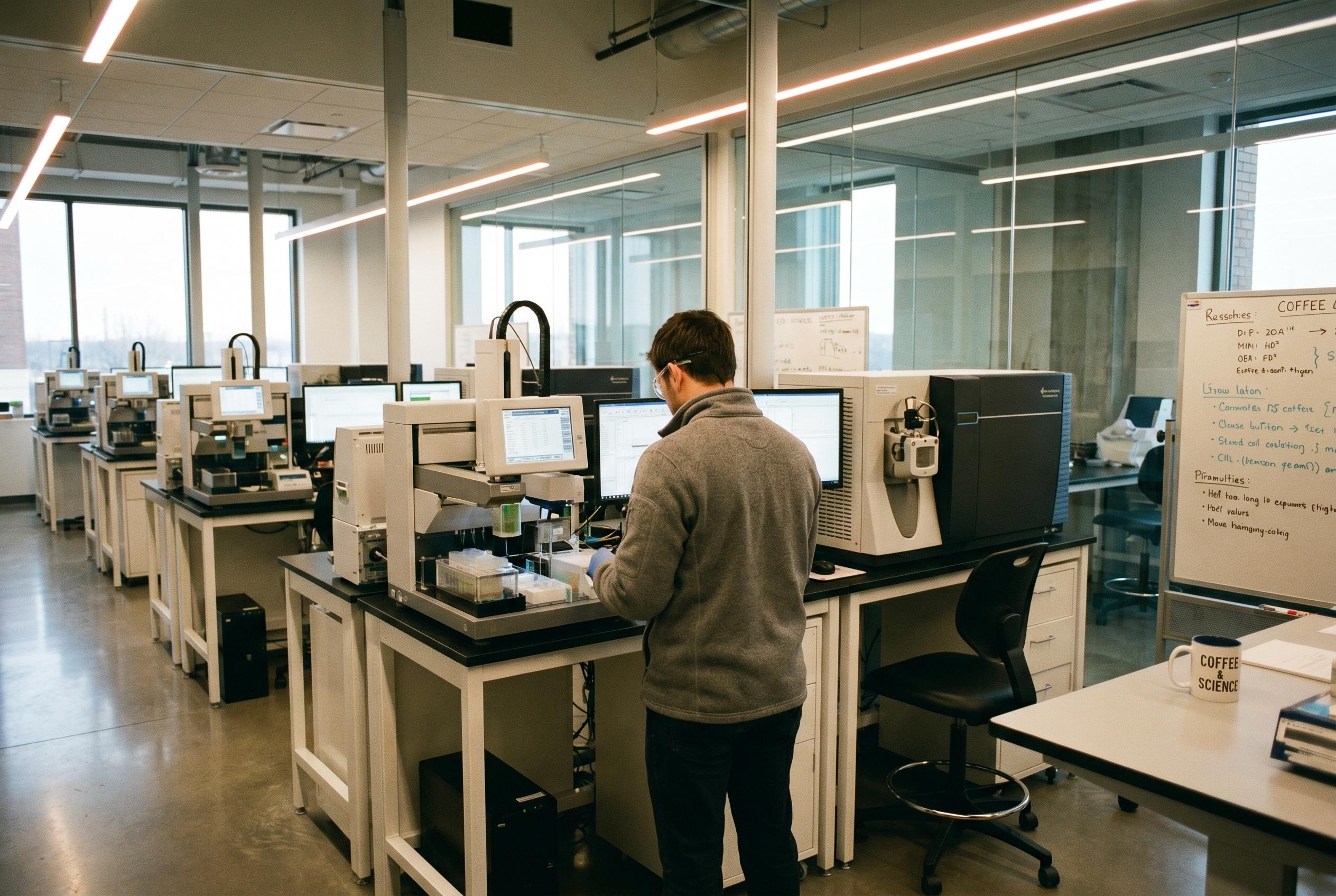
Shoppers are turning to cloud giants and AI labs as drug discovery gets a tech makeover , here’s who’s doing what, why it matters, and how these platforms could shave years and millions off the path from idea to patient.
Essential Takeaways
- Platform push: AWS, OpenAI and Anthropic are rolling life‑science platforms that stitch AI, cloud and lab partners into end‑to‑end workflows.
- Lab integration: Amazon Bio Discovery links models to wet‑lab partners for rapid validation, cutting weeks or months from candidate testing.
- Specialist models: GPT‑Rosalind and Claude for Life Sciences are tailored reasoning engines with connectors to literature and lab tools.
- Infrastructure matters: NVIDIA and cloud providers emphasise domain‑specific acceleration and integrated compute stacks to run heavy biology workloads.
- Practical tip: Pick a platform by workflow fit , data isolation, lab access, and protocol understanding are the real differentiators.
Why big tech is suddenly a serious lab partner
If you thought chips and cloud services were distant from pipettes and plates, think again; the boundary is blurring and it feels a bit like the lab just got a software update. Companies such as AWS, OpenAI and Anthropic are building platforms that don’t just predict molecules , they help pick models, design experiments and route results back into the system. That loop matters because drug timelines are measured in years and failures are common; anything that speeds iteration is valuable. According to life‑science announcements and product launches, the emphasis is on combining AI reasoning with practical lab workflows so teams can move from in‑silico ideas to wet‑lab tests far more rapidly.
Amazon’s “lab‑in‑the‑loop” approach , how it actually works
Amazon Bio Discovery demonstrates the idea: a marketplace of biological models plus AI agents that suggest experiments, and built‑in connections to contract research organisations for validation. The platform is designed to let organisations keep proprietary data private while tapping open models and partners, which is crucial for pharma clients. For teams that dread engineering overhead, the benefit is clear , the tooling reduces the need for bespoke compute stacks and lets scientists spend more time on biology than infrastructure. If you’re choosing a platform, ask whether it includes lab partners or just spec sheets; having a validation pipeline in one place is increasingly a deciding factor.

Tailored reasoning: GPT‑Rosalind and Claude for Life Sciences
Not every model is interchangeable. OpenAI’s GPT‑Rosalind and Anthropic’s Claude for Life Sciences illustrate the trend toward specialised reasoning engines that understand protocols, literature and sequence manipulation. These models aren’t generic chatbots repackaged for research , they’re tuned to tasks like hypothesis generation, protocol QA and cloning design, and they connect to scientific databases and tools. For researchers, that means fewer false starts and more usable outputs, but access models vary: some tools are in trusted‑access programmes while others offer broader enterprise integration. Practically, teams should pilot models on concrete tasks , say, construct design or literature synthesis , to judge real‑world value.
The compute story: why hardware and integration still matter
Behind the glossy demos is heavy lifting: protein folding, molecular simulation and multiomics ingestion need fast, specialised compute. NVIDIA and leading cloud providers are arguing that “accelerated computing” needs domain‑specific stacks, not just faster chips. That’s relevant because the easiest platform to adopt is often the one that removes engineering friction: preconfigured infrastructure, optimised runtimes and vertical integrations let labs run more experiments per dollar. If you manage budgets, track not just licence fees but expected compute costs and whether the vendor offers hooks to your existing pipelines.
What this means for startups and established pharma
The shift frees startups from building every layer themselves, but it also forces a strategic choice: which platform to build on. Venture and industry voices observe that the market isn’t about a single winner; it’s about which layer a team wants to own. For a biotech with unique assays, platform choice hinges on data portability, partner ecosystems and whether the platform supports private models. Large pharma may prefer cloud partners that guarantee isolation and compliance; smaller teams might prioritise direct model access and lower barriers to lab validation. Either way, the era of one‑off models is ending , platformisation is the new norm.
Picking a platform: simple, practical guidance
Start with your bottleneck. If you struggle to validate candidates, favour platforms with lab integration and CRO partners. If protocol interpretation and documentation are your pain points, look for models with strong protocol QA and digital notebook connectors. Always verify data governance , customer‑owned models and clear isolation are non‑negotiable for proprietary work. Finally, run a short, focused pilot that measures time‑to‑first‑wet‑result and the cost per tested candidate; those metrics tell you more than benchmark scores.
It’s a small change that can make every discovery cycle quicker and more reliable.
Source Reference Map
Story idea inspired by: [1]
Sources by paragraph:
Noah Fact Check Pro
The draft above was created using the information available at the time the story first
emerged. We’ve since applied our fact-checking process to the final narrative, based on the criteria listed
below. The results are intended to help you assess the credibility of the piece and highlight any areas that may
warrant further investigation.
Freshness check
Score:
6
Notes:
The article discusses recent developments in AI-powered drug discovery platforms by major tech companies, including Amazon Bio Discovery, Exscientia’s AWS AI-powered platform, and NVIDIA’s accelerated computing solutions. These platforms were announced between June and December 2024. The article was published on April 15, 2026, indicating that the content is approximately 1.5 years old. While the information is not outdated, it may not reflect the most current advancements in the field. Additionally, the article appears to be a summary of existing press releases and announcements, which may limit its originality. The reliance on press releases suggests a lower freshness score. The earliest known publication date of similar content is July 10, 2024, when Exscientia announced its AWS AI-powered platform. ([press.aboutamazon.com](https://press.aboutamazon.com/aws/2024/7/exscientia-launches-aws-ai-powered-platform-to-advance-drug-discovery?utm_source=openai)) This indicates that the narrative has been in circulation for nearly two years. The article includes updated data but recycles older material, which raises concerns about its originality. Given these factors, the freshness score is reduced.
Quotes check
Score:
5
Notes:
The article includes direct quotes from various sources, such as Exscientia’s CTO John Overington and AWS’s Patrick Lamplé. However, these quotes are sourced from press releases and may not be independently verifiable. The earliest known usage of these quotes is from July 10, 2024, in Exscientia’s announcement. ([press.aboutamazon.com](https://press.aboutamazon.com/aws/2024/7/exscientia-launches-aws-ai-powered-platform-to-advance-drug-discovery?utm_source=openai)) The lack of independently verifiable quotes raises concerns about the credibility of the information presented. Given these factors, the quotes check score is reduced.
Source reliability
Score:
4
Notes:
The article relies heavily on press releases from companies like Exscientia, AWS, and NVIDIA. While these sources are reputable within their respective industries, they may have inherent biases and vested interests. The reliance on a single source for each claim reduces the overall reliability of the information. Additionally, the article appears to be summarising or aggregating content from these press releases, which may limit its originality and independence. Given these factors, the source reliability score is reduced.
Plausibility check
Score:
7
Notes:
The claims made in the article align with known industry trends, such as the increasing integration of AI and cloud computing in drug discovery. However, the lack of independent verification and reliance on press releases raises questions about the accuracy of the information. The article lacks specific factual anchors, such as names, institutions, and dates, which further diminishes its credibility. Given these factors, the plausibility score is reduced.
Overall assessment
Verdict (FAIL, OPEN, PASS): FAIL
Confidence (LOW, MEDIUM, HIGH): MEDIUM
Summary:
The article presents information on AI-powered drug discovery platforms from major tech companies, but it relies heavily on press releases and lacks independent verification. The content is approximately 1.5 years old, and the reliance on press releases suggests a lower freshness and originality score. Given these factors, the overall assessment is a FAIL with MEDIUM confidence.

