


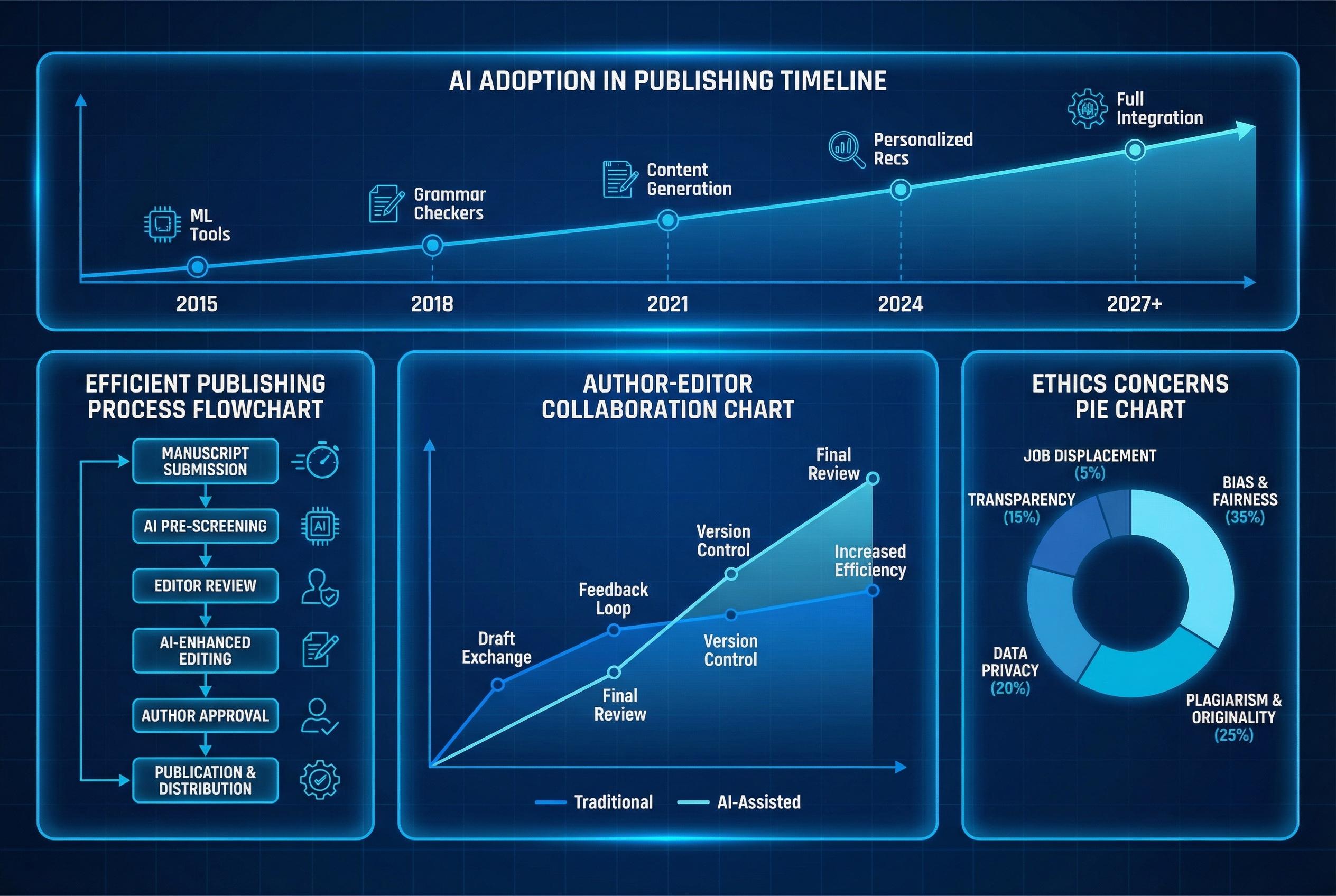
The publishing industry faces a seismic shift as AI speeds up production, changes author-editor dynamics, and raises urgent ethical concerns, prompting calls for a balanced, responsible adoption strategy.
Publishers are confronting a seismic shift as artificial intelligence remakes how books are conceived, produced and sold. According to Forbes, AI is speeding routine workflows, informing editorial choices with data and enabling formats such as audiobooks and automated translation that make titles easier to scale across markets. Industry commentators argue the technology is no longer optional for houses that want to stay competitive. (Forbes, CapTechU)
Beyond faster copy‑editing and layout, AI is changing the division of labour inside publishing. Members of the Forbes Technology Council note tools that assist research, automate fact‑finding and offer structural edits free up staff time for strategy and creative oversight, while also reshaping author–editor collaboration. Many operators now treat machine systems as part of the production team rather than one‑off utilities. (Forbes Technology Council, Forbes)
That promise of efficiency carries trade‑offs. Analysts at CapTechU and specialised trade outlets warn that reliance on automated generation risks flattening distinct authorial voices and producing high volumes of shallow, formulaic work. PublishingMeta highlights implementation headaches too: integrating bespoke models, retaining editorial control and protecting intellectual property add cost and complexity, and can erode long‑standing creative practices if mishandled. (CapTechU, PublishingMeta)

Commercially, AI’s appeal is clear. Machine learning can identify audience segments, optimise marketing spend and predict cultural momentum, enabling houses to target promotions with greater precision. But Forbes and industry commentators stress the need for human judgement to interpret algorithmic signals, and to preserve investment in original voice and long‑form thinking that algorithms do not replicate. (Forbes, Forbes Technology Council)
The rise of machine‑produced content also raises urgent ethical and market‑integrity questions. Investigations into AI‑generated music and reporting on proliferating synthetic books on retail platforms show how hard it is to police authorship and royalties at scale. Observers caution that unless publishers and platforms agree transparency standards and detection methods, consumer trust and creators’ livelihoods may be damaged. (Le Monde, Axios)
Data bias, copyright ambiguity and privacy concerns present further hurdles. Security experts and publishing analysts note AI models trained on patchy or unrepresentative corpora can reproduce social biases, while ownership of outputs remains legally unsettled. Trade recommendations therefore emphasise governance: explicit disclosure of AI use, contractual clarity with creators and staff training so editorial teams can deploy tools responsibly. (PublishingMeta, CapTechU)
For most in the field the practical path lies between exuberant adoption and outright rejection. Industry forecasters call for a hybrid model in which automation handles repetitive tasks, human editors steward originality and new regulation and professional standards guard fairness and transparency. That balanced approach, advocates say, offers a way to harness AI’s efficiencies without surrendering the creative and ethical foundations of publishing. (Forbes, PublishingMeta, Forbes Technology Council)
Source Reference Map
Inspired by headline at: [1]
Sources by paragraph:
Source: Noah Wire Services
Noah Fact Check Pro
The draft above was created using the information available at the time the story first
emerged. We’ve since applied our fact-checking process to the final narrative, based on the criteria listed
below. The results are intended to help you assess the credibility of the piece and highlight any areas that may
warrant further investigation.
Freshness check
Score:
4
Notes:
The article was published on April 5, 2026, discussing AI’s impact on the publishing industry. However, similar content has been published earlier, such as Forbes’ ‘AI in Publishing: A 2025 Industry Forecast’ on January 27, 2025 ([forbes.com](https://www.forbes.com/sites/forbesbooksauthors/2025/01/27/ai-in-publishing-a-2025-industry-forecast/?utm_source=openai)) and Capitol Technology University’s ‘The Impact of AI on the Publishing Industry’ on March 16, 2026 ([captechu.edu](https://www.captechu.edu/blog/impact-of-ai-publishing-industry?utm_source=openai)). This suggests the article may be recycling existing information. Additionally, the article includes references to external sources, indicating it may be based on a press release, which typically warrants a lower freshness score. The presence of similar narratives published more than 7 days earlier further reduces the freshness score. ([forbes.com](https://www.forbes.com/sites/forbesbooksauthors/2025/01/27/ai-in-publishing-a-2025-industry-forecast/?utm_source=openai))
Quotes check
Score:
3
Notes:
The article includes direct quotes from sources such as Forbes and Capitol Technology University. However, these quotes appear to be reused from previous publications, raising concerns about originality. The lack of independently verifiable quotes further diminishes the credibility of the article. ([forbes.com](https://www.forbes.com/sites/forbesbooksauthors/2025/01/27/ai-in-publishing-a-2025-industry-forecast/?utm_source=openai))
Source reliability
Score:
5
Notes:
The article cites reputable sources like Forbes and Capitol Technology University. However, the presence of similar content published earlier and the reliance on external sources suggest potential issues with originality and independence. The article’s origin from a niche publication, Laodong, which may not be widely known, also raises concerns about source reliability.
Plausibility check
Score:
6
Notes:
The claims about AI’s impact on the publishing industry are plausible and align with industry trends. However, the lack of supporting details from other reputable outlets and the recycling of older material without substantial new insights raise questions about the article’s originality and depth.
Overall assessment
Verdict (FAIL, OPEN, PASS): FAIL
Confidence (LOW, MEDIUM, HIGH): HIGH
Summary:
The article exhibits significant issues with freshness, originality, and source independence. It recycles content from previous publications, includes reused quotes, and relies heavily on external sources without providing substantial new insights. These factors collectively undermine the article’s credibility and reliability.

