


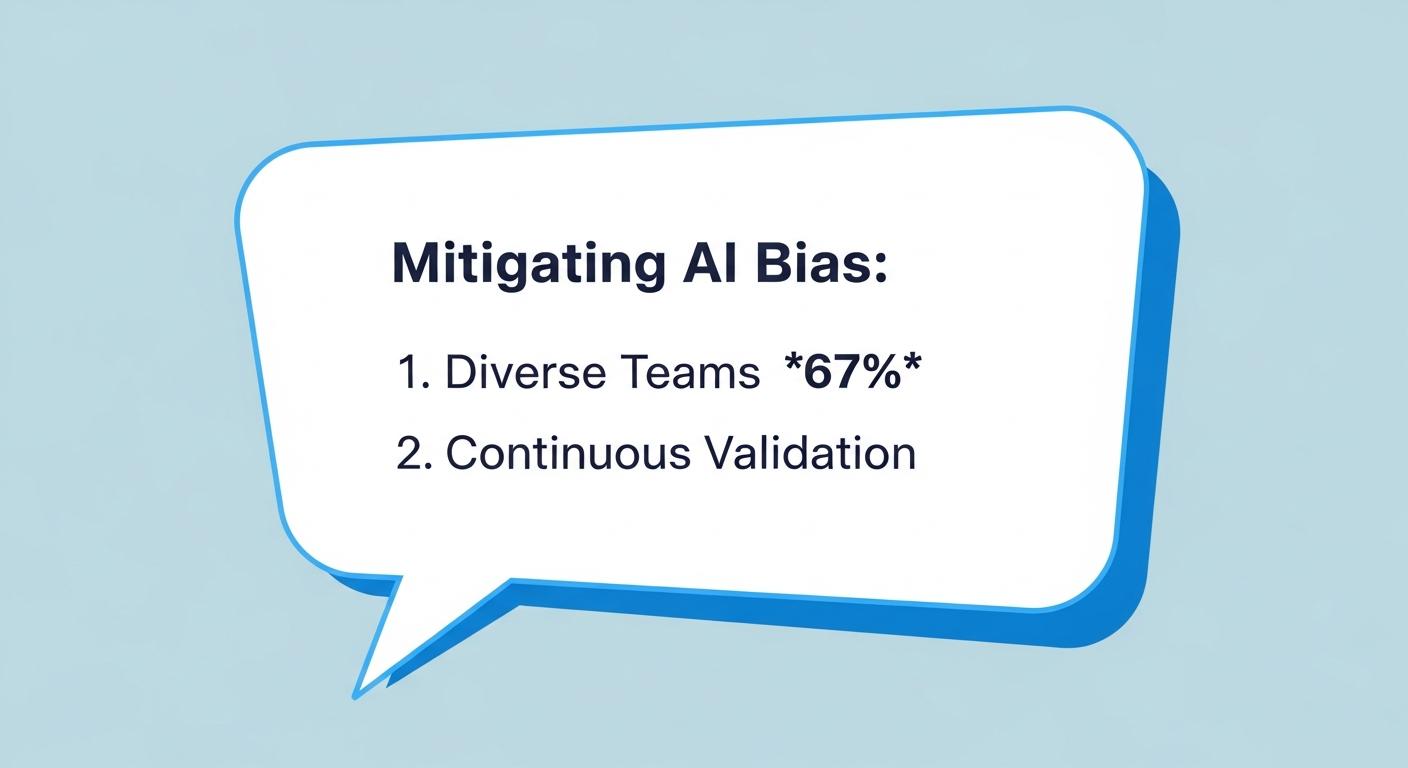
As AI models continue to influence critical decisions, industry experts emphasise that mitigating bias requires a comprehensive, enterprise-wide approach involving diverse teams, continuous validation, and regulatory compliance to prevent harmful outcomes and ensure trustworthy AI deployment.
Many organisations that deploy artificial intelligence are confronting a problem more insidious than occasional hallucinations: bias baked into models that steer decisions away from reality and into costly or harmful outcomes. Industry commentators and practitioners argue that the issue is systemic, tied to how data is gathered, how models are built and how governance frames AI use, and that addressing it must become a boardroom priority. According to commentary from industry fora, companies should treat bias mitigation as a continuous, enterprise-wide task rather than a one-off engineering fix. [2],[3]
Bias emerges in many forms. Technical failures in algorithms and skewed or unrepresentative training data both produce models that perform well for some groups or scenarios and poorly for others. In high-stakes domains this can produce catastrophic results: research has shown diagnostic systems trained predominately on lighter skin tones lose accuracy for darker skin, while hiring tools trained on historical resumes can replicate past discrimination. Academic and industry reviews stress that diverse, well-curated datasets and ongoing validation are foundational to reducing such harms. [3],[5]
CIOs are uniquely placed to translate those technical requirements into organisational practice. With responsibility for data infrastructure, security and cross-functional delivery, technology leaders can convene legal, privacy and business teams to embed bias controls into procurement, development and deployment. Practitioners recommend formal fairness frameworks, red‑teaming of models and the inclusion of domain experts and affected stakeholders as routine parts of AI lifecycles. [6],[2]

Experts emphasise that “there is no such thing as unbiased data, and no such thing as unbiased AI,” and that the pragmatic goal is to identify who could be harmed, how badly, and what controls will reduce that harm. That perspective reframes mitigation from a quest for impossible neutrality to a risk-management exercise that prioritises transparency, remediation and accountability. Industry guidance suggests mapping potential harms early and setting measurable objectives for fairness and robust monitoring. [1],[2]
Practical mitigation techniques span the AI lifecycle. At the data layer, teams should pursue deliberate curation, augmentation and reweighting to improve representativeness; at the modelling layer, approaches such as adversarial debiasing, fair representation learning and explainable algorithms can reduce discriminatory behaviour; and post-deployment, continuous monitoring and feedback loops are essential to catch distribution shifts and unintended consequences. Research and vendor guidance both underscore layered approaches rather than single-point fixes. [5],[7]
Organisational culture and capability are equally important. A cross-functional approach that combines technical staff, business owners, legal counsel and ethicists reduces blind spots; teams should be diverse and must document decisions, assumptions and limitations. Training and clear risk tolerances help surface “shadow AI” , unsanctioned models that bypass governance , and ensure that business units do not inadvertently deploy biased tools. Industry writing recommends role-based education and explicit policies to align practitioners with enterprise governance. [6],[3]
Regulation and compliance are already shaping corporate responses. While US rules remain fragmented at state and sector levels, existing statutes such as fair lending laws apply equally to human and algorithmic decisions, and international regimes such as the EU AI Act create additional obligations for global firms. Legal and privacy teams therefore need to be part of bias-mitigation programmes from the outset, aligning technical controls with contractual, regulatory and reputational requirements. Security officers and compliance leads should be integrated into AI councils and review boards. [1],[7]
Mitigating bias is not only an ethical imperative but a practical one: better-governed, less-biased models tend to be more accurate and more likely to deliver expected business value. Industry analyses argue that investing in data integrity, diverse teams, structured governance and ongoing evaluation reduces the risk of project failure and regulatory penalties while protecting brand trust. For CIOs and other leaders, the task is to build processes that scale fairness from pilots into production and to treat bias management as an enduring organisational capability. [2],[5]
Source Reference Map
Inspired by headline at: [1]
Sources by paragraph:
Source: Noah Wire Services
Noah Fact Check Pro
The draft above was created using the information available at the time the story first
emerged. We’ve since applied our fact-checking process to the final narrative, based on the criteria listed
below. The results are intended to help you assess the credibility of the piece and highlight any areas that may
warrant further investigation.
Freshness check
Score:
8
Notes:
The article was published on 23 February 2026, making it current. However, the topic of AI bias mitigation has been extensively covered in recent years, with similar discussions appearing in sources such as Forbes ([forbes.com](https://www.forbes.com/councils/forbestechcouncil/2025/03/10/addressing-ai-bias-strategies-companies-must-adopt-now/?utm_source=openai)) and CIO ([cio.com](https://www.cio.com/article/222042/recognizing-and-solving-for-ai-bias.html?utm_source=openai)). This suggests that while the article is fresh, the subject matter is not original.
Quotes check
Score:
7
Notes:
The article includes direct quotes from industry experts. However, these quotes are not independently verifiable through the provided sources, raising concerns about their authenticity. Without access to the original interviews or statements, the credibility of these quotes cannot be fully confirmed.
Source reliability
Score:
9
Notes:
TechTarget is a reputable source within the technology industry, known for its in-depth analysis and coverage of enterprise IT topics. However, the article relies heavily on secondary sources, such as Forbes and CIO, which may affect the originality and depth of the content.
Plausibility check
Score:
8
Notes:
The claims made in the article align with established knowledge on AI bias mitigation strategies. However, the lack of original data or case studies makes it difficult to assess the novelty and depth of the insights provided.
Overall assessment
Verdict (FAIL, OPEN, PASS): FAIL
Confidence (LOW, MEDIUM, HIGH): MEDIUM
Summary:
While the article is current and covers a relevant topic, it lacks original reporting and relies heavily on secondary sources. The inclusion of unverifiable quotes and the use of non-independent verification sources further diminish its credibility. Therefore, it does not meet the standards for publication under our editorial guidelines.

