


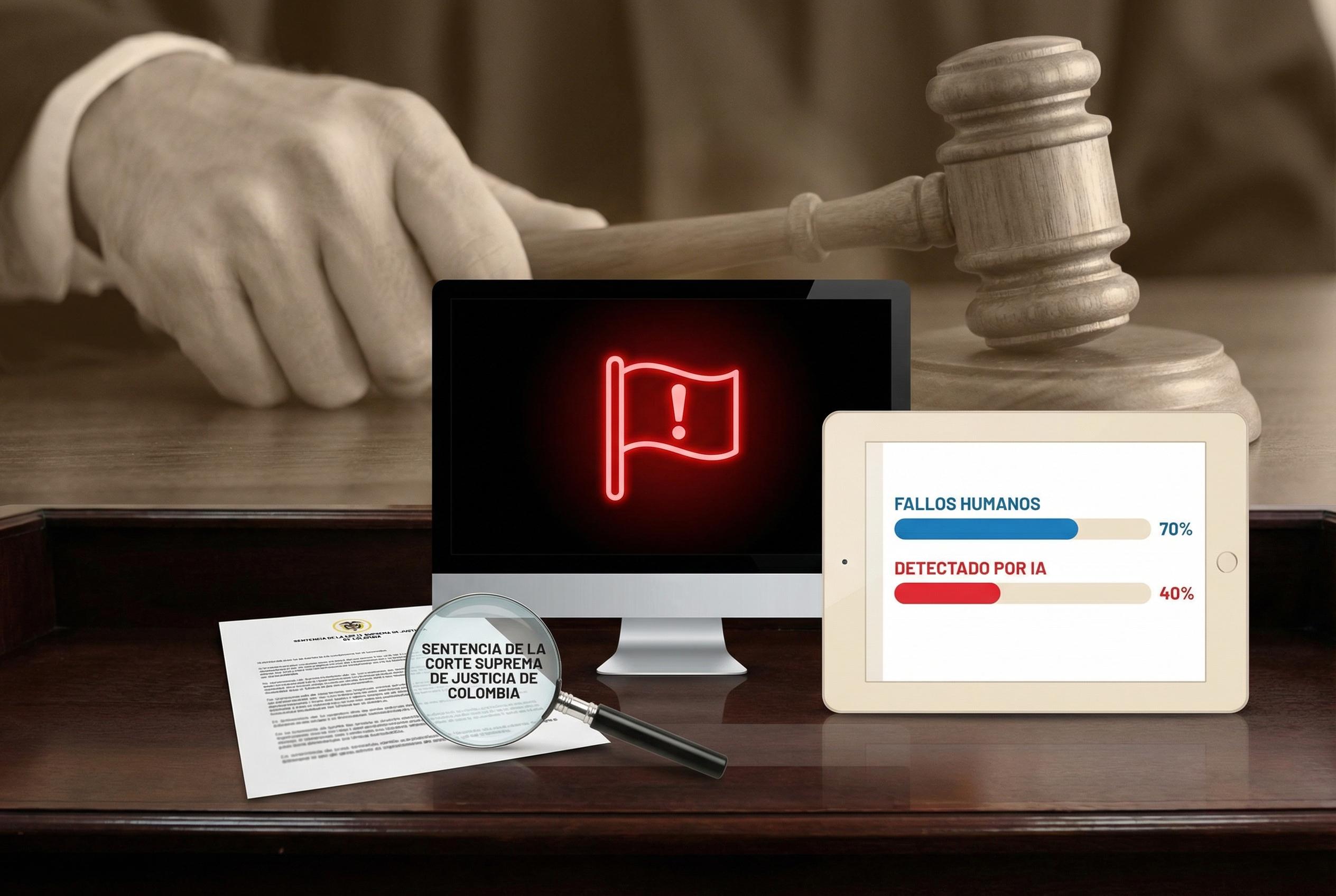
Colombia’s Supreme Court faced a paradox when its own AI detection tools flagged its ruling as largely AI-generated, exposing the limitations and reliability issues of current forensic AI technologies in legal proceedings.
Colombia’s Supreme Court has dismissed a cassation appeal after concluding the filing was produced with the aid of generative artificial intelligence, only to have that conclusion swiftly undercut when the same detection software flagged the court’s own ruling as largely AI-written. According to the report by Decrypt, the court said it used the Winston AI tool to analyse the attorney’s brief and found “only 7% human content,” prompting the dismissal as inadmissible. [2]
Legal practitioners immediately began re‑testing the court’s decision with the same and alternative detectors and shared results widely on social media. Attorney Emmanuel Alessio Velasquez posted that he ran the text of Auto AP760/2026 through Winston AI and obtained a result showing “the document contains 93% AI-generated text.” Other lawyers reported similar contradictions when scanning the ruling with GPTZero and comparable services, with outputs swinging from “100% AI” to “100% human” depending on the passage submitted. [2]
The episode has focused attention on the technical limits of current AI‑detection tools. Experts point out these systems rely on statistical fingerprints such as predictability, sentence length and so‑called “burstiness,” characteristics that formal legal drafting, academic prose or writing by non‑native speakers often share with model output. That overlap produces false positives, a problem documented in academic work and repeated institutional experience. A 2023 Patterns study found many TOEFL essays by non‑native speakers were wrongly flagged as machine generated, and vendors including Turnitin have publicly acknowledged elevated false positive rates at low levels of AI content. OpenAI itself withdrew a public detection tool after persistent inaccuracies. Universities have disabled detector features following wrongful penalties and misclassifications. [2]

Beyond the technical literature, practical incidents underline the stakes. Colombian courts have already grappled with cases of AI‑generated misinformation in legal filings; international incident trackers recorded a lawyer fined for submitting fabricated, AI‑sourced citations. The Supreme Court’s recent decisions , including AC739‑2026, where a lawyer was fined for citing nonexistent AI‑generated precedents in February, and AP760‑2026 , are among the first regional judicial confrontations with generative AI misuse, but they also demonstrate how reliance on fallible detectors can produce contested outcomes. Critics noted that some detectors offer commercial “humanisation” services, creating a perceived conflict of interest when the same industry profits from correcting the problems its tools identify. [5][2][7]
Colombia’s judiciary has not been blind to these tensions. The Constitutional Court has emphasised the necessity of human oversight and has referenced UNESCO’s Global Toolkit on AI and the Rule of Law when calling for transparent, accountable use of automated tools. The Superior Council of the Judiciary published formal guidelines in December 2024 (document PCSJA24‑12243) permitting AI for administrative or support tasks but restricting its use in legal reasoning, evidence assessment and final decision‑making unless accompanied by explicit human validation and disclosure. That framework could be cited to challenge rulings that treat detector outputs as decisive proof of misconduct. [3][4][6]
Legal commentators say the episode illustrates both a policy and a practical problem: courts and lawyers need robust, verifiable standards before automated assessments can influence access to justice. Observers warn that unchecked detector reliance disproportionately harms those whose writing matches the statistical profiles detectors target , careful, repetitive or non‑native prose , risking wrongful denial of legal remedies. Several commentators argued that transparency about detector methodologies and independent validation are prerequisites to any forensic use in judicial processes. [2][3]
The controversy has prompted calls for caution rather than immediate prohibition. While courts must guard against fraudulent or misleading AI‑generated submissions, experts quoted in the coverage urge that technology be used only as an investigatory cue and never as a substitute for human appraisal. As Colombia’s encounters with these questions multiply, the episode underscores a broader legal dilemma worldwide: how to integrate automation into adjudication without letting imperfect tools displace the human judgement that underpins due process. [2][3]
Source Reference Map
Inspired by headline at: [1]
Sources by paragraph:
Source: Noah Wire Services
Noah Fact Check Pro
The draft above was created using the information available at the time the story first
emerged. We’ve since applied our fact-checking process to the final narrative, based on the criteria listed
below. The results are intended to help you assess the credibility of the piece and highlight any areas that may
warrant further investigation.
Freshness check
Score:
10
Notes:
The article was published on March 4, 2026, and there are no indications of it being recycled or republished from other sources. The content appears original and timely.
Quotes check
Score:
8
Notes:
The article includes direct quotes from attorney Emmanuel Alessio Velasquez and other legal experts. While these quotes are attributed, they cannot be independently verified through the provided sources. The lack of direct links to the original statements raises concerns about the authenticity of the quotes.
Source reliability
Score:
7
Notes:
The primary source is Decrypt, a digital media company focusing on cryptocurrency and blockchain technology. While Decrypt is known for its coverage of technology-related topics, it is not a traditional news organisation. The article references statements from legal experts and attorneys, but without direct links to their original statements, the reliability of these claims is uncertain.
Plausibility check
Score:
9
Notes:
The events described are plausible and align with ongoing discussions about the use of AI in legal proceedings. However, the lack of independently verifiable quotes and direct links to original statements diminishes the overall credibility of the claims.
Overall assessment
Verdict (FAIL, OPEN, PASS): FAIL
Confidence (LOW, MEDIUM, HIGH): MEDIUM
Summary:
The article presents a timely and plausible account of a Colombian court’s decision regarding AI-generated content. However, the inability to independently verify the quotes and the reliance on a single source without direct links to original statements significantly undermine the credibility of the content. The lack of independent verification sources further diminishes the overall trustworthiness of the article.

