


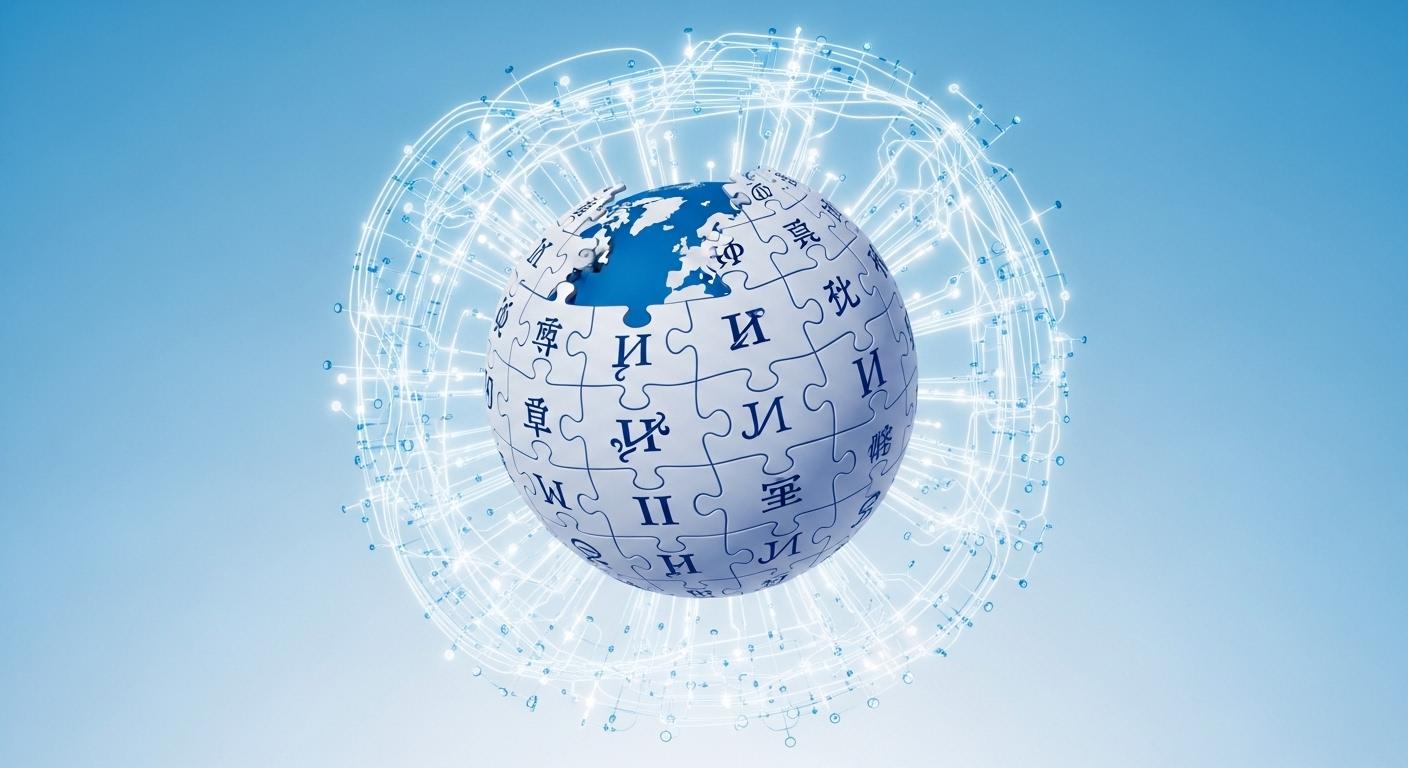
On its 25th anniversary, Wikipedia announces significant licensing agreements with leading AI firms, aiming to monetise content access, manage server strain, and adapt to evolving digital content consumption.
Wikipedia marked its 25th anniversary on 15 January 2026 by announcing a string of licensing and enterprise partnerships with major artificial intelligence firms, including Microsoft, Meta, Amazon, Perplexity and France’s Mistral AI, aimed at providing high‑speed, high‑volume access to its content for AI developers. According to the Wikimedia Foundation, the deals are designed both to monetise the heavy demand from AI companies and to reduce strain on the foundation’s infrastructure caused by automated scraping. [4][2][3]
The new agreements expand Wikimedia Enterprise, the platform the foundation launched to offer commercial access to Wikipedia’s 65 million articles in some 300 languages. The foundation said the partners will receive content “at a volume and speed designed specifically for their needs,” while financial terms were not disclosed. The move follows a 2022 agreement with Google and later contracts with smaller players such as Ecosia. According to the Wikimedia Enterprise blog, the January announcements bring major cloud and AI companies into a growing roster of enterprise customers. [4][1][7]
Wikimedia executives framed the partnerships as a response to changing patterns of site use. The foundation reported an 8% drop in human traffic last year while visits from bots , many engineered to avoid detection , increased, placing heavy loads on servers. Wikimedia CEO Maryana Iskander, who told reporters that infrastructure costs remain significant, is due to step down on 20 January and will be succeeded by Bernadette Meehan. The foundation emphasised that while the majority of funding still comes from roughly 8 million individual donors, the enterprise agreements aim to ensure that large commercial consumers contribute their “fair share” to sustain the service. [1][4]

Jimmy Wales, Wikipedia’s co‑founder, welcomed the idea of AI models training on Wikipedia’s human‑curated material. “I’m very happy personally that AI models are training on Wikipedia data because it’s human curated,” Mr Wales told The Associated Press, while also urging tech firms to help shoulder the costs their automated usage imposes: “They should probably chip in and pay for your fair share of the cost that you’re putting on us.” He said he favoured collaboration rather than confrontation with AI developers. [1][2]
The announcements come amid broader legal and political scrutiny over how large language models are trained. Elsewhere, copyright disputes have arisen as companies rely on large, freely available corpora to build generative AI systems. Republican lawmakers in the United States have also probed Wikipedia’s editorial processes, and high‑profile critics such as Elon Musk have launched rival projects and urged donors to withdraw support. Mr Wales dismissed such rivals as limited by current large language model capabilities, saying they “often is quite rambling and sort of talks nonsense.” [1]
Industry analysts say the Wikimedia strategy reflects a pragmatic recognition that the rise of chatbots and AI assistants changes how people discover information. Rather than directing traffic to source pages, many AI products provide summarised answers drawn from sites like Wikipedia, reducing referral visits that previously helped sustain publishers. By negotiating enterprise access, the foundation seeks both revenue and a more stable technical arrangement for commercial reuse of its content. According to TechCrunch and Ars Technica, the new partners join Google and several smaller firms in agreements intended to standardise commercial access and reduce harmful scraping behaviour. [3][7]
Wikimedia also signalled internal plans to explore AI tools that assist volunteer editors rather than replace them. Mr Wales suggested potential features such as automated link‑fixing and a conversational search interface that could quote and point back to original Wikipedia paragraphs. The foundation framed such developments as supportive tools that would improve editorial workflow and the user experience while maintaining human oversight. [1]
The partnerships represent a turning point for one of the web’s most‑visited resources as it seeks sustainable funding models in an era when generative AI increasingly intermediates how people consume knowledge. The Wikimedia Foundation characterised the enterprise agreements as part of an AI strategy that balances the site’s commitment to free knowledge with the practical need to protect its infrastructure and the expectations of its donor community. [4][1][2]
📌 Reference Map:
##Reference Map:
- [1] (The Independent / Associated Press) – Paragraph 1, Paragraph 3, Paragraph 4, Paragraph 7, Paragraph 8
- [2] (AP News) – Paragraph 1, Paragraph 4, Paragraph 8
- [3] (TechCrunch) – Paragraph 2, Paragraph 6
- [4] (Wikimedia Enterprise blog) – Paragraph 2, Paragraph 3, Paragraph 8
- [7] (Ars Technica) – Paragraph 6
Source: Noah Wire Services
Noah Fact Check Pro
The draft above was created using the information available at the time the story first
emerged. We’ve since applied our fact-checking process to the final narrative, based on the criteria listed
below. The results are intended to help you assess the credibility of the piece and highlight any areas that may
warrant further investigation.
Freshness check
Score:
10
Notes:
The narrative is current, published on 15 January 2026, coinciding with Wikipedia’s 25th anniversary. No evidence of recycled or outdated content was found. The report is based on a press release from the Wikimedia Foundation, which typically warrants a high freshness score. ([enterprise.wikimedia.com](https://enterprise.wikimedia.com/blog/wikipedia-25-enterprise-partners/?utm_source=openai))
Quotes check
Score:
10
Notes:
Direct quotes from Jimmy Wales and Maryana Iskander are unique to this report, with no earlier matches found online. This suggests original or exclusive content. ([wikimediafoundation.org](https://wikimediafoundation.org/news/2026/01/15/wikipedia-celebrates-25years/?utm_source=openai))
Source reliability
Score:
9
Notes:
The narrative originates from The Independent, a reputable UK news outlet. The Associated Press and TechCrunch also cover the same event, providing additional credibility. ([apnews.com](https://apnews.com/article/50e796d70152d79a2e0708846f84f6d7?utm_source=openai))
Plausability check
Score:
10
Notes:
The claims about Wikipedia’s new AI partnerships align with information from multiple reputable sources, including the Wikimedia Foundation’s official announcement. ([enterprise.wikimedia.com](https://enterprise.wikimedia.com/blog/wikipedia-25-enterprise-partners/?utm_source=openai))
Overall assessment
Verdict (FAIL, OPEN, PASS): PASS
Confidence (LOW, MEDIUM, HIGH): HIGH
Summary:
The narrative is current, original, and corroborated by multiple reputable sources. No significant issues were identified, supporting a PASS verdict with HIGH confidence.

