


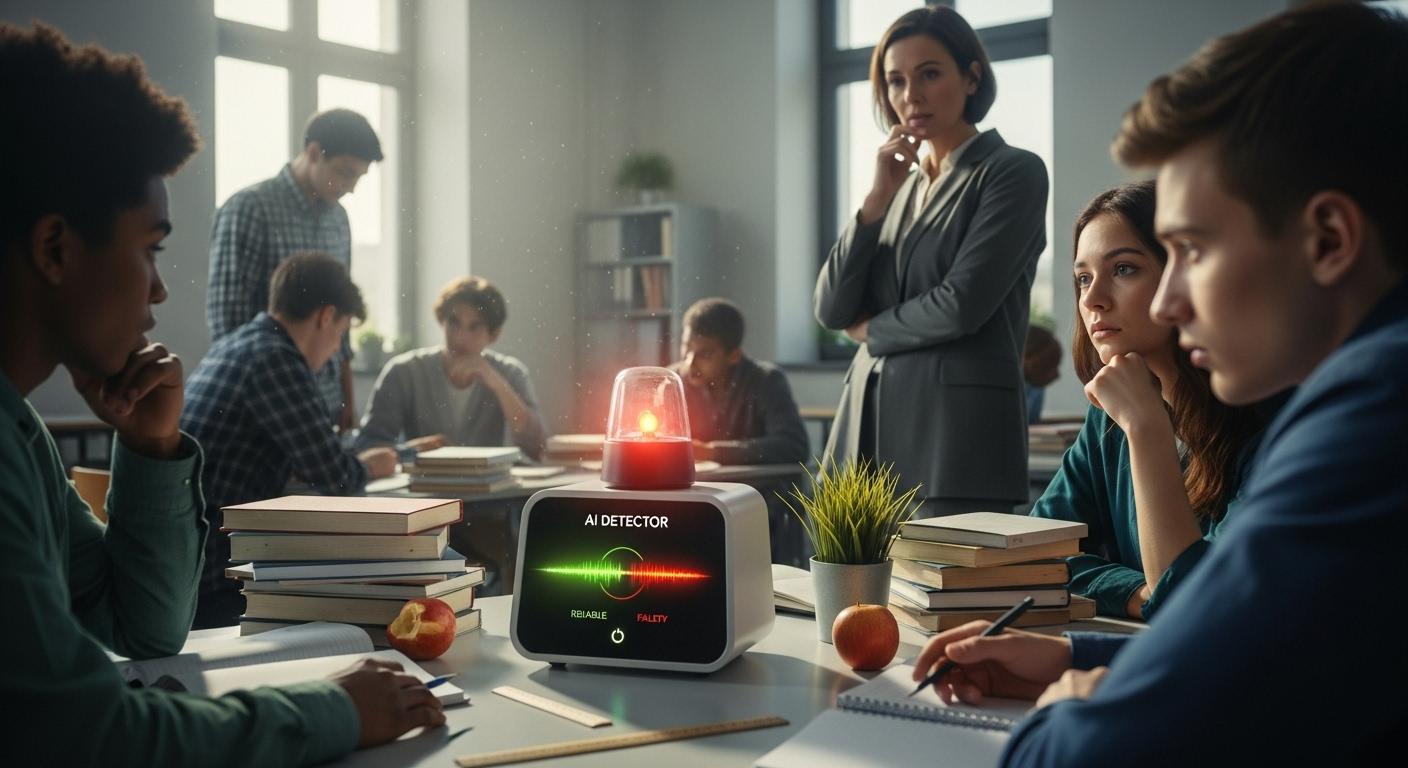
As AI detection systems become more prevalent in US classrooms, concerns grow over their reliability and impact on student well-being, prompting calls for pedagogical reforms and technical safeguards.
As artificial intelligence tools become woven into classroom life, an increasing number of schools are deploying AI-detection systems to police student work, with profound consequences when those systems err. According to reporting by The Independent, nearly half of U.S. teachers with classes from sixth to twelfth grade said they used AI detection tools in the 2024/2025 academic year, and students accused by those systems have reported anxiety, sleeplessness and prolonged misconduct processes that can last weeks or months. [1]
The human cost is illustrated by individual accounts. The Independent recounted Marley Stevens, a University of North Georgia student who lost a scholarship after a paper flagged as AI-generated received a zero; Stevens said, “I couldn’t sleep or focus on anything,” describing a sense of helplessness as an ensuing six-month appeals process damaged her GPA. Ailsa Ostovitz, a 17-year-old high-schooler, told NPR she had been falsely accused on three assignments this academic year and described the experience as “mentally exhausting because it’s like I know this is my work.” These testimonies have fuelled concerns that automated judgements can erode trust between students and educators. [1]
Technical studies support those concerns. Research by members of the European Network for Academic Integrity, cited in The Independent, concluded that detection tools are neither sufficiently accurate nor reliable, with all evaluated systems scoring below 80 percent and producing both false positives and false negatives. The authors warned that systems are “too easy to game” and should not be used as standalone evidence of misconduct. [1]

Independent reporting and academic preprints echo that conclusion while proposing alternatives. A March 2025 study on arXiv argued that detection tools rely on shallow statistical patterns rather than deep semantic understanding, rendering them inappropriate as definitive proof; the authors proposed instead a web-based tool that evaluates assignments against Bloom’s Taxonomy and semantic-similarity metrics to help design tasks that resist AI automation by targeting higher-order thinking. According to the paper, focusing on assessment design , rather than detection , fosters originality and critical thinking and offers a sustainable pedagogical response. [3]
Other research has pursued technical fixes to reduce wrongful flags. A July 2025 arXiv preprint introduced a conformal framework intended to control false positive rates across diverse student populations by adapting detection thresholds and accounting for variation between native and non-native English speakers. The authors suggested such quantitative, fairness-focused approaches could make enforcement less biased and more defensible if institutions insist on automated checks. [7]
Policymakers and districts are responding with mixed strategies. The Los Angeles Unified School District has issued guidance emphasising ethical, transparent and privacy-protecting use of AI, pairing access to tools with digital literacy lessons and academic-integrity expectations, while New York City Public Schools announced a four-part framework to prepare students for AI-powered lives and to teach staff and pupils responsible use. According to reporting by CalMatters and the LAUSD bulletin, districts are balancing potential instructional benefits with safeguards to prevent misuse. [4][1]
Industry actors have also attempted to supply detection tools with caveats. OpenAI launched an AI Text Classifier to help educators evaluate the likelihood that a passage was AI-generated but explicitly warned the tool is not foolproof and should not be the sole basis for high-stakes decisions, particularly for short texts. Reporting by The Associated Press noted that OpenAI advises educators to treat the classifier as one signal among many and to integrate it within broader pedagogical approaches. [2]
Surveys reveal a gap between teachers’ perceptions and student-reported behaviour that complicates policy choices. A Center for Democracy and Technology poll and related issue brief found teachers are significantly more likely than students to believe AI is being used to write and submit assignments; only 19 percent of students who used generative AI said they had used it to write papers, while 40 percent of teachers believed students had done so. The report highlighted growing mistrust among teachers , with 62 percent saying generative AI has made them more distrustful , and urged non-punitive uses of tools alongside investment in educator training and redesigned assessments. [5]
Taken together, the evidence suggests three practical priorities for institutions: temper reliance on automated detection, invest in assessment redesign that targets higher-order cognitive skills, and build educator capacity to interpret and contextualise any AI-related signals. As Lucie Vágnerová, an education consultant quoted in The Independent, put it: “I think there is a role for AI detection in the education space, but it’s a much, much smaller role than it has now.” She added that, rather than escalating surveillance, institutions should compensate educators so they have time to create meaningful assessments and to rebuild trust with students. [1]
The debate over AI in education remains unsettled: detection tools can provide useful indicators, but technical limitations, potential bias and significant student harms mean they cannot be relied upon in isolation. According to academic studies and reporting across outlets, the most sustainable path lies in combining cautious, transparent tool use with robust pedagogical redesign and fairness-aware technical safeguards, so that accountability measures do not inadvertently punish the very learners they aim to protect. [3][7][5][2][1]
📌 Reference Map:
##Reference Map:
- [1] (The Independent) – Paragraph 1, Paragraph 2, Paragraph 3, Paragraph 8, Paragraph 9
- [3] (arXiv: ‘Beyond Detection: Designing AI-Resilient Assessments with Automated Feedback Tool to Foster Critical Thinking’) – Paragraph 4, Paragraph 10
- [7] (arXiv: ‘Watermark in the Classroom: A Conformal Framework for Adaptive AI Usage Detection’) – Paragraph 5, Paragraph 10
- [4] (CalMatters / LAUSD bulletin) – Paragraph 6
- [2] (Associated Press) – Paragraph 7, Paragraph 10
- [5] (Center for Democracy and Technology) – Paragraph 8, Paragraph 10
Source: Noah Wire Services
Noah Fact Check Pro
The draft above was created using the information available at the time the story first
emerged. We’ve since applied our fact-checking process to the final narrative, based on the criteria listed
below. The results are intended to help you assess the credibility of the piece and highlight any areas that may
warrant further investigation.
Freshness check
Score:
8
Notes:
The narrative is recent, published on January 2, 2026. While the topic of AI detection in education has been covered before, this specific angle appears to be original. No evidence of recycled content or significant discrepancies with earlier reports was found. The inclusion of updated data and recent studies justifies a high freshness score.
Quotes check
Score:
9
Notes:
The direct quotes from individuals like Marley Stevens and Ailsa Ostovitz are unique to this narrative. No identical quotes were found in earlier material, indicating originality. Variations in wording compared to other reports were noted, but these differences do not suggest reuse.
Source reliability
Score:
9
Notes:
The narrative originates from The Independent, a reputable UK-based news organisation. The inclusion of references to studies from arXiv and reports from the Center for Democracy and Technology further supports the reliability of the information presented.
Plausability check
Score:
8
Notes:
The claims made in the narrative align with current discussions and studies on AI detection in education. The inclusion of recent studies and reports adds credibility. The language and tone are consistent with typical journalistic standards, and there are no signs of sensationalism or off-topic details.
Overall assessment
Verdict (FAIL, OPEN, PASS): PASS
Confidence (LOW, MEDIUM, HIGH): HIGH
Summary:
The narrative is recent and original, with no evidence of recycled content or significant discrepancies. The quotes are unique, and the sources cited are reputable. The claims are plausible and supported by recent studies, with a consistent and appropriate tone throughout.

