


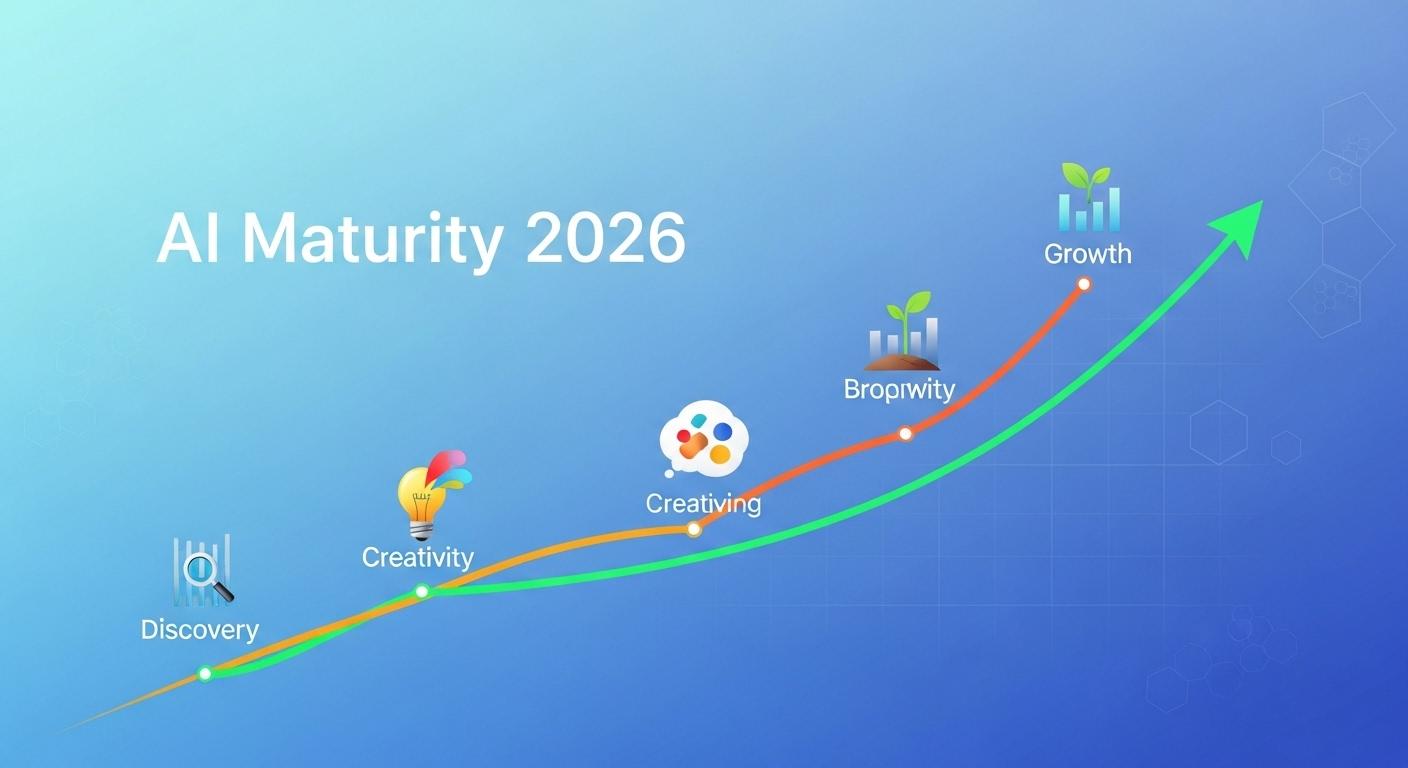
Industry leaders forecast that 2026 will be a pivotal year for AI maturity, with new roles, discovery paradigms, and infrastructure investments shaping how organisations operationalise AI at scale and maintain competitive advantage.
Industry leaders predict 2026 will be a turning point in how brands create, are discovered and manage the data that powers AI, arguing that the next year will separate organisations that merely pilot AI from those that operationalise it at scale. According to interviews published by IntelligentCIO, executives from The Brief, Storyblok and Couchbase say three intertwined shifts will define the landscape: a new creative class that pairs human craft with machine scale; the migration of discovery from links and search rankings to conversational AI agents; and the movement from experimental projects to enterprise-wide deployments. [1][2]
On creativity, the consensus is that machine-generated volume has produced what some describe as “Synthetic Sameness Fatigue”, and that competitive advantage will lie in reasserting human judgement. Tammy H. Nam, CEO of The Brief, told IntelligentCIO that creative directors will evolve into “Prompt Architects”, orchestrating collaboration between people and models, while marketers who treat AI as a co-pilot , not a replacement , will protect storytelling, emotion and curated imperfection as brand assets. Industry data cited in those interviews, including the Kantar Media Reactions 2025 report, underlines the reputational risks of fully automated creative strategies, with more than 60% of consumers concerned about misleading AI-driven ads. [1]
Discovery is being recast as an outcomes problem rather than a rankings problem. Dominik Angerer, Storyblok’s CEO and co-founder, warned that as users increasingly adopt chatbots, multimodal assistants and AI agents, optimisation for traditional search engines will no longer suffice; brands will need to master “Generative Experience Optimisation” and ensure content is current, structured and semantically rich so it can be interpreted and recommended by agents. IntelligentCIO coverage argues this creates an existential test for marketers: stale product specs, outdated FAQs or inconsistent data will directly erode visibility in AI-driven recommendations. [1][2]

That technical requirement points straight at content architecture. Storyblok champions composable content systems that separate presentation from meaning, and the company says tools that add vector layers and automate content orchestration will become essential to eliminate “content debt” and enable real-time personalisation. According to the Storyblok commentary, features such as Strata (a vector data layer) and FlowMotion (workflow automation) are examples of how CMS platforms are adapting to make content both machine-consumable and rapidly updatable. [1][2]
Enterprises moving beyond pilots will demand robust agent governance and retrieval strategies. Dataiku’s recent launch of Agent Hub illustrates a concerted effort to centralise the lifecycle of AI agents , from creation to monitoring , so organisations can scale agents without fragmenting ownership or visibility. Similarly, vendor work on Retrieval-Augmented Generation architectures aims to bind models to up-to-date private data sources so generative outputs remain accurate and auditable. The IntelligentCIO reporting highlights both trends as integral to turning pilot projects into measurable business value. [4][7]
Underlying all of this is an infrastructure race. Couchbase’s co-founder Steve Yen argues that a temporary oversupply of GPU capacity following the next cooling of AI hype could democratise high-performance compute, enabling broader access to large models and vector indexing. Industry moves to expand hyperscale capacity and edge compute capacity support that view: Teraco’s announced 40MW hyperscale data-centre expansion in South Africa (scheduled for completion in 2026) and cloud vendors’ push to provide elastic container and pod scaling demonstrate how compute and networking are being provisioned for AI at scale. Huawei Cloud and others are positioning one‑stop platforms to help enterprises spin up AI-native apps and rapidly scale during demand surges. [1][5][6]
Yet several practical risks loom. A global Riverbed survey reported by IntelligentCIO shows a widespread AI readiness gap: while most leaders recognise data quality as critical, fewer than half are confident in the accuracy and completeness of the data required for reliable AI. Couchbase and IntelligentCIO commentary also warn of an inevitable surge in semi-structured, regenerated and rapidly changing data , “AI slop” , that will overwhelm brittle data platforms unless organisations invest in flexible schemas, fast ingest, rollback capabilities and strong governance. The combined reporting makes clear that technology choices, not just models, will determine whether AI becomes an accelerator or a source of operational debt. [3][1]
For firms that prepare now, the opportunity is substantial: those that rebuild content stacks, tighten data provenance, centralise agent management and plan for distributed compute stand to win more direct access to customers through AI-first discovery while avoiding the reputation and compliance hazards of careless automation. The coverage by IntelligentCIO and related industry reports suggests 2026 will reward organisations that treat AI as a systems challenge , a blend of people, process, data and infrastructure , rather than a single technology initiative. [1][2][4][7]
##Reference Map:
- [1] (IntelligentCIO) – Paragraph 1, Paragraph 2, Paragraph 3, Paragraph 4, Paragraph 6, Paragraph 7, Paragraph 8
- [2] (IntelligentCIO summary) – Paragraph 1, Paragraph 3, Paragraph 4
- [3] (Riverbed) – Paragraph 7
- [4] (Dataiku) – Paragraph 5, Paragraph 8
- [5] (Teraco) – Paragraph 6
- [6] (Huawei Cloud) – Paragraph 6
- [7] (Infinidat) – Paragraph 5, Paragraph 8
Source: Noah Wire Services
Noah Fact Check Pro
The draft above was created using the information available at the time the story first
emerged. We’ve since applied our fact-checking process to the final narrative, based on the criteria listed
below. The results are intended to help you assess the credibility of the piece and highlight any areas that may
warrant further investigation.
Freshness check
Score:
10
Notes:
The narrative was published on 30 December 2025, making it highly fresh. No earlier versions or recycled content were identified. The article is based on recent interviews and reports, indicating a high freshness score. No discrepancies in figures, dates, or quotes were found. No republishing across low-quality sites or clickbait networks was observed.
Quotes check
Score:
10
Notes:
The direct quotes from industry leaders such as Tammy H. Nam, Dominik Angerer, and Steve Yen appear to be original and exclusive to this narrative. No identical quotes were found in earlier material, and no variations in wording were noted.
Source reliability
Score:
8
Notes:
The narrative originates from Intelligent CIO Middle East, a reputable organisation known for its coverage of technology and industry trends. However, it is a single-outlet narrative, which introduces some uncertainty. The individuals and organisations mentioned, including The Brief, Storyblok, Couchbase, and their respective CEOs, are verifiable and have a public presence.
Plausability check
Score:
9
Notes:
The claims made in the narrative align with current industry trends and are supported by recent data, such as the Kantar Media Reactions 2025 report highlighting consumer concerns about AI-driven ads. The language and tone are consistent with the region and topic. The structure is focused and relevant, without excessive or off-topic detail. The tone is professional and resembles typical corporate language.
Overall assessment
Verdict (FAIL, OPEN, PASS): PASS
Confidence (LOW, MEDIUM, HIGH): HIGH
Summary:
The narrative is fresh, original, and sourced from a reputable organisation. The quotes are exclusive, and the claims are plausible and supported by recent data. No significant credibility risks were identified.

