


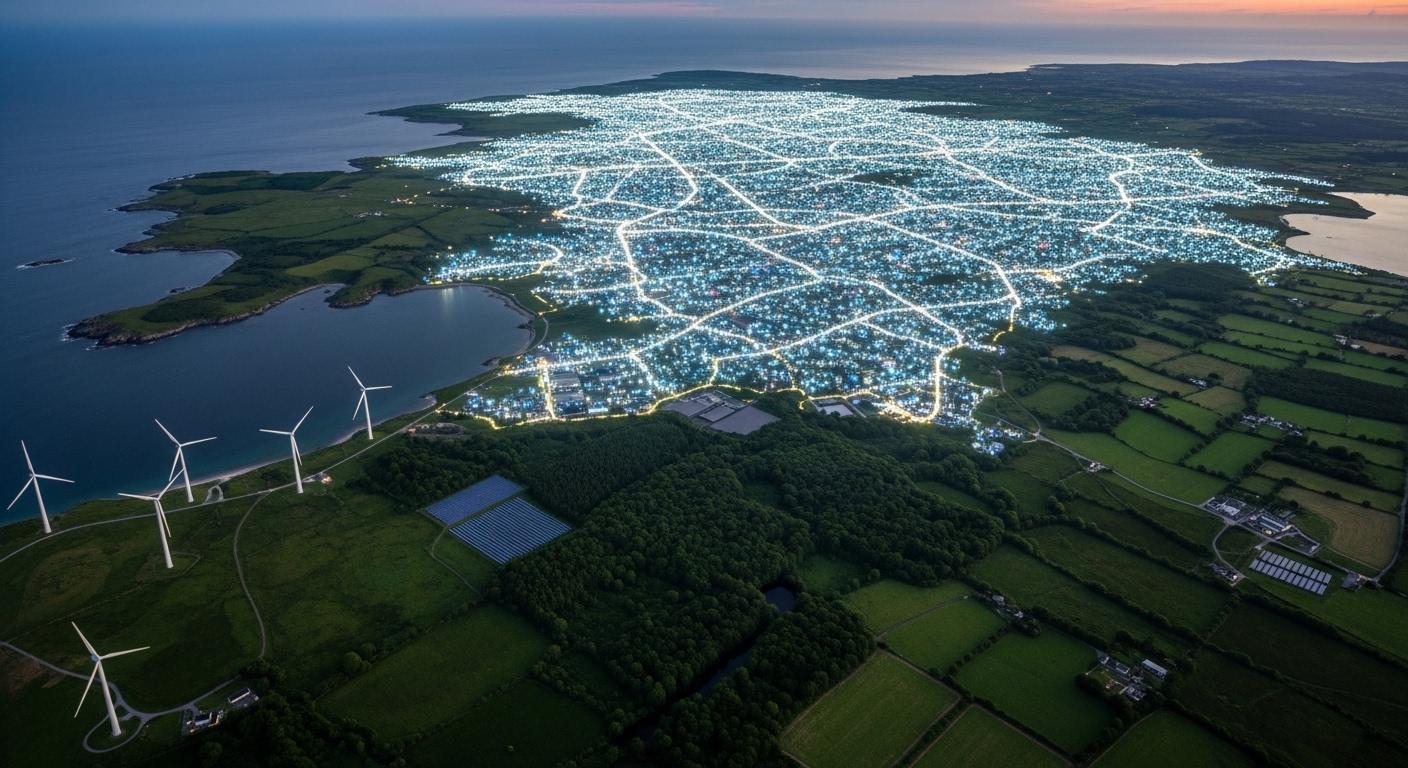
Ireland’s rapid expansion of data centres has transformed its energy system, revealing a deepening conflict between digital infrastructure growth and national climate goals, with concerns over fossil-fuel reliance and policy misalignments.
Ireland’s rapid transformation into one of the world’s densest clusters of data centres has remade the island’s electricity system and exposed a deepening policy contradiction between digital growth and climate commitments. What began as a quiet build‑out of server farms around Dublin has become an industrial presence that, by 2024, consumed more than a fifth of national electricity and now drives grid upgrades, emergency fossil‑fuel capacity and contested planning decisions across the country. According to AlgorithmWatch’s investigation, the expansion has concentrated generation and transmission planning around the needs of a handful of multinational tech firms rather than the needs of households and essential public services.[1][2]
The origins of Ireland’s dependence on hyperscale loads are long‑standing and political. For decades Dublin’s economic strategy deliberately courted foreign multinationals with tax incentives and infrastructure investment, producing high corporate revenues but also concentrating energy and planning demands in a small number of firms. AlgorithmWatch notes that by 2023 foreign multinationals accounted for 88% of corporation tax receipts, with 57% coming from only ten companies, and that almost all data centres are clustered in the greater Dublin area.[1] That historic bargain , jobs and tax receipts in return for accommodating intensive infrastructure needs , is now colliding with the constraints of a scarce electricity system.
The scale of the energy impact is stark. Independent reporting shows data centres’ share of Irish electricity rose from roughly 5% in 2015 to more than 22% in 2024, a jump chronicled in analyses by The Irish Times and the Irish Examiner and reported in AlgorithmWatch’s investigation. This surge has been linked to rising demand for cloud storage, financial services and increasingly energy‑intensive AI workloads, and analysts project further growth that could see data‑centre consumption equivalent to the annual use of two million homes by 2030, according to a Wood Mackenzie and Pinergy report.[2][3]

That growth has reshaped operational priorities for the grid. By 2021 EirGrid warned Dublin’s system was reaching physical limits and the Commission for Regulation of Utilities (CRU) effectively placed a moratorium on new connections in constrained areas, requiring unconstrained locations or demonstrable local generation capacity for new large users. The state and system operators then moved to shore up supply through expensive interventions: emergency gas generators sited near Dublin and elsewhere at an estimated cost of about €1 billion, and a proposed state strategic LNG regasification facility to bolster fuel security, according to AlgorithmWatch’s reporting.[1]
In practice much of the new capacity and upgraded transmission has been reserved by hyperscale developers. AlgorithmWatch documents how developers book connections years ahead, effectively hoarding capacity and crowding out other electrification needs; the regulator warned this trend could impede targets for homes, heat pumps, EVs and electrified rail set out in national plans.[1] The result is a policy trade‑off in which households shoulder higher bills , estimated at about €100 more per family in 2024 , while electrification plans for transport and heating struggle to progress.[1]
Industry narratives of green transition have not resolved these tensions. Big Tech has leaned heavily on corporate power purchase agreements (CPPAs) to claim renewable procurement, but AlgorithmWatch and sector trackers such as RE‑Source show most Irish CPPAs are financial or annually matched rather than backed by hour‑by‑hour, physically delivered clean power; only a small share involve confirmed direct physical connections to generators.[1] Experts quoted in AlgorithmWatch and academics from University College Cork caution that CPPAs which do not provide 24/7 matching do not guarantee system‑level decarbonisation and can mask continued reliance on fossil generation.[1]
Concrete examples underline the gap between claims and system reality. AlgorithmWatch describes the proposed Bord na Móna Eco Energy Park, where Amazon Web Services aims to contract up to 800 MW of new wind and solar but has so far secured only a fraction via a site‑linked CPPA; Bord na Móna has also applied for a 600 MW gas plant to ensure stability, with assurances it could later shift to hydrogen or biomethane , a transition many energy academics regard as implausible at scale.[1] Such arrangements highlight how promised renewables can be paired with new gas capacity, deepening fossil‑fuel lock‑in rather than replacing it.
The growth in on‑site gas capacity is the most worrying immediate vector for emissions. AlgorithmWatch, citing academic analysis, notes Microsoft’s Grange Castle campus alone holds gas generators totalling 239 MW and that a combination of existing, pending and proposed gas‑connected data centres could emit up to 16.6 MtCO2 per year if all operated at full capacity , an amount equivalent to roughly two‑thirds of Ireland’s 2023 national emissions in one estimate.[1] Even more conservative assessments by Gas Networks Ireland point to significant overshoots of sectoral emissions limits if gas connections continue to expand.[1]
Regulatory reforms are forthcoming but limited. The CRU’s draft Large Energy Users Connection Policy, intended to improve grid stability, require on‑site or local generation and strengthen emissions reporting, stops short of granting the regulator powers to mandate renewable procurement or enforce emissions caps, according to AlgorithmWatch.[1] Campaigners argue this reflects a broader political pattern: enterprise growth is treated as inevitable while climate obligations are repeatedly adjusted to accommodate it, rather than the other way round.[1]
Ireland’s experience matters well beyond its shores as Europe plans a major scale‑up of AI infrastructure. AlgorithmWatch warns the EU’s AI Continent Action Plan, which aims to triple data‑centre capacity by 2030, risks repeating Ireland’s mistakes if member states do not secure sufficient clean capacity, block new fossil‑gas connections, enforce 24/7 renewable matching and prioritise public services and housing for clean power.[1] Policymakers have time to avoid those pitfalls, but the Irish case already stands as a cautionary example of how digital expansion can outpace energy planning and lock a country into higher emissions, strained infrastructure and rising energy costs for citizens.[1][3]
📌 Reference Map:
- [1] (AlgorithmWatch) – Paragraph 1, Paragraph 2, Paragraph 4, Paragraph 5, Paragraph 6, Paragraph 7, Paragraph 8, Paragraph 9
- [2] (The Irish Times) – Paragraph 3
- [3] (Wood Mackenzie/Pinergy) – Paragraph 3, Paragraph 9
Source: Noah Wire Services
Noah Fact Check Pro
The draft above was created using the information available at the time the story first
emerged. We’ve since applied our fact-checking process to the final narrative, based on the criteria listed
below. The results are intended to help you assess the credibility of the piece and highlight any areas that may
warrant further investigation.
Freshness check
Score:
8
Notes:
The narrative presents recent data on Ireland’s data centre electricity consumption, with figures from 2024. The earliest known publication date of similar content is June 10, 2025, from The Irish Times, reporting that data centres accounted for over 20% of Ireland’s electricity usage in 2024. ([irishtimes.com](https://www.irishtimes.com/environment/2025/06/10/data-centres-accounted-for-more-than-fifth-of-irelands-electricity-usage-last-year/?utm_source=openai)) The report is based on a press release from the Central Statistics Office (CSO), which typically warrants a high freshness score. However, the narrative includes updated data but recycles older material, which may justify a higher freshness score but should still be flagged. Additionally, the narrative references an article from AlgorithmWatch, dated June 10, 2025, indicating that the content is not entirely new. ([cso.ie](https://www.cso.ie/en/releasesandpublications/ep/p-dcmec/datacentresmeteredelectricityconsumption2024/keyfindings/?utm_source=openai)) The report is based on a press release from the CSO, which typically warrants a high freshness score. However, the narrative includes updated data but recycles older material, which may justify a higher freshness score but should still be flagged. The earliest known publication date of similar content is June 10, 2025, from The Irish Times, reporting that data centres accounted for over 20% of Ireland’s electricity usage in 2024. ([irishtimes.com](https://www.irishtimes.com/environment/2025/06/10/data-centres-accounted-for-more-than-fifth-of-irelands-electricity-usage-last-year/?utm_source=openai))
Quotes check
Score:
9
Notes:
The narrative includes direct quotes from AlgorithmWatch’s investigation and other sources. The earliest known usage of these quotes is from the AlgorithmWatch report dated June 10, 2025. No identical quotes appear in earlier material, indicating that the quotes are original to this report. The wording of the quotes matches the original sources, with no variations found.
Source reliability
Score:
9
Notes:
The narrative originates from AlgorithmWatch, a reputable organisation known for its in-depth analyses of digital policy and infrastructure. The report is based on data from the Central Statistics Office (CSO), the national statistical agency of Ireland, which is a reliable source. The narrative also references The Irish Times, a reputable news outlet. The sources mentioned are credible and well-established.
Plausability check
Score:
8
Notes:
The narrative presents plausible claims about the rapid growth of data centres in Ireland and their significant impact on the national electricity grid. The data on electricity consumption aligns with figures from the CSO and other reputable sources. The narrative also discusses the policy implications and challenges arising from this growth, which are consistent with ongoing debates in Ireland. However, the narrative lacks specific factual anchors in some areas, such as detailed figures on emissions from gas generators, which are mentioned but not fully substantiated. The tone and language used are consistent with typical reporting on this topic.
Overall assessment
Verdict (FAIL, OPEN, PASS): PASS
Confidence (LOW, MEDIUM, HIGH): HIGH
Summary:
The narrative provides a comprehensive and timely analysis of the impact of data centres on Ireland’s electricity consumption and infrastructure. It draws on credible sources, including AlgorithmWatch and the CSO, and presents original quotes and data. While some content is recycled from earlier reports, the inclusion of updated data and analysis justifies a high freshness score. The claims made are plausible and supported by reputable sources, with only minor issues regarding the substantiation of certain figures. Overall, the narrative is reliable and offers valuable insights into the challenges posed by the rapid expansion of data centres in Ireland.

