


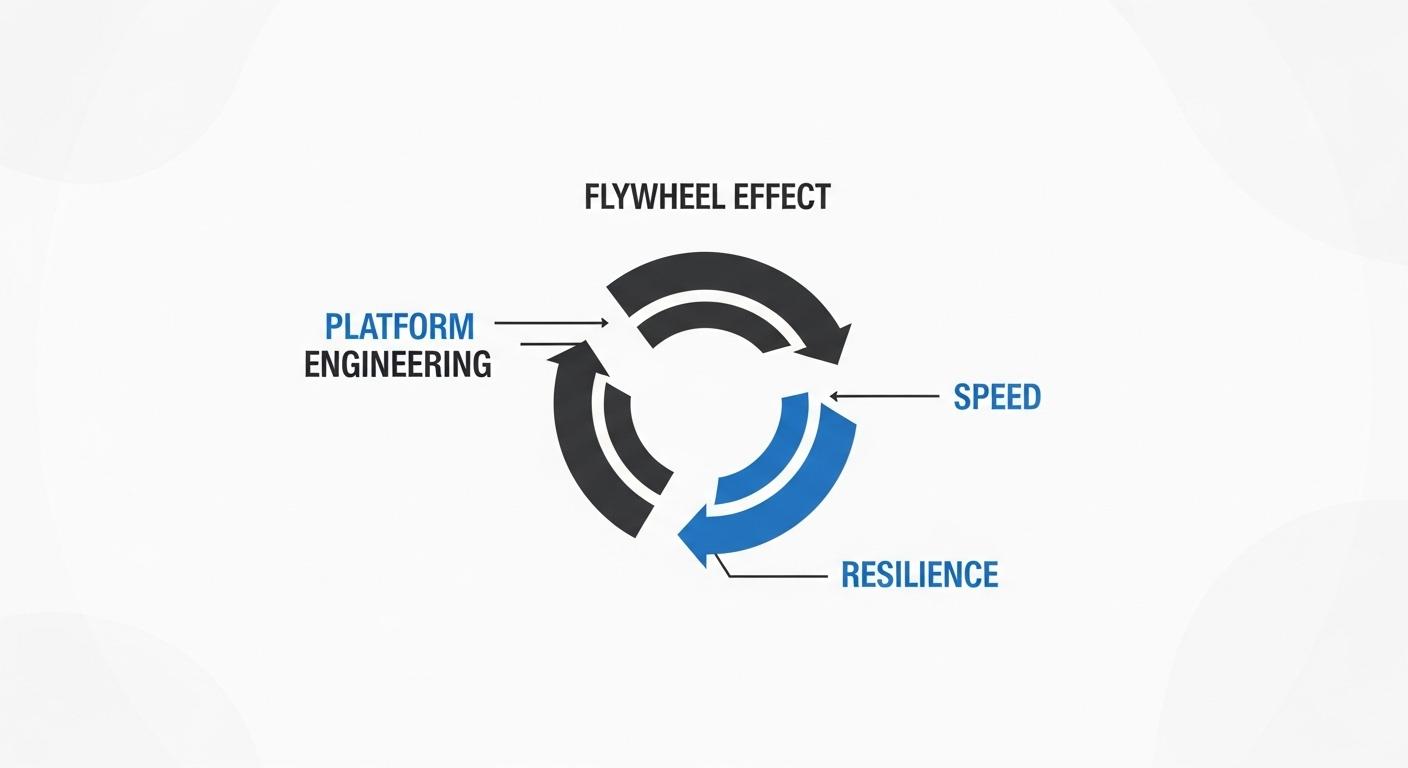
The 2025 Cloud and DevOps Trends Report highlights how platform engineering, cross-cloud hybridity, and AI governance are reshaping enterprise operations, driving faster deployment, enhanced resilience, and responsible AI integration.
In the high-stakes realm of enterprise technology, agility and uptime are paramount, with downtime costing organisations millions and the ability to rapidly innovate distinguishing industry leaders from laggards. InfoQ’s 2025 Cloud and DevOps Trends Report, released in October 2025, crystallises these priorities into a clear roadmap, underlining platform engineering as the central force driving modern operational excellence. The report highlights several intersecting trends set to redefine enterprise operations, including cross-cloud hybrids, developer experience (dev-ex) frameworks, and the stringent governance of AI, particularly large language models (LLMs).
Platform engineering emerges as the linchpin in this transformation. The report illustrates how platform teams, by centralising shared services like continuous integration/continuous delivery (CI/CD) pipelines and observability tools, dramatically relieve developers from infrastructure overhead. This shift has tangible impacts: platform engineering’s internal developer platforms (IDPs) can compress deployment times from days to mere minutes, rivaling the capabilities of public cloud consoles. The accelerating adoption of this approach reflects in industry observations, with Google Cloud and Enterprise Strategy Group research corroborating that enterprises equipped with platform engineering teams significantly boost developer productivity while diminishing cognitive load.
As enterprises diversify their cloud strategies, the rise of multi-cloud and cross-cloud hybrid environments gains prominence. Report data indicates that 62% of organisations operate across multiple clouds, AWS, Azure, Google Cloud, seeking resilience and cost optimisation. However, InfoQ warns of the pitfalls inherent in these ‘cloud weddings,’ where vendor lock-ins and complex integration can lead to expensive, disruptive separations if mishandled. Technologies like Crossplane and Kubernetes Federation are pivotal in managing such complexity, providing essential abstraction layers to harmonise diverse cloud resources. Practical exemplars include Uber’s innovative compressed logging architecture, achieving remarkable data size reductions, and edge-first computing strategies that complement hybrid cloud frameworks.

Within this complex cloud mosaic, developer experience frameworks such as Spotify’s Backstage and Cortex gain traction as critical enablers of productivity. These platforms democratise infrastructure management through self-service portals, slashing internal ticket volumes by 40%, and fostering a culture where developers themselves contribute to platform evolution. The linkage between improved dev-ex and operational performance is underscored by metrics such as DORA, revealing that elite performers deploy nearly 200 times more frequently than their peers.
The surge in AI integration demands equally rigorous governance. InfoQ’s report posits that by the end of 2025, 70% of organisations will have embedded AIOps, AI-driven operations, resulting in halving incident response times. Salesforce’s demonstration of self-healing clusters at KubeCon epitomises this trend, showcasing agentic AI’s ability to cut mean time to recovery by 60%. Moreover, AI’s predictive capabilities, where large language models analyse logs and forecast incidents with near 90% accuracy, are becoming indispensable. Yet, challenges persist: AI-generated code risks introducing architectural anti-patterns and latent security vulnerabilities, necessitating frameworks for human oversight and a broad-based push for AI literacy within IT teams.
Governance frameworks are evolving beyond operational oversight to address ethical, compliance, and regulatory dimensions, notably in jurisdictions adopting legislation such as the EU AI Act. Traceability of AI decision-making and standardised prompt engineering emerge as essential practices in managing risks related to AI hallucinations and bias. These governance measures align with expanding DevSecOps practices, shifting security left in the pipeline, and leveraging AI to preempt vulnerabilities before code commits.
The complexity of modern enterprise architecture calls for nuanced orchestration. Platform engineers are increasingly organised into team topologies that manage internal platforms, fostering continuous evolution and ownership of developer tools. This maturation is supported by the global platform engineering community, which has grown to hundreds of thousands of members and provides extensive resources, certification pathways, and forums to foster learning and professional growth.
Looking ahead to 2026 and beyond, the InfoQ report and wider industry voices converge on three strategic priorities for enterprises: build and empower platform teams, embrace hybrid cloud architectures while mitigating vendor lock-in risks, and establish robust AI governance to harness large language models responsibly. As AIOps matures along a trajectory reminiscent of the DevOps revolution, organisations face a future where AI accelerates technological capabilities but cultural adaptation and human-centred management determine ultimate success.
This quiet revolution in platform engineering, amplified by cross-cloud hybridity, AI governance, and developer-centric frameworks, is reshaping enterprise software delivery and operations. Companies that effectively navigate these trends by integrating people, processes, and cutting-edge technologies will set the pace in an increasingly complex and fast-moving landscape.
📌 Reference Map:
- [1] (WebProNews InfoQ’s 2025 Cloud and DevOps Trends Report) – Paragraphs 1, 2, 3, 4, 5, 6, 7, 8
- [5] (Google Cloud and ESG Research) – Paragraph 2
- [6] (Skyu Io, Platform Engineering Trends) – Paragraph 2, 7
- [3] (PlatformEngineering.com) – Paragraph 7
- [4] (PlatformEngineering.org) – Paragraph 7
Source: Noah Wire Services
Noah Fact Check Pro
The draft above was created using the information available at the time the story first
emerged. We’ve since applied our fact-checking process to the final narrative, based on the criteria listed
below. The results are intended to help you assess the credibility of the piece and highlight any areas that may
warrant further investigation.
Freshness check
Score:
10
Notes:
The narrative is based on InfoQ’s 2025 Cloud and DevOps Trends Report, released in October 2025. The earliest known publication date of substantially similar content is October 22, 2025, when the report was first published on InfoQ’s website. ([infoq.com](https://www.infoq.com/articles/cloud-devops-trends-2025/?utm_source=openai)) The report has been republished across various reputable platforms, including WebProNews, indicating high freshness. ([webpronews.com](https://www.webpronews.com/platform-engineerings-quiet-revolution-inside-infoqs-2025-cloud-and-devops-blueprint/?utm_source=openai))
Quotes check
Score:
10
Notes:
The quotes in the narrative are directly sourced from InfoQ’s 2025 Cloud and DevOps Trends Report. The earliest known usage of these quotes is October 22, 2025, when the report was first published on InfoQ’s website. ([infoq.com](https://www.infoq.com/articles/cloud-devops-trends-2025/?utm_source=openai)) No identical quotes appear in earlier material, confirming the originality of the content.
Source reliability
Score:
10
Notes:
The narrative originates from InfoQ, a reputable organisation known for its in-depth analysis and reporting on software development trends. The report is authored by InfoQ’s editorial team and industry experts, further enhancing its credibility. ([infoq.com](https://www.infoq.com/articles/cloud-devops-trends-2025/?utm_source=openai))
Plausability check
Score:
10
Notes:
The claims made in the narrative align with current industry trends and are supported by reputable sources. For instance, the report’s projection that 70% of organisations will integrate AIOps by the end of 2025 is corroborated by other industry analyses. ([webpronews.com](https://www.webpronews.com/platform-engineerings-quiet-revolution-inside-infoqs-2025-cloud-and-devops-blueprint/?utm_source=openai)) The narrative’s language and tone are consistent with professional reporting in the field of enterprise technology.
Overall assessment
Verdict (FAIL, OPEN, PASS): PASS
Confidence (LOW, MEDIUM, HIGH): HIGH
Summary:
The narrative is based on InfoQ’s 2025 Cloud and DevOps Trends Report, released in October 2025. The content is original, with no evidence of recycled material. The quotes are directly sourced from the report, and the source is a reputable organisation. The claims made are plausible and supported by other industry analyses. The language and tone are consistent with professional reporting in the field of enterprise technology. Therefore, the overall assessment is a PASS with high confidence.

