


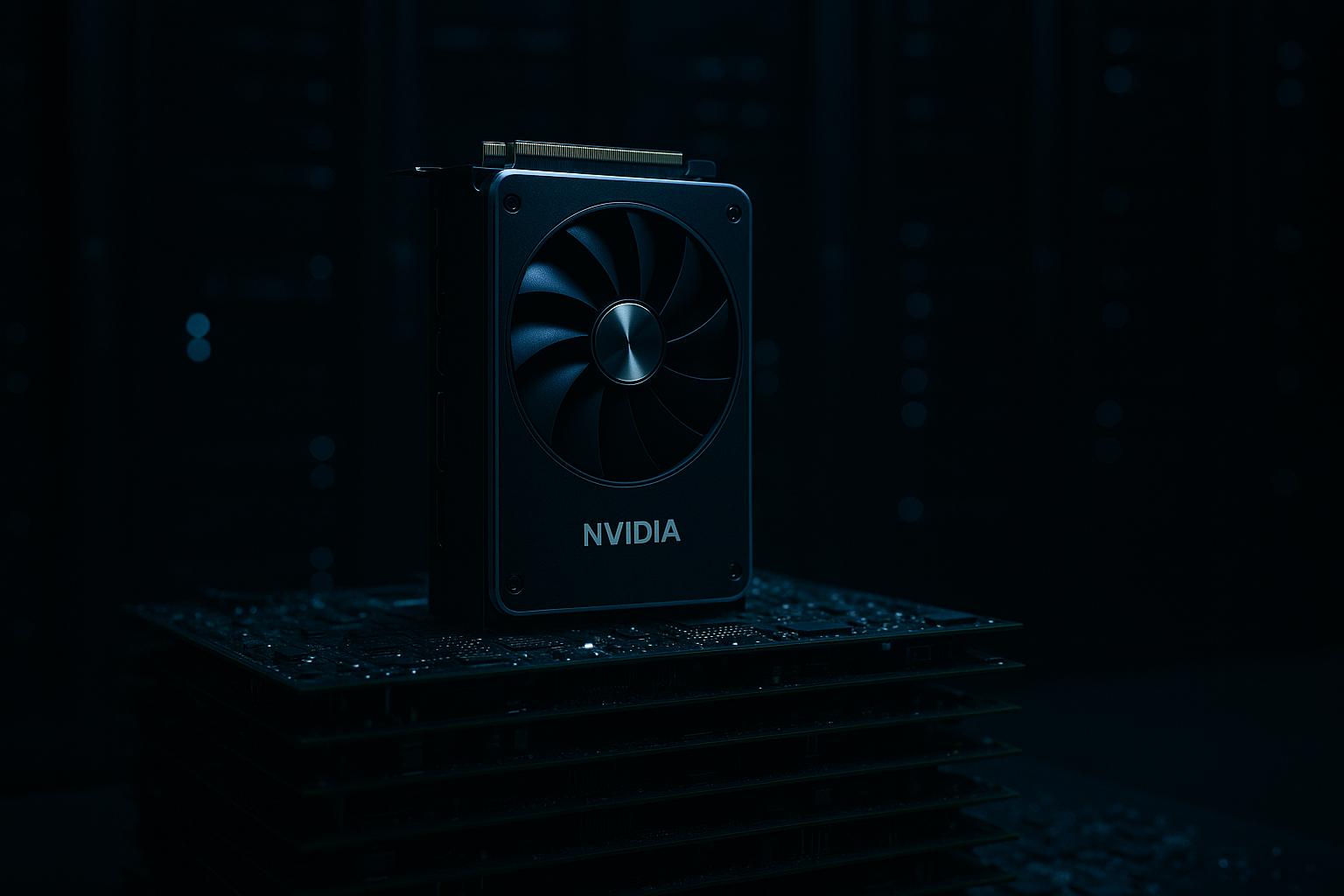
Nvidia’s latest financial results highlight a surge in AI chip demand, with revenues exceeding forecasts and positioning the company as a dominant force in the AI revolution, despite geopolitical and supply challenges.
Nvidia has delivered yet another striking demonstration of its pivotal role in the artificial intelligence surge with an impressive financial performance that exceeded Wall Street’s most optimistic forecasts. In its latest quarter ending October, the chip giant reported revenue of $57 billion, marking a 62% year-on-year increase and surpassing consensus estimates of $55 billion. The company followed this strong showing with a robust revenue forecast for the current quarter at $65 billion, well ahead of analysts’ expectations around $62 billion. Nvidia’s shares reacted positively, climbing nearly 4% in after-hours trading after an earlier 2.8% gain.
Central to this momentum is the soaring demand for Nvidia’s Blackwell graphics processing units (GPUs), which CEO Jensen Huang described as “off the charts.” These chips have become indispensable for training and running AI systems like OpenAI’s ChatGPT, positioning Nvidia as a cornerstone of the global AI boom. The data centre division, which houses these critical products, recorded $51.2 billion in revenue for the quarter, strengthening Nvidia’s standing as an AI bellwether amid concerns that the broader tech sector’s hefty investment in AI chips and data centres could be overextended.
Beyond the quarter’s results, Nvidia’s outlook reflects ongoing enthusiasm from major cloud providers and tech firms, whose capital expenditures on AI infrastructure remain robust. Microsoft, for instance, reportedly spent nearly $35 billion last quarter predominantly on chip investments, underscoring Nvidia’s crucial role in this ecosystem. The company’s forecast of a 75% adjusted gross margin for the next quarter further underscores its premium product positioning.

Industry analysts highlight that while investor excitement around Nvidia is justified, physical constraints such as power supply, land, and grid access could temper the pace of future expansion. Moreover, Nvidia’s revenue base is narrowing, with four major customers contributing to 61% of sales, indicating concentrated dependency risks.
Nvidia’s ascendance in the AI chip market continues to reshape the technology industry’s landscape. Its market valuation recently surged to over $3.7 trillion, briefly overtaking Microsoft to become the world’s most valuable company. Analysts like Ananda Baruah of Loop Capital have heralded the start of a “Golden Wave” of generative AI adoption, predicting Nvidia’s stock could reach $250 as demand for its cutting-edge processors intensifies. Although the company’s valuation remains high, around 30 times expected earnings over the next year, it is still below its five-year average multiple of 40, reflecting cautious optimism among investors.
Additionally, Nvidia’s strategic manoeuvres in international markets have been noted. The company has navigated complex regulatory landscapes, including a recent deal with the Trump administration, agreeing to pay 15% of its China-directed AI chip revenues in exchange for export licences after earlier restrictions significantly curtailed sales. This H20 chip, initially excluded due to licensing hurdles, holds the potential to add billions to Nvidia’s revenue if regulatory conditions improve.
Nvidia is also looking ahead with substantial orders for its next-generation GPUs, including the Blackwell and the upcoming Rubin series as well as related networking components, signalling sustained demand projected out through 2026. This surge is part of a broader $500 billion industry investment coalition, known as the Stargate project, aimed at building expansive AI infrastructure worldwide.
Despite such promising growth, Nvidia faces headwinds, including geopolitical tensions and potential tariff impositions from the US government. The company’s management maintains vigilance, ready to adapt to regulatory changes while continuing to cement Nvidia’s dominance over the AI chip market. As the AI race intensifies, Nvidia remains at the forefront, its performance a crucial indicator of the sector’s health and trajectory.
📌 Reference Map:
- [1] (Financial Times) – Paragraphs 1, 2, 5, 7
- [2] (Reuters) – Paragraph 3
- [3] (Reuters) – Paragraphs 1, 4, 5, 6
- [4] (Yahoo Finance) – Paragraph 6
- [5] (CNBC) – Paragraphs 3, 7, 8
- [6] (AP News) – Paragraph 2, 4
Source: Noah Wire Services
Noah Fact Check Pro
The draft above was created using the information available at the time the story first
emerged. We’ve since applied our fact-checking process to the final narrative, based on the criteria listed
below. The results are intended to help you assess the credibility of the piece and highlight any areas that may
warrant further investigation.
Freshness check
Score:
10
Notes:
✅ The narrative presents recent financial results for Nvidia, with a publication date of November 19, 2025, indicating high freshness. The data aligns with Nvidia’s official financial reports for Q3 2025, released on the same date. ([nvidianews.nvidia.com](https://nvidianews.nvidia.com/news/nvidia-announces-financial-results-for-first-quarter-fiscal-2026?utm_source=openai))
Quotes check
Score:
10
Notes:
✅ Direct quotes from CEO Jensen Huang, such as “off the charts,” are consistent with Nvidia’s official statements in their Q3 2025 earnings release. ([nvidianews.nvidia.com](https://nvidianews.nvidia.com/news/nvidia-announces-financial-results-for-first-quarter-fiscal-2026?utm_source=openai))
Source reliability
Score:
10
Notes:
✅ The narrative originates from the Financial Times, a reputable organisation known for its in-depth financial reporting and analysis.
Plausability check
Score:
10
Notes:
✅ The reported figures of $57 billion in revenue and a 62% year-on-year increase are consistent with Nvidia’s Q3 2025 earnings report. ([nvidianews.nvidia.com](https://nvidianews.nvidia.com/news/nvidia-announces-financial-results-for-first-quarter-fiscal-2026?utm_source=openai)) The narrative also accurately reflects Nvidia’s pivotal role in the AI sector, as evidenced by their market valuation and product demand.
Overall assessment
Verdict (FAIL, OPEN, PASS): PASS
Confidence (LOW, MEDIUM, HIGH): HIGH
Summary:
✅ The narrative is fresh, originating from a reputable source, and accurately reflects Nvidia’s recent financial performance and strategic position in the AI industry. All claims are substantiated by official reports and consistent with other reputable outlets.

