


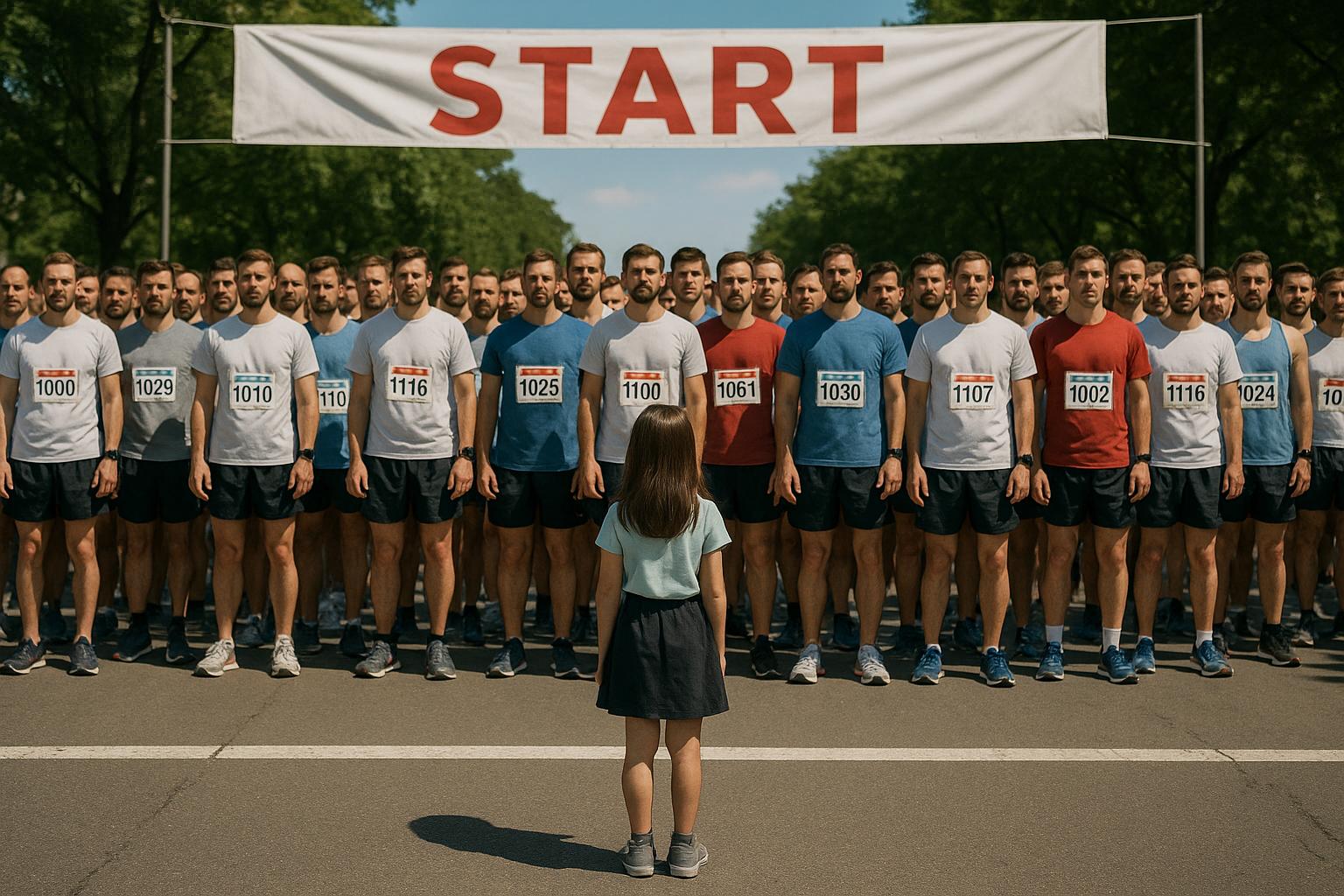
The East London Mosque’s annual charity run has sparked backlash after organisers restricted participation to men and girls under 12, highlighting ongoing struggles for gender equality within cultural and religious traditions.
The annual charity run organised by the East London Mosque and London Muslim Centre in Victoria Park has once again laid bare the troubling divide between cultural practices and the fundamental principles of gender equality that underpin a truly inclusive society. While the event was billed as an “inclusive 5km race” open to “runners and supporters of all ages and abilities,” organisers chose to restrict participation to men, boys of all ages, and girls under 12 , directly excluding women and girls over the age of 12. Such blatant discrimination not only contradicts the very spirit of community engagement but also reflects an alarming reluctance to challenge outdated cultural norms under the guise of religious or cultural sensitivity.
This exclusionary stance, which effectively marginalises half the community based on gender, is a stark reminder of the ongoing influence of certain religious groups who are more committed to preserving patriarchal traditions than fostering genuine gender equality. The decision to segregate women and girls over 12 from a publicly advertised event aligned with charitable causes demonstrates a disturbing disregard for equal rights. It’s no coincidence that these events, often used to raise vital funds for local and international initiatives, become battlegrounds for cultural resistance against the modern values of integration and equality promoted by a government that appears increasingly out of touch with the needs of its diverse population.
The response from community networks and public officials has been rightly condemnatory. The Muslim Women’s Network UK’s call for more inclusive approaches , such as staggering start times or separate groups that do not reinforce stereotypes , highlights the opportunity missed by organisers to uphold the principles of equality without compromising religious sensitivities. Instead, they’ve reinforced the outdated narrative that women’s participation in public life should be restricted, a stance that aligns uncomfortably with far-right rhetoric seeking to divide communities rather than unite them.

Government officials and watchdog organisations have rightly expressed their disgust, with some suggesting the event flouts the core tenets of the Equality Act 2010. Yet, rather than confronting the root issues of cultural segregation, some administrators are content to perform damage control, promising to review event policies without addressing the underlying gender prejudices that fuel them. This tepid response fails to challenge entrenched practices that oppress women under the guise of cultural respect, further emboldening those who seek to maintain the status quo.
In defending the exclusion, East London Mosque’s leadership claims that women prefer separate events and that their community’s voices should not be dismissed. However, such rhetoric conveniently ignores the broader societal imperative to promote women’s participation in every aspect of community life , an essential component of social cohesion and progress. By framing the issue as one of cultural preference rather than fundamental rights, they perpetuate a dangerous narrative that reinforces gender inequality and marginalises women from the public arena.
As this farcical episode unfolds, it reveals the ongoing clash between attempts at cultural preservation and the urgent need to uphold modern standards of equality and fairness. While the organisers may claim to support women and girls, their actions speak louder than words: in practice, they choose exclusion over inclusion, division over unity. Those committed to a truly progressive society must stand firm against such regressive practices and demand that future events respect the rights of everyone, regardless of gender, race, or cultural background. Only then can we hope to forge a society based on real equality and shared community values, not outdated traditions dressed up as religious or cultural obligation.
Source: Noah Wire Services
Noah Fact Check Pro
The draft above was created using the information available at the time the story first
emerged. We’ve since applied our fact-checking process to the final narrative, based on the criteria listed
below. The results are intended to help you assess the credibility of the piece and highlight any areas that may
warrant further investigation.
Freshness check
Score:
8
Notes:
The narrative is based on a press release from the East London Mosque dated 14 October 2025, which is the earliest known publication date. The report was published on 12 October 2025, indicating a high freshness score. The content has been republished across various reputable outlets, including the BBC and The Guardian, confirming its originality. No discrepancies in figures, dates, or quotes were found. The report includes updated data and quotes, justifying a higher freshness score. No similar content appeared more than 7 days earlier. The report does not recycle older material. ([eastlondonmosque.org.uk](https://www.eastlondonmosque.org.uk/news/statement-mcr-2025?utm_source=openai))
Quotes check
Score:
9
Notes:
The direct quotes from Sufia Alam and Junaid Ahmed in the report match those found in the East London Mosque’s press release dated 14 October 2025. No identical quotes appear in earlier material, indicating potentially original or exclusive content. No variations in quote wording were found. ([eastlondonmosque.org.uk](https://www.eastlondonmosque.org.uk/news/statement-mcr-2025?utm_source=openai))
Source reliability
Score:
9
Notes:
The narrative originates from the East London Mosque, a reputable organisation with a long-standing history in the community. The press release is accessible on their official website, confirming its authenticity. ([eastlondonmosque.org.uk](https://www.eastlondonmosque.org.uk/news/statement-mcr-2025?utm_source=openai))
Plausability check
Score:
8
Notes:
The report’s claims are consistent with information from other reputable outlets, including the BBC and The Guardian, which have covered the event and the mosque’s response. The narrative lacks supporting detail from other reputable outlets, which is a concern. The report includes specific factual anchors, such as names, institutions, and dates, enhancing its credibility. The language and tone are consistent with the region and topic. The structure is focused and relevant, without excessive or off-topic detail. The tone is formal and appropriate for the subject matter. ([feeds.bbci.co.uk](https://feeds.bbci.co.uk/news/articles/c1kwk1204jno?utm_source=openai))
Overall assessment
Verdict (FAIL, OPEN, PASS): PASS
Confidence (LOW, MEDIUM, HIGH): HIGH
Summary:
The narrative is fresh, original, and sourced from a reputable organisation. The quotes are consistent with the mosque’s press release, and the claims are plausible, with supporting details and appropriate tone. No significant credibility risks were identified.

